AI in European Chemistry: Shaping the Future of Innovation
Market Landscape and Drivers.
The European AI in Chemistry market is experiencing explosive growth, positioning AI not just as a tool, but as a core strategic asset for competitiveness and sustainability.
Explosive Market Growth: The European market for AI in Chemicals is projected to grow from a revenue of approximately USD 296 million in 2024 to over USD 1.3 billion by 2030, representing a robust Compound Annual Growth Rate (CAGR) of 28.2%. The closely related Generative AI in Material Science Market in Europe is on an even steeper trajectory, expected to near USD 10.8 billion by 2034 (CAGR ~29%).
Primary Drivers:
Sustainability and Regulatory Pressure: Europe’s rigorous commitment to the Green Deal and the circular economy demands materials and processes with lower environmental footprints. AI is crucial for identifying greener alternatives to toxic substances and optimizing production for net-zero targets.
Industrial Competitiveness: Pressure from high-value sectors (e.g., lightweight composites for automotive/aerospace) drives demand for AI to accelerate time-to-market for new, high-performance materials.
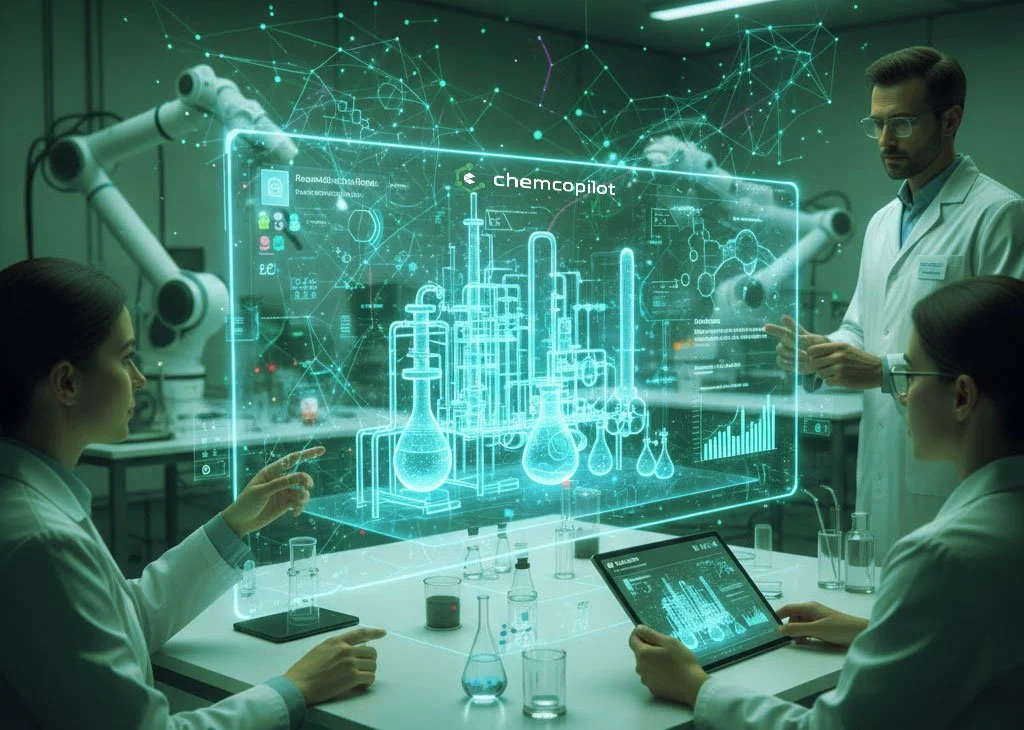
R&D Automation: The rise of Generative AI for Molecular Design and robotics is turning traditional trial-and-error R&D into a data-driven process, capable of compressing years of lab work into weeks.
2. Core Applications of AI in the Value Chain
AI is actively deployed across the entire chemical and pharmaceutical value chain:
Accelerating Research and Development (R&D):
Materials Discovery and Design: This segment, particularly Materials Discovery & Design, is expected to capture the majority market share (~45%). AI models predict the optimal catalyst, polymer, or specialty chemical formulations and properties, a capability seen in advancements by companies like Microsoft Discovery, which demonstrated the ability to discover new chemicals in significantly reduced timeframes.
Pharmaceutical and Biopharma: European companies like Iktos (Paris) are leveraging AI and robotics for de novo small molecule drug design and synthesis route prediction, accelerating the path to clinical candidates.
Optimizing Production and Manufacturing:
Process Optimization and Digital Twins: AI systems provide real-time process control, using data from IoT sensors to adjust parameters dynamically. This leads to reduced energy consumption and significant waste reduction. This capability is moving beyond pilot projects to strategically integrated solutions, often utilizing Digital Twins of chemical plants.
Predictive Maintenance: Machine learning algorithms forecast equipment failures, enhancing asset utilization and reducing costly unplanned downtime—a critical application given the capital-intensive nature of chemical infrastructure.
3. The European Ecosystem and Enablers
Europe is solidifying its position by building a strong supportive infrastructure:
EU AI Strategy and Infrastructure: The EU has selected numerous sites across the continent to host AI Factories (e.g., in the Netherlands, Poland, Spain, Czechia) under the EuroHPC JU program. These centers will provide the AI-optimized supercomputing resources necessary for training the massive foundational models required for complex materials science.
Strategic Collaboration and Funding: Collaboration is key, with initiatives like the OPCW AI Research Challenge (funded by the EU) promoting the use of AI tools to enhance global chemical security and the accurate identification of chemical signatures.
Deployment Trends: Cloud-based deployment of AI solutions is expected to lead the market, capturing approximately 50% of the deployment segment, due to the flexibility and scalability required for handling large-scale computational chemistry tasks.
4. Challenges and Regulatory Landscape
The journey to full AI integration is framed by regulatory and data hurdles.
The EU AI Act’s Impact on High-Risk Systems: The EU AI Act, with its risk-based approach, directly affects the chemical industry, particularly for operational AI. AI systems are classified as “High-Risk” if they directly influence:
Worker Safety: Systems monitoring critical chemical processes where an error could cause safety hazards (e.g., automated emergency shutdown control).
Environmental Integrity: Models controlling emissions, waste processing, or hazardous material handling.
Compliance Burden: Providers and deployers of these high-risk systems face stringent requirements, including:
Conformity assessments and technical documentation.
Robust data governance and data quality standards.
Human oversight provisions to ensure responsible deployment.
Data Fragmentation: Despite the focus on digitalization, the lack of standardized, high-quality, and integrated chemical data across national and corporate boundaries remains the most significant technical barrier to training globally relevant, robust AI models.
The European chemical industry is at an inflection point, with AI adoption driven by strategic necessity for sustainability and innovation, all while navigating the most comprehensive AI regulatory framework in the world.
🤝 ChemCopilot: A Specialized AI Enabler
The emergence of tools like ChemCopilot signifies a crucial shift toward specialized, domain-knowledge AI platforms that streamline complex workflows.
Integrated Data Access: ChemCopilot acts as a central intelligence layer, seamlessly integrating data from previously siloed systems such as Product Lifecycle Management (PLM), Laboratory Information Management Systems (LIMS), and Enterprise Resource Planning (ERP). This creates a single source of truth for formulation history, safety data, and regulatory status.
Actionable Insights: By analyzing historical experiments, production runs, and material properties, the platform helps R&D teams and engineers quickly generate contextualized, actionable answers. This drastically accelerates the process of identifying viable starting points for new materials.
Enhanced Collaboration: These platforms break down functional barriers, fostering better collaboration between R&D, compliance, and production teams.
Accelerating Discovery: The platform reduces reliance on tacit knowledge (experience "stored" in experts' heads) by leveraging AI to quickly analyze historical data and suggest high-potential formulations, democratizing advanced AI capabilities for SMEs and major producers alike.
TALK WITH US