
Chemcopilot Blog: AI for Chemical Formulation, Screening & R|&D

What Is QSAR? How to Use It in Chemical R&D (2026)
What is QSAR? A practical 2026 guide to QSAR modeling for chemical R&D — how it works, where it fails, and how machine learning chemistry changed it.

AI Synthesis Planning Software: The Complete 2026 Guide for Chemical R&D
Compress multi-step reaction design from months to minutes. Explore the 2026 guide to AI synthesis planning, automated retrosynthesis, and IP protection.

How to Get PhD Chemists to Adopt AI Tools: A Change Management Guide for R&D Leaders
Overcome scientific skepticism in chemical R&D. Discover how zero-code interfaces and explainable AI drive tool adoption among senior bench chemists.

How Retrieval-Augmented Generation (RAG) Transforms LLMs for Enterprise Chemistry
Learn how Retrieval-Augmented Generation (RAG) transforms LLMs in chemistry by linking generative models to air-gapped vector DBs for zero-hallucination R&D.
What is Forward Deployed Engineering (FDE)? The Operational Blueprint for Chemical AI
Explore Forward Deployed Engineering (FDE): the operational model embedding engineers to connect dark LIMS data with sovereign AI for chemical R&D.

The Chemical Tech PM Playbook: Bridging Physical Science, Sparse Data, and Enterprise AI
A comprehensive playbook for Technical Product Managers in the chemical industry. Learn how to architect unified digital threads, deploy active learning over sparse data, embed real-time SDS compliance, and drive adoption among bench chemists.

The FDE Advantage in Chemistry: Why Embedded Engineering is Required to Bridge Legacy LIMS/ERP with AI
Discover how Forward Deployed Engineering (FDE) bridges legacy LIMS, SAP ERP, and dark lab data with sovereign AI—without internal IT backlogs.

Sovereign AI for Chemical R&D: How Single-Tenant Architectures Protect Multi-Billion Dollar Molecular IP
Discover how single-tenant Sovereign AI protects multi-billion dollar molecular IP in chemical R&D. Learn how private VPCs and Zero-Data Retention safeguard trade secrets.
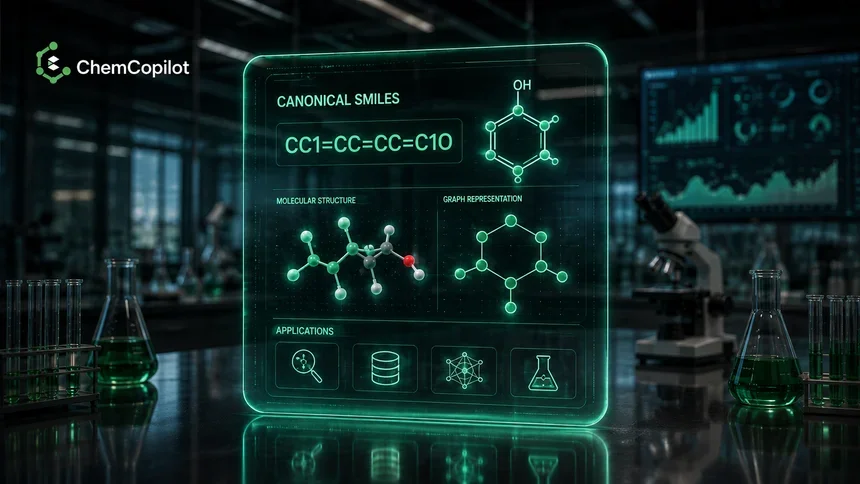
What is Canonical SMILES? How to use and 2026 News
Learn the importance of Canonical SMILES in informatics. See how ChemCopilot translates sketches into code and visualizes molecules in real-time for seamless research.

Q3 2026 Quarterly Report on Chemical AI, Autonomous Labs, and Digital R&D Transformation
What defined Chemical AI in Q3 2026? From Durham’s robotic labs to 1,000x cost reductions in virtual screening, read our comprehensive quarterly report on how autonomous workflows are transforming modern chemical R&D.

How AI is Transforming Chemical Research and Product Development
Artificial Intelligence (AI) is revolutionizing chemical research and product development, driving efficiency, innovation, and sustainability.

Retrosynthesis Software: Online, Free, and Downloadable Tools for R&D
Explore top online, free, and downloadable retrosynthesis software for chemical R&D. Compare open-source CAOS tools and AI platforms to accelerate synthetic route planning.

Molecular Docking: From In-Silico Mechanics to Industrial R&D Pipeline
Learn how enterprise R&D pipelines integrate 3D conformational sampling, virtual high-throughput screening (vHTS), and active learning loops. Acelerate lead discovery while slashing physical assay costs.

AI for R&D Data: Connect Spreadsheets, PDFs, Lab Notebooks, and Experiments
Which AI should you chose for R&D Data: Connect Spreadsheets, PDFs, Lab Notebooks, and Experiments?

The Best AI for Chemistry in 2026 -Top Tools Transforming the Field
Explore the best AI for chemistry in 2026. Discover top tools like ChemCopilot and see how AI for chemistry is revolutionizing research and manufacturing.

Time-Series AI for Chemical Process Monitoring: Plant Engineer’s Guide
Learn how time-series AI transforms chemical process monitoring. Discover LSTM autoencoders, soft sensors, dynamic time warping, and real-time anomaly detection architectures.

Reinforcement Learning for Chemical Process Optimization: Real-World Applications
From batch reactor thermal runaway prevention to continuous distillation optimization, discover real-world applications and safe Sim-to-Real strategies.

The Unified R&D Lifecycle: How Connected Data & AI Acceleration Redefine Product Development
Discover how connected R&D data and AI can unify the product development lifecycle, accelerate innovation, and reduce costly experimentation.

What is Chemical Embedding?
Learn what chemical embedding is, how molecular structures are converted into continuous numerical vectors, and how AI uses chemical embeddings for drug discovery and formulation design.
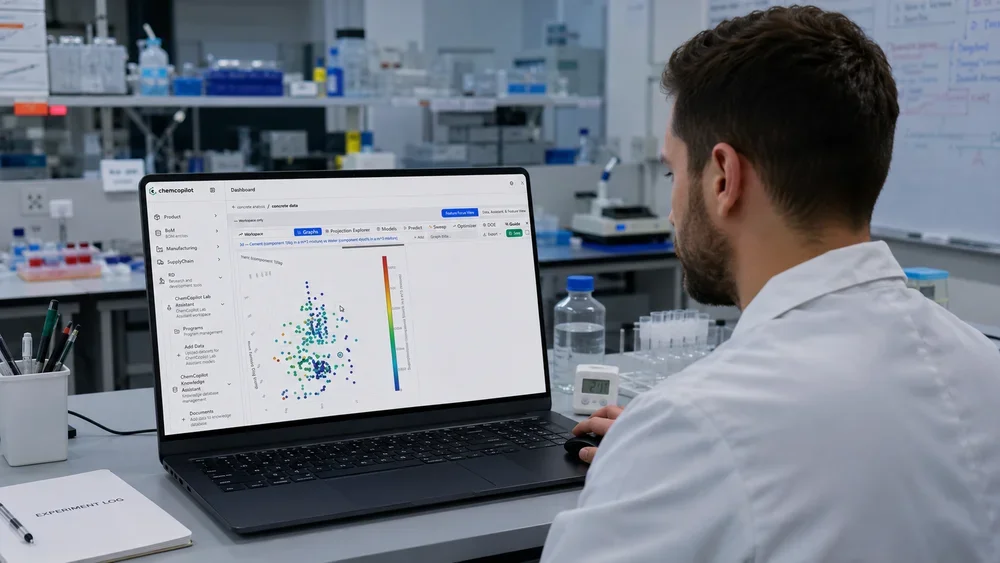
Chemcopilot User Guide: Tabular Formulation Modeling & In-Silico Experimentation
Learn How to use Chemcopilot AI: Tabular Formulation Modeling & In-Silico Experimentation