
AI Synthesis Planning Software: The Complete 2026 Guide for Chemical R&D
Author: Jonathan Woo | Chief Product Officer, ChemCopilot
Category: Retrosynthesis & Reaction Design | Digital Lab Acceleration
Last Updated: September 2026
About the Author: Jonathan Woo is the Chief Product Officer at ChemCopilot. Former VP of Product at Noble.AI, Co-founder/CTO at Nanostellar (Quantum Simulation & Catalysts), and NASA/Harvard ACIS Software Team Leader. Over 25 years pioneering enterprise SaaS, deep-tech AI architectures, and automated materials modeling.
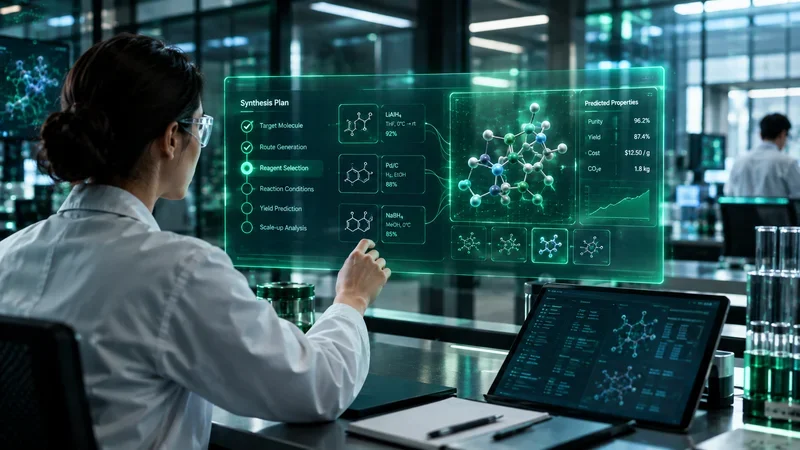
AI synthesis planning software has evolved from academic template-matching into an enterprise-grade engine for autonomous retrosynthesis, route scoring, and green chemistry optimization. In 2026, leading R&D organizations leverage computational synthesis planning to compress complex multi-step reaction design from months to minutes while safeguarding core intellectual property.
1. The 2026 Retrosynthesis Stack: Beyond Rule-Based Matching
Early reaction prediction software relied heavily on manually curated, expert-written transformation rules. While accurate for well-documented reaction classes, rule-based systems break down when navigating novel molecular scaffolds or complex stereocenters.
Modern AI synthesis planning combines three distinct computational approaches:
Template-Based Neural Models: Utilize millions of historical patent reactions to extract generalized transformation templates, pairing Monte Carlo Tree Search (MCTS) with deep neural networks to navigate disconnection trees.
Template-Free Transformer Models: Treat retrosynthesis as a sequence-to-sequence translation problem, mapping target SMILES strings directly to precursor SMILES without pre-defined rules.
Physics-Informed Graph Neural Networks (GNNs): Evaluate electron density, 3D steric hindrance, and transition state energetics to predict regioselectivity and stereochemical outcomes.
As detailed in our analysis of AI Retrosynthesis Tools Revolutionizing Organic Chemistry, pairing template-free models with MCTS search trees allows computational chemists to explore previously inaccessible disconnection pathways while minimizing total step count.
2. End-to-End Autonomous Synthesis Pipeline
Modern synthesis planning software extends far beyond proposing valid disconnections. It connects retrosynthetic graphs with commercial building block availability, reaction condition optimization, and automated lab execution.
TARGET MOLECULE (SMILES)
- 3D Structure Ingestion
- Canonicalization & Sanitization
- Stereocenter Mapping
DISCONNECTION SEARCH (MCTS)
- Transformer Route Generation
- Building Block Inventory Sync
- Protection Group Minimization
FORWARD VALIDATION & EXECUTION
- Condition & Yield Prediction
- E-Factor / Green Score
- Robotic Lab File Generation
3. Integrating In Silico Screening with Synthesis Realities
A common pitfall in digital discovery is designing target molecules that score exceptionally high in virtual binding or property models but prove unfeasible or prohibitively expensive to synthesize.
Connecting synthesis planning with In Silico Experiments Accelerating Discovery in the Digital Lab creates a closed-loop evaluation workspace:
Synthetic Accessibility Filtering (SAScore): Every candidate generated during virtual screening is automatically assigned a synthetic difficulty score before computational resources are spent on high-level property predictions.
Dynamic Route Scoring: Proposed pathways are evaluated across multiple real-world constraints:
Economic Viability: Live API integration with chemical catalog vendors (e.g., Enamine, eMolecules) and internal SAP ERP inventory to calculate total precursor costs ($/g).
Process Sustainability: Calculating Environmental Impact Factors ($\text{E-Factor} = \frac{\text{Mass of Waste}}{\text{Mass of Product}}$) and flagging hazardous reagents subject to ECHA/REACH regulations.
Reaction Condition Prediction: Recommending optimal catalysts, ligands, solvents, and temperature profiles to maximize predicted forward yield.
4. Key Criteria for Evaluating AI Synthesis Platforms
When selecting an enterprise synthesis planning solution, R&D leaders, CISOs, and CTOs should benchmark software against four critical dimensions:
Commercial & Private Inventory Integration: Does the platform sync with internal LIMS/ERP compound management databases to prioritize in-stock building blocks over external suppliers?
Regioselectivity & Stereocenter Handling: Can the underlying forward prediction models correctly flag undesirable side reactions, regioisomers, or epimerization risks?
Robotic Hardware Export: Does the software export execution scripts (e.g., PyRPL, Chemspeed protocols) for direct deployment onto automated synthesis workstations?
Sovereign IP Security: Because retrosynthetic queries directly reveal target product strategy, execution must take place inside a dedicated Single-Tenant Virtual Private Cloud (VPC) or on-premise infrastructure under strict Zero-Data Retention (ZDR) protocols.
Securing the Future of Chemical Route Design
AI synthesis planning software has redefined reaction design from a manual, literature-intensive task into an automated, data-driven discipline. By integrating retrosynthetic AI with real-time inventory management, green chemistry scoring, and sovereign cloud infrastructure, chemical enterprises reduce synthesis failure rates and bring new formulations to market ahead of competitors.
