CFD vs AI Surrogate Models for Chemical Process Engineers
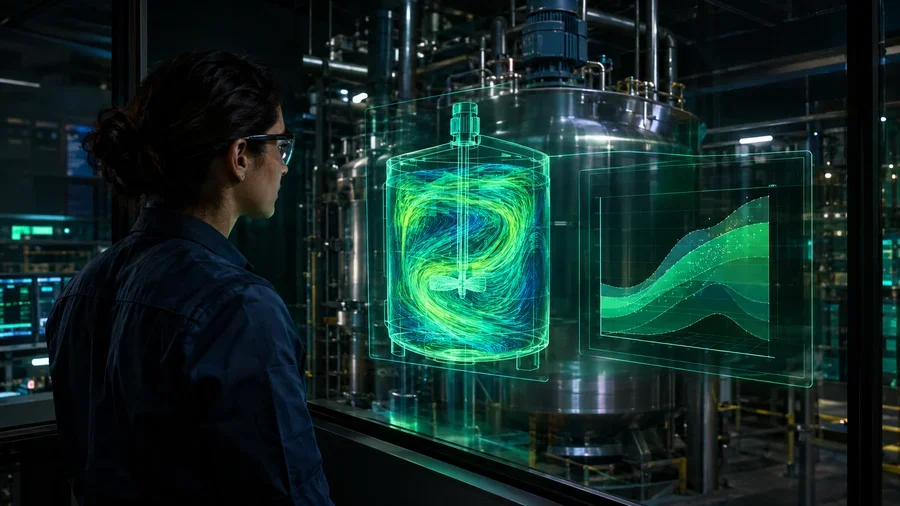
A process engineer has a mixing problem in a 5,000 L stirred tank. Yield is drifting, the pilot data says the impeller speed is fine, and the plant says it is not. The classic answer is CFD in chemical engineering: build a mesh, set up the turbulence model, run the solver, wait. The result, four to six days later, is a beautiful velocity field for one geometry, one fluid, and one set of boundary conditions. Then production asks what happens at 60% fill level with the higher-viscosity grade, and the clock starts again. This article compares computational fluid dynamics with AI surrogate models so you can decide, case by case, which tool actually gets your team to a decision faster.
What CFD in Chemical Engineering Actually Does Well
Computational fluid dynamics solves the Navier–Stokes equations (plus energy, species, and sometimes reaction kinetics) over a discretized domain. In chemical engineering, that means it can resolve things no spreadsheet or correlation can: dead zones in a reactor, local hot spots in an exothermic tubular reactor, gas holdup distribution in a bubble column, droplet breakup in a static mixer, or shear exposure in a crystallizer that explains why particle size distribution shifted after scale-up.
The strength of CFD is that it is physics-first. You do not need historical data to run it; you need geometry, fluid properties, and boundary conditions. For a first-of-a-kind reactor or a novel heat exchanger layout, CFD is frequently the only tool that can tell you anything meaningful before metal is cut. It also produces spatially resolved output, which matters enormously when the failure mode is local rather than global.
Teams that get the most out of CFD use it for a small number of high-consequence questions: validating a new impeller design, diagnosing a hot spot that caused an off-spec batch, or sizing a quench system where the safety margin is thin. These are problems where a week of computing time is cheap relative to the cost of being wrong.
The Limits of CFD in Chemical Engineering at Industrial Scale
The problem is not that CFD is inaccurate. The problem is that it answers one question at a time, and process optimization is a many-question problem.
Consider a mid-size specialty chemical producer that wants to understand how a hydrogenation reactor behaves across its real operating envelope: three feedstock grades, catalyst loading from 0.8% to 1.5%, agitation from 120 to 220 rpm, temperature across a 25 °C window, and two fill levels. Even a coarse grid over those five factors is several hundred combinations. At one to several days of wall-clock time per high-fidelity simulation, that envelope is simply never explored with CFD alone. Teams end up simulating three or four "representative" cases and extrapolating by intuition, which quietly reintroduces the trial-and-error they were trying to eliminate.
There are three other recurring constraints. First, CFD requires specialists: meshing, turbulence model selection, and convergence troubleshooting are skills most formulation chemists and plant engineers do not have. Second, reaction-coupled CFD (reacting flows with multi-step kinetics) is still computationally brutal, so kinetics are often simplified to the point where the simulation no longer reflects the chemistry that matters. Third, CFD does not learn. The 40 simulations your team ran last year sit in a folder of result files; they do not automatically make the 41st question cheaper to answer.
That last point is the one most relevant to the hidden variables that destroy scale-up reproducibility: mixing time, heat removal, and mass transfer rarely fail in the single case you simulated. They fail in the operating corner nobody had time to simulate.
What an AI Surrogate Model Is (and Is Not)
An AI surrogate model is a statistical or machine-learning approximation of a slow, expensive function. In process engineering the expensive function can be a CFD solver, a kinetic model, a pilot plant, or the production line itself. You feed the surrogate inputs (geometry parameters, flow rates, temperatures, concentrations) and it returns predicted outputs (mixing time, conversion, hot-spot temperature, pressure drop, particle size) in milliseconds instead of days.
The important distinction is that a surrogate model does not replace the physics; it compresses the knowledge already generated by physics or by experiment. Common choices include Gaussian process regression (useful because it returns an uncertainty estimate alongside the prediction), gradient-boosted trees such as XGBoost for tabular process data, random forests for robustness on noisy plant data, and neural networks when the input space is large and the training set is big enough to justify them. Bayesian optimization often sits on top of the surrogate to decide which expensive simulation or experiment to run next.
A well-built surrogate is trained on a deliberate mix of sources: a modest set of CFD runs spanning the design space, pilot plant data, and historical batch records. It then becomes the engine of a process digital twin, the kind of model described in this introduction to digital twins in chemical manufacturing, that engineers can interrogate interactively rather than batch-submit to a cluster.
What a surrogate is not: a substitute for CFD when you have zero data, a radically new geometry, or a phenomenon outside anything in the training set. Extrapolation is where surrogates fail, and a good platform tells you when you have left the trusted region.
CFD vs AI Surrogate Models: Side-by-Side Comparison
| Criterion | CFD (high-fidelity simulation) | AI surrogate model |
|---|---|---|
| Time per evaluation | Hours to days | Milliseconds to seconds |
| Data required | None; needs geometry, properties, boundary conditions | Training set from CFD runs, pilot data, or batch records |
| Spatial resolution | Full 3D fields (velocity, temperature, species) | Usually scalar KPIs; fields only with specialized architectures |
| Novel geometry / new physics | Strong | Weak outside training domain |
| Exploring a wide operating envelope | Impractical beyond a handful of cases | Thousands of what-if evaluations per minute |
| Uncertainty quantification | Model-form uncertainty rarely reported | Native with Gaussian processes and ensembles |
| Skills needed | CFD specialist (meshing, turbulence, convergence) | Process engineer with no-code ML tooling |
| Learns from past work | No; each run is independent | Yes; every new data point improves the model |
| Best for | Diagnosis, design validation, safety-critical sizing | Optimization, operator what-ifs, DOE design, real-time twins |
The table makes the central point: these are not competitors. They sit at opposite ends of a fidelity–speed trade-off, and the engineering value is in connecting them.
How the Two Fit Together in a Process Workflow
The most effective pattern in chemical process optimization is a hybrid loop. CFD generates a small, carefully designed set of high-fidelity data points. A surrogate learns from those points plus whatever plant history exists. Bayesian optimization uses the surrogate's uncertainty to pick the next CFD run or pilot experiment where it will reduce uncertainty the most. Each iteration makes the surrogate sharper and the CFD budget smaller.
Geometry, flow, T, concentration ranges
8–20 CFD runs across the envelope
GP / XGBoost on CFD + plant records
Thousands of virtual evaluations
1–3 CFD runs or pilot trials where uncertainty is highest
New data retrains the surrogate
An illustrative scenario: a coatings resin producer with a 180-record batch history for an emulsion polymerization reactor wants to reduce off-spec batches tied to particle size. Running CFD across the full agitation, feed-rate, and temperature envelope would have meant roughly 90 simulations. Instead, the team runs 12 CFD cases chosen by a space-filling design, combines them with the batch records, trains a gradient-boosted surrogate, and lets Bayesian optimization propose the three most informative confirmation runs. The total CFD budget drops from an estimated 90 runs to 15, and the resulting model is fast enough for operators to query before every grade change. That is the shape of the gain, and it is typical of what the hybrid approach delivers: not a replacement of CFD, but a tenfold reduction in how much of it you need.
This is also where a platform matters. ChemCopilot, an AI platform built for chemical R&D teams and chemical engineers, lets a process engineer upload CFD summary outputs and batch records as tabular data, train surrogate models (Gaussian process, XGBoost, random forest, or neural network) without writing code, run Bayesian optimization to choose the next experiment, and expose the resulting digital twin to operators and to ERP or historian systems through a REST API. The CFD solver stays where it is; the knowledge it produces stops disappearing into a results folder.
Choosing Between CFD and AI Surrogate Models: A Decision Guide
When a question lands on your desk, the choice usually resolves on three axes.
Ask first whether the problem is novel or familiar. A new reactor internals design, a change in phase behavior, or an unexplained hot spot in a geometry you have never modeled calls for CFD. A question about a known reactor under different operating conditions calls for a surrogate, provided those conditions sit inside the data you have.
Ask second how many answers you need. One answer, with full spatial detail, is a CFD job. Hundreds of answers, ranked, with a recommended operating window and an uncertainty band, is a surrogate job. If the real need is "help the operator decide what to do at the next grade change," no CFD workflow will ever be fast enough.
Ask third what happens to the result. If the output is a design review slide, CFD alone is fine. If the output should become a living asset that improves with every batch and feeds a digital twin, the CFD runs should be treated as training data from day one, which means structuring their inputs and outputs in a consistent tabular form rather than archiving raw solver files.
Process engineers who adopt this framing stop asking "CFD or AI?" and start asking "how few CFD runs do I need to make the surrogate trustworthy for this decision?" That question has a measurable answer, and it changes how you budget simulation time.
Frequently Asked Questions
Can an AI surrogate model replace CFD in chemical engineering entirely?
No. A surrogate interpolates within the data it was trained on. For new geometries, new phase behavior, or any phenomenon outside the training domain, CFD (or physical experiment) remains the only reliable source. The practical goal is to reduce the number of CFD runs needed, typically to a designed set of 10–20 for a given reactor, not to eliminate them.
How many CFD runs are needed to train a useful surrogate?
It depends on the number of input variables and the smoothness of the response. For three to five continuous factors on a single unit operation, 10–20 well-placed runs (space-filling design plus a few corner cases) are often sufficient to start, especially when combined with historical plant data. Bayesian optimization then tells you where additional runs add the most information.
Which machine learning model works best for process surrogates?
Gaussian process regression is a strong default when data is scarce because it provides calibrated uncertainty. Gradient-boosted trees such as XGBoost handle larger, noisier tabular datasets from plant historians well. Neural networks become worthwhile when the input space is large and training data is plentiful. Most teams benefit from comparing several architectures on their own data rather than committing to one upfront.
Do process engineers need to code to build surrogate models?
Not anymore. No-code ML tooling designed for chemical data lets engineers upload tabular CFD summaries and batch records, select target variables, compare model types, and run optimization without Python. CFD itself still requires specialist skills; the surrogate layer does not.
Is a surrogate model the same thing as a digital twin?
A surrogate model is one component of a digital twin. The twin adds live data connections (sensors, historians, ERP), a physical-asset context, and a feedback loop that retrains the model as new data arrives. A surrogate trained once and never updated is a snapshot; a digital twin is the living version.
Key Takeaways
CFD in chemical engineering remains the right tool for diagnosis, novel design validation, and safety-critical sizing where spatial detail matters and no prior data exists. AI surrogate models are the right tool for exploring wide operating envelopes, supporting operator what-ifs, and powering digital twins. The highest-return strategy for most process teams is the hybrid: use a small, designed set of CFD runs as training data, let a surrogate carry the optimization load, and let Bayesian optimization decide where the next expensive run belongs.
If your team is spending days per CFD case and still cannot answer the plant's questions fast enough, it is worth seeing how a surrogate layer would fit your existing solver and batch data. Talk to the ChemCopilot team about building a process digital twin from the simulation and plant records you already have.