Chemical R&D Software: What Modern Labs Actually Need in 2026
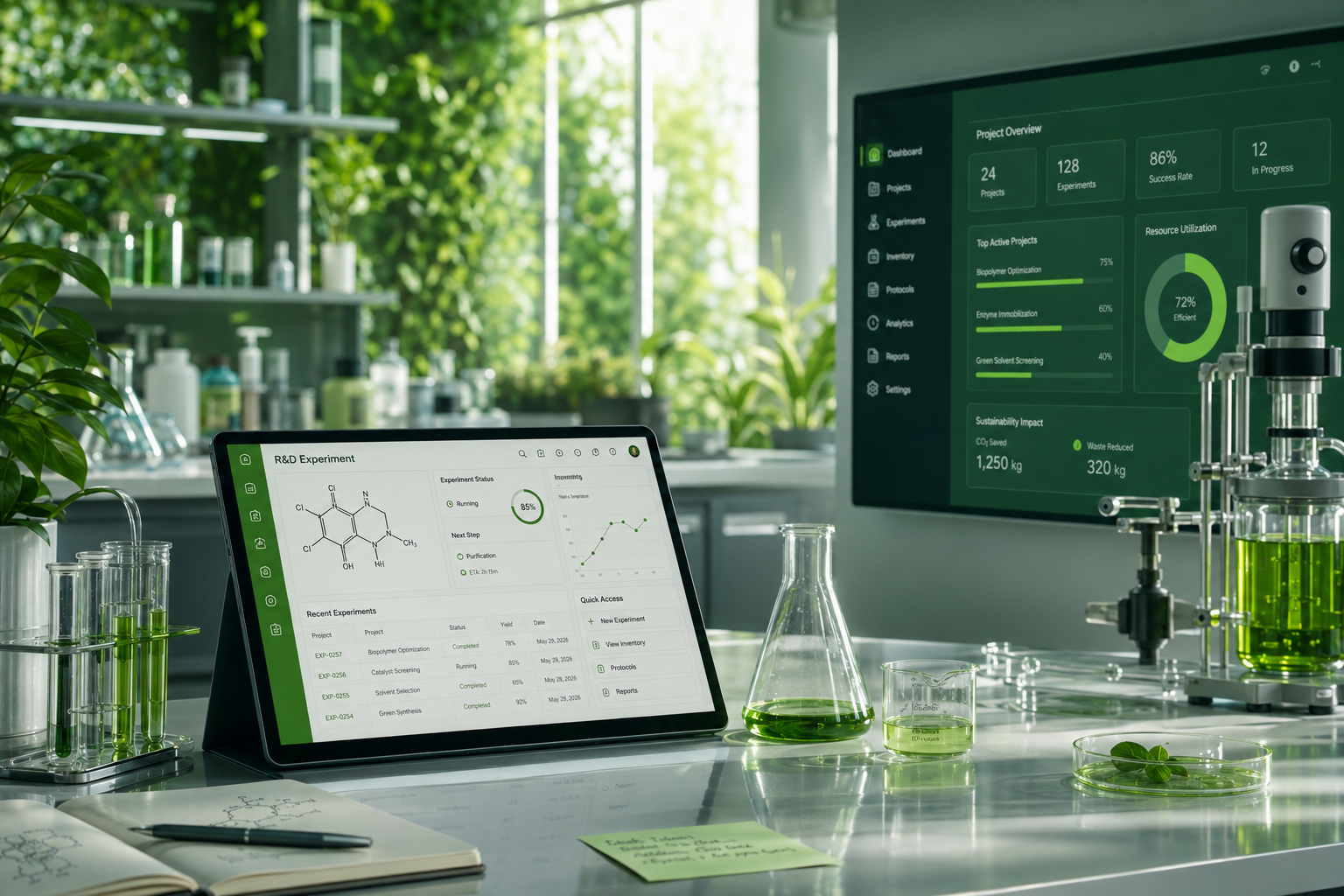
The traditional chemical research laboratory is facing an identity crisis. For decades, the software stack in a typical chemical or materials R&D lab was passive. Electronic Lab Notebooks (ELNs) acted as digital paper to record what had already happened. Laboratory Information Management Systems (LIMS) functioned as structural databases to track sample logistics and post-validation quality data.
In 2026, this passive record-keeping infrastructure is no longer sufficient.
Driven by aggressive global restrictions on toxic precursors (such as the widespread EPA and ECHA phase-outs of PFAS), severe raw material scarcity, and the need to hit carbon-equivalent ($CO_2e$) sustainability targets, modern laboratories cannot afford to treat software as a secondary consideration.
To survive a market demanding rapid cycles, chemical enterprises must transition from software that merely stores data to software that actively accelerates chemistry.
Here is what modern chemical R&D laboratories actually need to operate successfully in 2026.
1. Zero-Friction Semantic Data Ingestion
The single greatest bottleneck in chemical research isn't a lack of data; it is trapped data. Up to 80% of an organization's proprietary chemistry knowledge is unstructured—buried inside decades of legacy PDFs, supplier Technical Data Sheets (TDS), instrument readouts, and unstandardized lab notebooks.
Modern labs no longer have the luxury of dedicating valuable hours for bench chemists or data scientists to manually clean data, align schemas, or convert chemical structures into rigid formats like SMILES strings.
What Labs Need:
R&D software must feature built-in, chemistry-native semantic intelligence. The platform should allow an engineer to drag and drop disparate, unstructured files into the system, automatically parsing text, extracting reaction parameters, identifying formulations, and mapping relationships to build an instantly searchable, relational corporate memory bank.
2. Small-Data Competency and Active Learning
Many generic machine learning tools fail in chemical R&D because they require massive datasets—often thousands of uniform data rows—to yield accurate predictions. In specialty chemical development, running 2,000 physical lab iterations just to train a neural network is a financial and operational impossibility.
Legacy Statistical DoE
Manual / Static SandboxRelies on rigid, pre-defined experimental boundaries. Requires massive, multi-trial physical baseline data and cannot dynamically extrapolate beyond the initial static constraints or adapt on the fly to trial anomalies.
Modern AI Active Learning
Continuous Optimization LoopLeverages closed-loop active learning models (e.g., Bayesian optimization) to accurately predict formulation outputs from sparse datasets, continuously recommending the single next best experiment to minimize lab waste.
What Labs Need:
Modern software must excel at small-data machine learning (utilizing frameworks like Bayesian Optimization or Gaussian Processes). The software should be capable of taking as few as 5 to 10 initial physical trials and generating a highly accurate predictive map of the high-dimensional chemical space.
Furthermore, the platform must feature an Active Learning loop. Instead of just predicting properties, the software should dynamically recommend the next best experiment to run, identifying the exact formulation variant that will maximize performance while minimizing overall prediction uncertainty.
3. Real-Time Dynamic Property & Compliance Mapping
Historically, checking if a new formulation met regulatory compliance (REACH, TSCA) or hit strict raw material cost targets occurred at the end of the development cycle. If a product failed these checks, the R&D team had to return to the bench, resulting in weeks of wasted effort.
In 2026, compliance and cost parameters must be treated as initial design constraints, handled directly within the software workspace.
What Labs Need:
As a chemist adjusts the concentration sliders of a formulation blend inside their software dashboard, the system must dynamically calculate and display derived properties on the fly:
Calculated Active Ingredient Levels & Total Solids %
Volatile Organic Compounds (VOC) Content & Estimated Viscosity
Real-Time Raw Material Cost per Kilogram
Instant Regulatory Compliance Verification (EPA, ECHA restrictions)
If an engineer introduces an additive that triggers a future regional environmental restriction, the software must flag it immediately and suggest verified, non-toxic alternatives.
4. Bridge to the Factory: Scale-Up Simulation
The most challenging phase of product development is moving from a 500 ml laboratory beaker to a 10,000-liter factory reactor—a transition known as scale-up. Formulations optimized in pristine lab conditions frequently experience phase separation, thermal spikes, or mechanical shear failures when introduced to industrial production lines.
The Scale-Up Mandate: Modern R&D software cannot remain isolated within the laboratory walls. It must understand the physical constraints of the manufacturing floor.
What Labs Need:
Labs need integrated scale-up digital twins. By combining chemical formulation profiles with physical plant geometries, heat-transfer limits, and mixing vessel shear constraints, the software should allow engineers to run virtual "what-if" scale-up scenarios. This ensures that when a formula leaves R&D, it is structurally optimized for first-time-right production at commercial scale.
Moving Beyond Digital Paper
The era of using disconnected spreadsheets and passive databases is drawing to a close. The modern laboratories dominating the industry in 2026 recognize that software must serve as an active partner at the bench—interpreting historical data, predicting physical properties, ensuring regulatory compliance, and guiding experimental discovery.
By deploying unified, AI-native software platforms tailored specifically for chemical ontology, R&D organizations can finally stop wrestling with data silos and focus entirely on sustainable, high-value chemical innovation.
Take Control of Your Formulation Space
Are you ready to move your laboratory beyond static spreadsheets and legacy databases? Discover how you can leverage predictive machine learning models, automate your Design of Experiments (DoE), and accelerate your product development cycles with an active AI assistant designed specifically for chemists and materials engineers.
👉 Transform your R&D workflows today.
Also, subscribe to receive news ans updates