
Electrochemistry : AI-Optimized Batteries, Hydrogen Systems, and Reaction Efficiency - Intelligent Chemistry
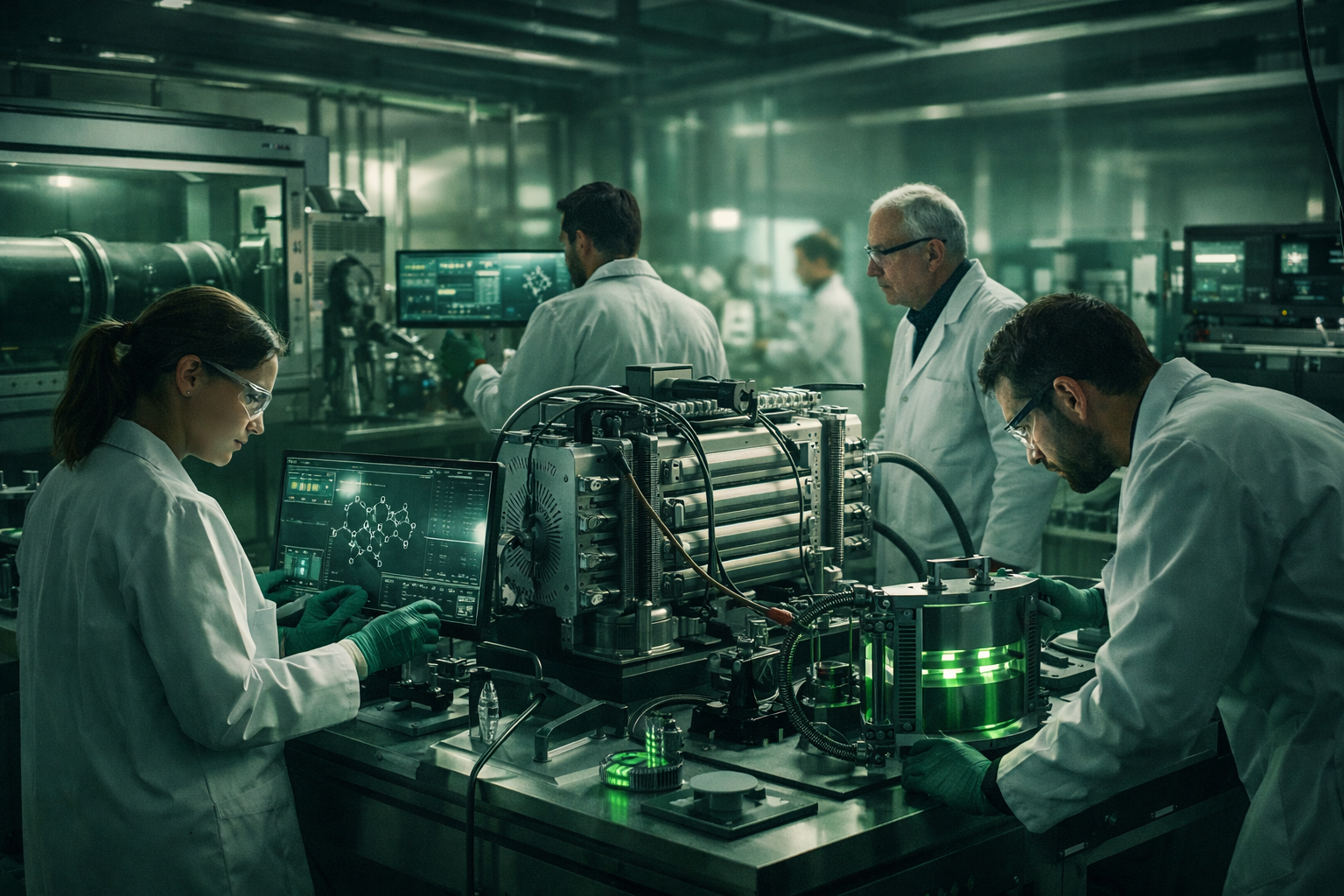
Electrochemistry is experiencing a renaissance not merely because of new materials or improved instrumentation, but because the discipline itself is being re-architected by intelligence. For decades, progress in electrochemical science was shaped by persistence—long experimental cycles, incremental parameter tuning, and the slow accumulation of empirical knowledge. Today, the paradigm is shifting from observation-driven chemistry to prediction-driven chemistry. This shift is powered by computational modelling, artificial intelligence, and structured experimental memory systems that transform laboratories into hybrid environments where electrons, equations, and algorithms collaborate.
At its essence, electrochemistry governs the transfer of electrons across interfaces—phenomena invisible to the naked eye yet foundational to batteries, fuel cells, corrosion science, catalysis, and environmental remediation. Every charge–discharge cycle in a battery, every molecule of hydrogen produced in an electrolyzer, and every selective electro-organic reaction is orchestrated by interfacial electron dynamics. The challenge lies not in understanding isolated reactions, but in decoding the vast, interconnected web of variables—temperature, electrode morphology, electrolyte composition, current density, surface chemistry—that collectively define performance. Traditional experimentation struggles to manage this multidimensional complexity. Intelligent chemical systems, however, thrive in precisely such environments, converting scattered data into coherent, predictive insight.
The Scientific Complexity of Electrochemistry: Why Intelligence Became Essential
Electrochemical systems are inherently multiscale. Atomic-level adsorption events influence macroscopic device lifetimes; nanometer surface defects can cascade into full-scale structural failure; microstructural porosity dictates ion diffusion patterns that determine efficiency. Unlike many chemical domains where reactions occur in homogeneous solutions, electrochemistry unfolds at interfaces—regions where solid, liquid, and sometimes gas phases intersect. These interfaces are dynamic, evolving with each electron transfer and each thermal fluctuation.
Historically, scientists addressed this complexity through controlled isolation—studying one parameter at a time. While methodologically sound, this approach is inherently slow and often blind to nonlinear interactions. Modern electrochemistry, however, generates data at unprecedented density: impedance spectra, cyclic voltammograms, thermal logs, in-situ imaging, and spectroscopy outputs accumulate faster than manual interpretation can handle. Artificial intelligence introduces analytical scalability. Instead of isolating variables, it integrates them, revealing correlations that are statistically robust and chemically meaningful. The laboratory thus evolves from a site of isolated experiments into a living analytical ecosystem where every reaction contributes to a continuously expanding knowledge structure.
Battery Science: From Energy Storage to Predictive Lifespan Engineering
Modern battery research has transcended the singular pursuit of higher energy density. The contemporary challenge is predictive lifespan engineering—the ability to forecast how a battery will behave over thousands of cycles before those cycles physically occur. Degradation pathways in lithium-ion and emerging chemistries are complex and path-dependent. Microscopic phenomena such as dendrite formation, electrolyte decomposition, and interphase instability gradually influence macroscopic performance metrics like capacity retention and internal resistance.
Artificial intelligence transforms this challenge by converting early-stage diagnostic signals into long-term predictions. Subtle inflections in voltage curves or impedance spectra, once regarded as inconclusive, now serve as early indicators of structural stress or chemical imbalance. Digital twin frameworks amplify this predictive power by creating virtual replicas of battery systems. These twins simulate mechanical stress, thermal gradients, and electrochemical kinetics simultaneously, enabling researchers to conduct thousands of virtual experiments within minutes. The implications are profound: development cycles compress, safety risks diminish, and the boundary between theoretical modelling and applied engineering dissolves.
Moreover, predictive intelligence democratizes innovation. Laboratories that once required years of iterative testing can now compete globally by leveraging simulation-driven workflows. The battery thus becomes not merely a storage device, but a dynamic data entity whose behavior is continuously learned, refined, and optimized.
Hydrogen Electrolysis: Catalytic Intelligence and the Future of Clean Energy
Hydrogen electrochemistry represents one of the most promising pathways toward sustainable energy ecosystems. Efficient water splitting, however, is governed by delicate balances—catalyst activity versus durability, electrolyte conductivity versus corrosion resistance, and energy input versus yield. These trade-offs unfold within multidimensional parameter spaces where traditional linear modelling provides only partial insight.
Intelligent analytical systems introduce a holistic perspective. By examining historical reaction matrices alongside real-time sensor data, AI-driven platforms identify optimization pathways invisible to conventional approaches. Catalyst compositions can be evaluated not solely for immediate activity but for projected long-term stability. Electrolyte formulations can be refined through predictive conductivity modelling. Operational strategies—ramping speeds, thermal windows, and load variability—can be simulated before deployment, transforming hydrogen production from a reactive process into a strategically engineered system.
The broader implication is not merely higher efficiency but greater resilience. As renewable energy sources introduce variability into power grids, hydrogen systems must adapt dynamically. Predictive intelligence ensures that adaptation is guided by data-anchored foresight rather than trial-based improvisation.
Reaction Efficiency and Electrocatalysis: From Empirical Guesswork to Structured Discovery
Electrochemical reactions extend beyond energy storage and fuel generation into domains such as carbon dioxide reduction, ammonia synthesis, wastewater treatment, and fine chemical manufacturing. Each of these processes involves intricate networks of intermediate species and competing pathways. Selectivity, yield, and energy consumption are rarely governed by a single parameter; they emerge from the collective influence of geometry, transport phenomena, and surface chemistry.
Artificial intelligence introduces structured discovery into this complexity. Active learning algorithms determine which experiments are most informative, reducing redundant trials. Multimodal data fusion integrates spectroscopy, imaging, and electrochemical measurements into unified analytical frameworks. Mechanism-aware models embed chemical constraints into predictive engines, ensuring that recommendations remain chemically plausible rather than purely statistical. The laboratory thus shifts from exploratory empiricism toward hypothesis-guided precision, accelerating the transition from conceptual research to industrial applicability.
ChemCopilot: Building a Cognitive Infrastructure for Electrochemical Science
Within this evolving scientific environment, ChemCopilot functions as a cognitive infrastructure rather than a conventional analytical application. Electrochemical research generates immense volumes of fragmented data—experimental logs, spectral outputs, kinetic measurements, and imaging datasets—often scattered across projects and institutions. ChemCopilot introduces semantic organization and contextual continuity, transforming these fragments into interconnected knowledge systems.
Its defining strength lies in process awareness. Experimental deviations are not treated as isolated anomalies but as contextual events linked to historical conditions, material properties, and environmental variables. This layered intelligence enables researchers to retrieve prior insights instantly, compare reaction pathways across projects, and evaluate efficiency trends with clarity. The platform effectively becomes a scientific memory—one that evolves with each experiment and bridges disciplinary boundaries.
Furthermore, ChemCopilot enables cross-domain transferability. Patterns identified in battery degradation can inform hydrogen catalyst stability; insights from electrocatalytic selectivity can influence environmental remediation strategies. By structuring knowledge rather than merely storing it, the platform transforms isolated expertise into collective intelligence, accelerating discovery while preserving methodological rigor.
Data, Reproducibility, and the Emergence of Digital Laboratories
The renaissance of electrochemistry is inseparable from the rise of digital laboratories—environments where data standardization, reproducibility, and interoperability become foundational principles. Structured metadata schemas, ontology-driven classification, and automated documentation ensure that experiments are not only repeatable but comparable across institutions. Negative results, once discarded, gain value as informative data points that refine predictive models and prevent redundant exploration.
ChemCopilot contributes to this transformation by embedding best practices into daily workflows. Automated tagging of experimental variables, versioned process logs, and searchable reaction histories convert laboratories into living archives of chemical intelligence. This digital continuity ensures that knowledge persists beyond individual researchers, fostering institutional resilience and collaborative innovation.
A Global Scientific Inflection Point
Electrochemistry’s resurgence is not bound to geography; it is a global inflection point shaped by universal demands for sustainable energy, efficient storage, and cleaner chemical processes. Laboratories across continents converge on shared challenges—extending battery lifespans, enhancing hydrogen yield, and minimizing energy loss in electrochemical transformations. The distinguishing feature of this era is not merely technological sophistication but the integration of adaptive intelligence into the scientific method itself.
ChemCopilot’s role in this transformation is that of a silent collaborator—an analytical companion that enhances precision, preserves institutional memory, and reveals hidden efficiencies across electrochemical landscapes. The renaissance of electrochemistry is therefore not simply about new materials or advanced fuel cells; it is about redefining how knowledge is generated, structured, and evolved. As laboratories transition from isolated experimentation to interconnected intelligence, chemistry advances toward anticipatory science—where discovery is guided by insight before it manifests in electrodes, catalysts, or reaction vessels.
In this vast and evolving frontier, electrochemistry is no longer a discipline confined to the transfer of electrons. It becomes a domain of predictive possibility, where digital cognition and chemical intuition converge to illuminate pathways that were once invisible, accelerating humanity’s journey toward cleaner energy, smarter materials, and more intelligent scientific exploration.
