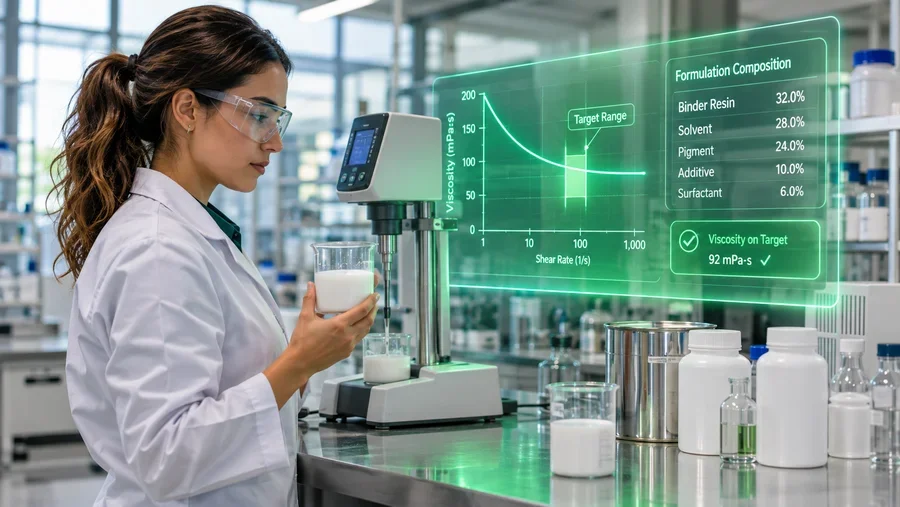
The batch is made, the pigment is dispersed, the pH is adjusted, and then the Brookfield reading comes back 40% above target. The next three days disappear into thickener trims, dilutions, re-measurements and a second batch that is now too thin. Every formulator knows this loop, and most labs treat it as the cost of doing business. It does not have to be. Formulation AI can predict the viscosity of a candidate recipe before a single gram is weighed, and when it is trained on a lab's own batch records, it turns the viscosity-adjustment loop from a multi-batch exercise into a single confirmation run.
This article walks through why viscosity is so resistant to rules of thumb, how a viscosity prediction model is built from the data a formulation lab already has, which model architectures fit which data sizes, and what changes in day-to-day R&D practice once the prediction is reliable enough to trust.
Why Viscosity Is So Hard to Predict by Hand
Viscosity is not a property of any single ingredient; it is an emergent property of the whole system. A rheology modifier behaves one way in a low-solids acrylic emulsion and completely differently when pigment volume concentration climbs. Associative thickeners (HEUR, HASE) interact with surfactants and latex particle surfaces, so a small change in a wetting agent can collapse or spike the viscosity even though the thickener loading did not move. Add pH-dependent swelling, temperature sensitivity, shear-rate dependence and batch-to-batch raw material variation, and the response surface is strongly nonlinear with multi-way interactions.
Formulators cope with experience and a few heuristics: "start at 0.8% thickener for this grade and trim up." Those heuristics work inside a narrow envelope and fail the moment a new resin, a bio-based solvent or a reformulation for VOC compliance pushes the system outside it. That is precisely when rework batches multiply.
The Rework Loop a Coatings Lab Actually Lives In
Consider an anonymized but representative scenario. A mid-size architectural coatings team maintains roughly 240 historical batch records for a family of interior matte paints. Each record contains the full composition, dispersion time, final pH, and viscosity measured at two shear rates (Stormer KU and ICI high-shear). When a new project asks for a lower-VOC variant with a different coalescent, the first batch lands at 118 KU against a 95-100 KU target. The team trims thickener, remeasures, over-corrects, adjusts again, and by the time the recipe is in spec they have consumed five batches and about three weeks of calendar time, most of it waiting on equilibration and queue time on the rheometer.
118 KU (high)
Batch 2: 88 KU
Batch 3: 104 KU
in spec: 97 KU
±4 KU for 60 candidates
at 97 KU predicted
confirms 96 KU
The second path in the schema is what a viscosity model trained on those 240 records makes possible. Instead of iterating in the beaker, the team screens 60 candidate recipes in silico, selects the two or three predicted closest to target, and runs a single confirmation batch. The physical experiment does not disappear; it moves from the discovery phase to the verification phase.
How Formulation AI Models Viscosity
A viscosity prediction model is a regression task: inputs are the composition and process conditions, the output is viscosity under a defined measurement condition. Three decisions matter more than the choice of algorithm.
First, the target definition. Viscosity spans orders of magnitude and is right-skewed, so models should predict log viscosity rather than raw centipoise or KU. The shear rate and temperature at which viscosity was measured must either be fixed across the dataset or included as input features. Mixing Brookfield readings at different spindles and speeds into one target column is the single most common reason a first model fails.
Second, the feature representation. Composition expressed as weight percent is the baseline. Derived features add real signal: pigment volume concentration, total solids, thickener-to-binder ratio, surfactant-to-thickener ratio, and categorical encodings for thickener chemistry (HEUR, HASE, cellulosic, clay). For teams that model across chemically distinct raw materials, structure-aware descriptors or embeddings of the thickener and surfactant molecules let the model generalize to grades it has not seen.
Third, the model family, chosen by how much data exists and how much interpretability the team needs. The table below summarizes the trade-offs for a typical formulation dataset.
| Model | Records needed | Handles interactions | Interpretability | Best fit for viscosity |
|---|---|---|---|---|
| Elastic Net (regularized linear) | 30-80 | Only if engineered | High | Narrow product family, few variables |
| Random Forest | 80-300 | Yes | Medium (feature importance) | Robust first model, noisy lab data |
| XGBoost / Gradient Boosting | 100-500 | Yes, strong | Medium (SHAP) | Best accuracy on tabular batch records |
| Neural Network | 500+ | Yes | Low | Multi-product datasets with embeddings |
| Gaussian Process + Bayesian Optimization | 20-100 | Yes | Medium (uncertainty) | Sequential targeting of a viscosity window |
For most formulation labs, gradient boosting on 100-500 well-structured batch records is the pragmatic sweet spot: it captures thickener-surfactant interactions without hand-engineering them, and SHAP values explain which ingredient drove a given prediction. If you have not yet seen how those explanations are read in a formulation context, the guide to SHAP values and feature importance for formulators covers it in detail.
A Step-by-Step Workflow for Viscosity Prediction With Formulation AI
Step 1: Assemble and clean the batch records. Pull every batch with a complete composition and a viscosity reading from the ELN, LIMS or spreadsheet archive. Standardize ingredient names (the same HEUR thickener appears under three trade names in most archives), convert all compositions to weight percent on the same basis, and record the measurement condition for each viscosity value. Discard records where the measurement condition is unknown rather than guessing.
Step 2: Define the target and the applicability domain. Choose one measurement condition as the primary target, for example KU at 25 °C, and log-transform it. Document the composition ranges the data actually spans; predictions outside those ranges are extrapolations and should be flagged as such.
Step 3: Train with grouped validation. Random train/test splits overestimate accuracy because near-duplicate batches land on both sides. Group records by base recipe or project and hold out entire groups. A model that predicts within ±5% of target on held-out projects is usable for screening; ±10% is still useful for ranking candidates even if it cannot replace a confirmation batch.
Step 4: Check the model against physics. Partial dependence plots should show viscosity rising with thickener loading and with solids, and the pH dependence of an HASE thickener should look like a swelling curve. If the model says more water raises viscosity, the data has a labeling problem, not the chemistry.
Step 5: Deploy as a pre-batch gate. Every new recipe gets a predicted viscosity and an uncertainty band before it is scheduled. Recipes predicted far from target are revised on screen; only those near target go to the bench. After each confirmation batch, the measured value is appended to the training set so the model improves with use.
This workflow mirrors the structure used in the earlier guide on predicting emulsion stability with machine learning; the data hygiene and grouped-validation lessons transfer directly, and many teams train both models from the same cleaned batch table.
From Prediction to Inverse Design
Once a viscosity model is trustworthy, the more valuable question flips: not "what viscosity will this recipe give?" but "which recipes land inside 95-100 KU while keeping cost under a ceiling and hiding power above a floor?" This is where a prediction model becomes a design tool. Bayesian optimization over the model, constrained by the other properties the lab also models, proposes a small set of candidates that satisfy every target simultaneously. The 60-candidate screen in the coatings scenario above is a simple grid version of this; a proper multi-objective optimizer does it with far fewer evaluations and reports the trade-off frontier explicitly.
Platforms built for this kind of work, such as ChemCopilot, let a formulator train the viscosity model on tabular batch data without writing code, run the inverse search against several property targets at once, and keep the resulting recipes linked to their compliance and raw-material records so a candidate that violates a VOC limit or uses a restricted substance is filtered out before it ever reaches the bench.
(composition + viscosity + condition)
grouped validation
viscosity, cost, hiding, VOC
proposes 3 candidates
result appended to data
Where Viscosity Models Go Wrong
Three failure modes account for most disappointing first attempts. The first is thixotropy: a single viscosity number taken at an unrecorded time after mixing hides whether the sample had recovered structure, and the model inherits that noise. Recording the rest time, or measuring after a fixed equilibration, fixes it. The second is raw-material drift: a new lot of latex with a different particle size shifts the whole response, and the model has no feature to capture it. Adding lot-level attributes such as particle size or solids from the certificate of analysis restores accuracy. The third is silent extrapolation: a model trained on cellulosic thickeners will produce a confident number for an HEUR recipe and be wrong. Applicability-domain checks and uncertainty estimates exist precisely to catch this, and any deployment that skips them will eventually mislead a formulator at the worst moment.
Key Takeaways
A viscosity model trained on a lab's own batch history can move the adjustment loop off the bench, turning five rework batches into one confirmation run. Success depends far more on target definition, measurement-condition consistency and grouped validation than on the algorithm. Gradient boosting on 100-500 clean records is the practical default, with Gaussian process models for small sequential campaigns and neural networks only when the dataset spans many product families. The real payoff arrives when the predictor is inverted into a design tool that respects cost, performance and regulatory constraints together.
Can formulation AI predict viscosity across different measurement methods?
Only if the measurement method, shear rate and temperature are included as input features or held constant. Mixing Brookfield, Stormer and cone-and-plate readings into one target without that information produces a model that fits noise.
How many batch records are needed before a viscosity model is useful?
A regularized linear or Gaussian process model can give useful rankings from a few dozen records within a single product family. Gradient-boosted models that capture thickener-surfactant interactions typically need 100 or more records with consistent measurement conditions.
Does the model replace the rheometer?
No. It replaces the discovery batches, not the confirmation batch. The measured result from each confirmation run is fed back into the dataset, which is what keeps the model accurate as raw materials and product lines change.
What about shear-thinning behavior rather than a single viscosity value?
The same approach works by predicting viscosity at several shear rates as separate targets, or by predicting the parameters of a flow model such as Herschel-Bulkley. This requires full flow curves in the training data rather than single-point readings.
Ready to see how many of your past batches already contain the data needed for a viscosity model? Talk to the ChemCopilot team about running a pilot on your own formulation records.