Multi-Agent Systems: How AI is Mastering Complexity
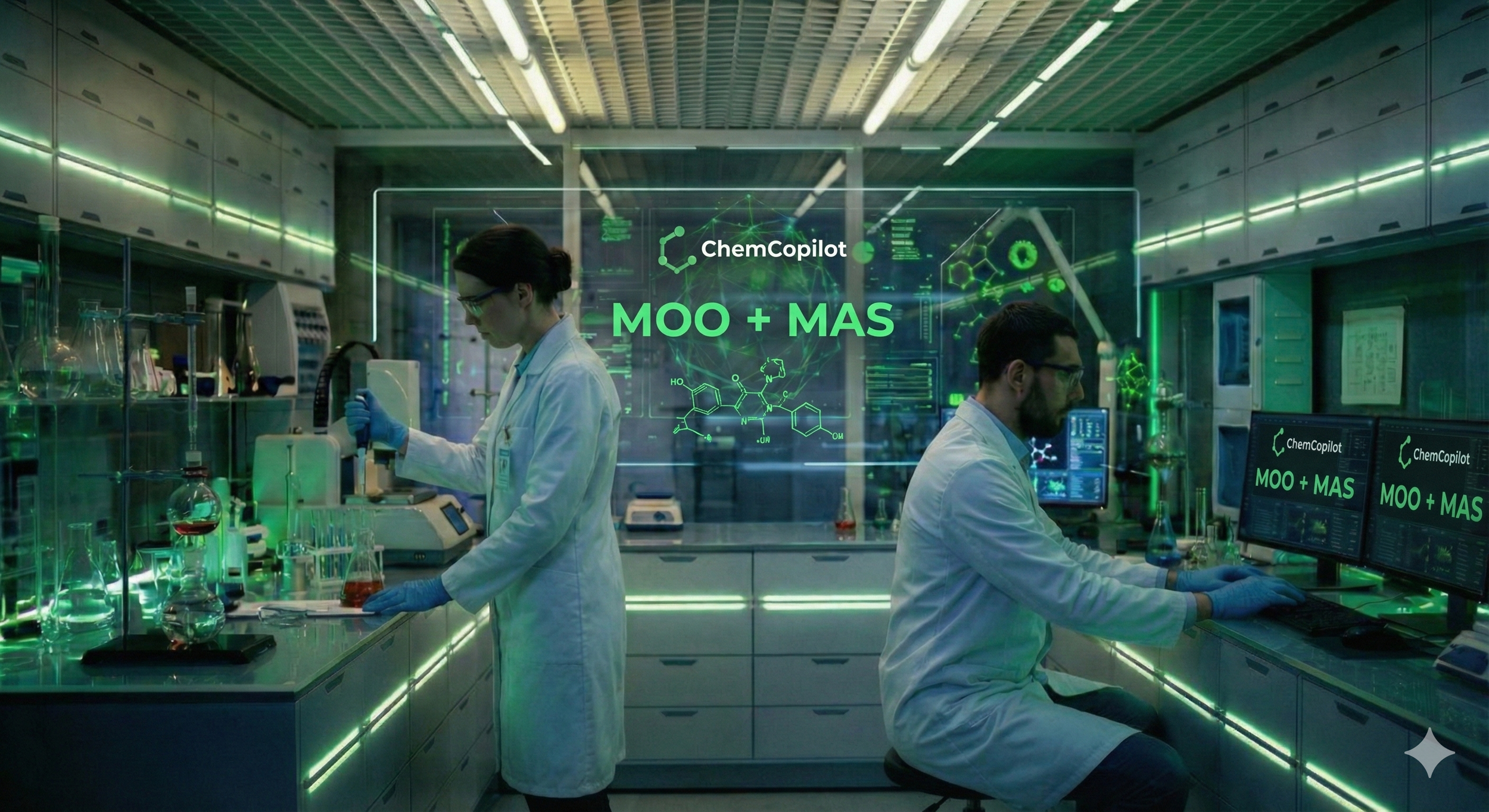
In the real world, we rarely want just one thing. We want potent and safe medicines, faster and greener supply chains. This is the challenge of Multi-Objective Optimization, and a new generation of AI—led by platforms like ChemCopilot—is rewriting the rules on how we solve it.
The Myth of "The Best"
In introductory business or engineering courses, optimization is often presented neatly. You have a single objective: maximize profit, minimize time, or maximize structural strength. You run an algorithm, it crunches the numbers, and it spits out "The Optimal Solution."
The real world, however, is rarely so cooperative.
Real-world problems are messy and riddled with conflicting desires. An automotive engineer needs to design a car that is fast, fuel-efficient, safety-compliant, and affordable. An investment manager needs to maximize returns while simultaneously minimizing risk.
These are Multi-Objective Optimization (MOO) problems. In these scenarios, there is no single "best" answer. Improving one objective almost invariably harms another. You cannot have the fastest, safest, and cheapest product all at once.
For decades, solving these complex balancing acts required massive computational power and significant human intuition. Today, however, Artificial Intelligence is stepping into this arena, navigating complex trade-offs with a speed and sophistication that traditional methods cannot match.
The Challenge: Finding the "Pareto Frontier"
The core difficulty of a multi-objective problem is that you aren't looking for a single needle in a haystack; you are looking for a specific collection of needles.
When objectives conflict, the goal shifts from finding one optimal solution to finding a set of optimal trade-offs. This set is known in mathematics as the Pareto Frontier.
Imagine a graph plotting a new drug's "Potency" against its "Safety." A solution is on the Pareto Frontier if you cannot improve it (e.g., make it more potent) without making another aspect worse (e.g., making it more toxic).
Any point behind the frontier is sub-optimal. Any point beyond the frontier is impossible given current physics or chemistry. The frontier itself represents the best possible menu of compromises. Finding this frontier in complex fields like chemistry or logistics is unimaginably difficult for human minds alone.
Enter the AI Paradigm Shift
Artificial Intelligence is uniquely suited for the chaotic landscape of MOO problems. AI doesn't just "crunch numbers"; it learns the shape of the problem space.
While techniques like Surrogate Modeling (using AI to speed up slow simulations) and Evolutionary Algorithms (breeding better solutions over generations) are crucial, one of the most exciting developments for handling complex, competing goals is the use of Multi-Agent Systems.
The Power of Negotiation: Multi-Agent Systems (MAS)
In many traditional AI approaches, a single monolithic model tries to learn everything. A Multi-Agent System (MAS) takes a different approach, inspired by human organizations.
Imagine a corporate boardroom trying to launch a new product. The CFO wants to minimize costs. The CTO wants maximum technical performance. The Head of Sales wants the fastest possible launch date. They must negotiate to find a strategy they can all live with.
In a MAS approach to optimization, distinct AI "agents" are created, each assigned a specific objective. In a logistics scenario, one agent might be rewarded solely for reducing delivery time, while another is rewarded solely for minimizing fuel consumption.
These agents interact in a shared environment. They compete, cooperate, and effectively "negotiate" with each other. Through thousands of iterations, the system finds equilibrium points where the agents have balanced their competing goals. The resulting solutions naturally form the Pareto Frontier, arising from the dynamic interplay of these specialized AI entities.
Case Study Spotlight: ChemCopilot and the Challenge of Chemical Space
Perhaps nowhere is the challenge of Multi-Objective Optimization more acute than in chemistry, particularly drug discovery and materials science. The "search space" of possible molecules is astronomical—often cited as larger than the number of atoms in the universe—and the constraints are unforgiving.
This is the frontier where platforms like ChemCopilot are proving the value of the AI-driven approach.
In chemical discovery, there is almost never a "perfect" molecule. A candidate compound might be incredibly potent against a disease target, but highly toxic to the liver. Another might be safe and potent, but impossible to synthesize in a lab at scale.
ChemCopilot addresses this by utilizing advanced AI techniques, including the Multi-Agent System philosophy, to navigate these complex trade-offs. Instead of a single algorithm trying to find a needle in a haystack, ChemCopilot deploys specialized agents that balance the best outcomes between them.
We can imagine different agents representing critical chemical objectives:
The "Potency Agent" ruthlessly seeks structures that fit the biological target perfectly.
The "Safety Agent" simultaneously analyzes those suggestions, flagging potential toxicities or side effects.
The "Synthesis Agent" acts as the realist, rejecting complex structures that are too difficult or expensive to manufacture.
Through the interaction of these specialized agents, ChemCopilot can rapidly discard billions of dead-end possibilities and hone in on the Pareto Frontier of molecules that offer the best balance of efficacy, safety, and manufacturability.
The Future: Informing, Not Replacing, the Human
It is crucial to understand that in Multi-Objective Optimization, AI rarely gives the final order. Platforms like ChemCopilot are designed to act as super-powered advisors—true "copilots."
By rapidly identifying the Pareto Frontier, the AI presents human experts—whether they are chemists, engineers, or logistics managers—with the best possible menu of choices. It quantifies the trade-offs accurately: "If you want this much more potency, historical data suggests it will cost exactly this much in added synthesis complexity."
Ultimately, deciding which trade-off is acceptable remains a human value judgment. But thanks to AI and Multi-Agent Systems, those judgments are no longer based on intuition and guesswork, but on a rigorous, accelerated exploration of the possible.