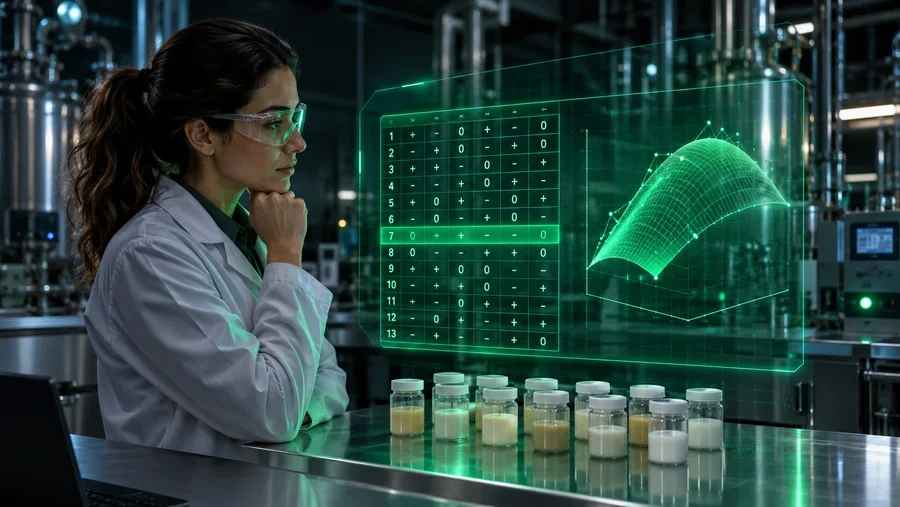
A formulator rebuilding a waterborne adhesive has six variables that might matter: surfactant level, co-solvent ratio, pH, rheology modifier dose, cure temperature, and mixing speed. The textbook design of experiments (DOE) answer is a full 2^6 factorial, which means 64 batches, roughly three weeks of bench time, and a lab manager asking why the team is burning a month to find out which four of those six factors are irrelevant. The usual shortcut, a fractional factorial, cuts that to 16 runs but silently confounds interactions, and neither design can tell you whether the response curves. Screening DOE in chemistry has been stuck in this trade-off for decades: pay for runs, or pay later in follow-up experiments. Definitive screening designs (DSDs) break that trade-off, and for most chemical R&D screens they do it in 2k + 1 runs: six factors, thirteen batches.
Why Classical Screening DOE Wastes Runs in Chemical R&D
The problem with classical screening is not the number of runs alone. It is what those runs cannot tell you.
A resolution III fractional factorial, the most common 8- or 16-run screen, aliases main effects with two-factor interactions. If surfactant level appears important, you cannot know whether that signal is really the surfactant or the surfactant-pH interaction riding on top of it. A resolution IV design fixes that but still aliases two-factor interactions with each other, so a strong pH-temperature interaction becomes indistinguishable from a co-solvent-mixing speed interaction. Plackett-Burman designs are even more efficient in run count, but their alias structure is partial and messy, and in chemical systems with real interactions they are prone to false positives.
The second blind spot is curvature. Every two-level design assumes the response is linear across the range you tested. In formulation and process chemistry that assumption is routinely wrong: viscosity vs. rheology modifier is nonlinear, yield vs. temperature usually has an optimum, and emulsion stability vs. surfactant concentration frequently peaks and collapses. A two-level screen runs at the extremes and misses the middle entirely. Teams add a few center points to detect "some curvature somewhere," but they still cannot attribute it to a specific factor.
The result is a two-stage cost. After the screen, most teams run a second designed experiment (often a response surface design) to recover the interactions and curvature the first one threw away. The 16 runs that looked cheap become 16 + 20, and the calendar stretches accordingly.
How a Definitive Screening Design Works
A definitive screening design, introduced by Jones and Nachtsheim in 2011, is a three-level design built from fold-over pairs. For k continuous factors it uses 2k + 1 runs: k pairs of mirror-image runs plus one overall center point. In each pair, one factor sits at its center level while the others sit at their extremes, and the second run of the pair is the exact negative of the first. When k is odd, two extra runs are typically added, which is why the practical recommendation for 5 or 7 factors is 2k + 3.
That structure buys three properties that matter directly for chemists. Main effects are orthogonal to two-factor interactions, so a detected main effect is a main effect, not a disguised interaction. Two-factor interactions are not fully aliased with one another, so the model can usually separate them when only a few are active. And because every factor is tested at three levels, each factor's quadratic effect can be estimated individually. A single 13-run design therefore answers the three questions a classical screen needs two experiments to answer: which factors matter, which interact, and which are nonlinear.
6 factors, low/center/high levels, 1-2 responses
13 runs: 6 fold-over pairs + 1 center point
randomized order, replicate center if noisy
main effects, 2FI, quadratics via effect heredity
drop inert factors, add runs or Bayesian optimization
The practical consequence for the adhesive team is simple. Thirteen batches instead of 64, and the thirteen include the information that would otherwise require a follow-up design.
Screening DOE Comparison: Full Factorial vs Fractional vs Plackett-Burman vs DSD
For a six-factor chemical screen, the options look like this.
| Design | Runs (6 factors) | Levels | Main effects aliased with 2FI? | Detects per-factor curvature? | Best use |
|---|---|---|---|---|---|
| Full factorial 2^6 | 64 | 2 | No | No | Few factors, cheap runs |
| Fractional 2^(6-2), Res IV | 16 | 2 | No (2FI aliased with 2FI) | No | Interactions assumed small |
| Plackett-Burman | 12 | 2 | Yes (partial) | No | Many factors, no interactions expected |
| Definitive screening design | 13 | 3 | No | Yes | Chemical screens with likely interactions and nonlinearity |
| Central composite (RSM) | 45+ | 5 | No | Yes | Optimization after screening, not screening itself |
The row that surprises most teams is the last one. A response surface design is what people run when they want curvature, but with six factors it costs more than three times the runs of a DSD. The DSD gives a coarser picture of the surface, yet it is enough to decide which two or three factors deserve a proper optimization study. The question of whether that optimization should be a classical response surface or a sequential approach is covered in depth in our comparison of RSM vs Bayesian optimization for chemical process DOE.
Step-by-Step: Running a DSD for a Formulation Screen
Step one is factor selection and range setting, and it is where most screens are quietly ruined. A DSD assumes continuous factors, so a categorical choice such as "surfactant A vs. surfactant B" should either be fixed for the screen or handled with the two-level extension of the design, which costs extra runs. Ranges need to be wide enough that a real effect shows up above measurement noise, but not so wide that batches fail to form. For the adhesive example, a pH range of 6.5 to 8.5 is informative; 4 to 10 would produce coagulated batches at one end and tell you nothing at the other.
Step two is generating the design. For six factors you get 13 runs; for eight factors, 17; for ten, 21. Each row specifies every factor at -1, 0, or +1, and the center row sits at 0 for all of them. If your response is noisy, which is typical for properties like peel strength, tack, or emulsion stability, replicate the center point two or three times. The added runs give a clean estimate of pure error and cost almost nothing in calendar time.
Step three is execution. Randomize the run order, because the fold-over structure makes it tempting to run pairs back to back, and that bakes drift in raw material lots or ambient humidity straight into your factor estimates. If you have to split the design across two days or two reactors, use the DSD blocking option so the block effect is estimated separately rather than absorbed by a factor.
Step four is analysis, and this is where DSDs differ from classical screens. With 13 runs and 27 candidate terms (6 main effects, 15 interactions, 6 quadratics), you cannot fit everything at once. The standard approach uses effect heredity: fit the main effects first, identify the active ones, and then search only among interactions and quadratics involving those active factors. In the adhesive case, if surfactant, pH, and cure temperature come out active and the other three are inert, the model search is restricted to three two-factor interactions and three quadratic terms, which the 13 runs can comfortably support.
Step five is augmentation. Once you know which factors matter, drop the inert ones and add runs in the reduced space. A DSD projected onto three active factors is already a usable response surface design, so a handful of additional axial or model-chosen points often gets you to a predictive model without starting over.
Where Definitive Screening Designs Break Down
DSDs are not a universal replacement for every screening DOE in chemistry, and knowing the failure modes prevents misapplication.
The first is mixture constraints. If your six factors are ingredient fractions that must sum to 100%, the orthogonal structure of a DSD collapses, because you cannot set one ingredient to its high level while every other ingredient also sits at an extreme. Formulation teams in this situation need a mixture design or a mixture-process hybrid, and the difference is laid out in our guide to mixture design vs factorial DOE for formulators.
The second is the sparsity assumption. A DSD works well when roughly half or fewer of the factors are active. If five of six factors turn out to matter, with several interactions, 13 runs cannot support the model and the analysis becomes ambiguous. In practice this means DSDs are strongest early, when the candidate list is long and the active list is expected to be short.
The third is heavy noise. Because many terms share limited degrees of freedom, a response with a coefficient of variation above about 15% will blur the quadratic and interaction estimates even if the main effects survive. Measuring a more precise surrogate response, such as viscosity instead of a subjective "spreadability" score, often fixes the design without adding a single run.
From Screening to Optimization: DSD as the First Step in AI-Driven DOE
The reason definitive screening designs matter more today than in 2011 is that they are the natural front end for sequential, model-driven experimentation. An AI-driven DOE workflow does not treat the screen as a disposable first pass. The 13 runs become the seed dataset: a model fitted on them, with explicit uncertainty on the quadratic and interaction terms, tells a Bayesian optimization loop where the next batch should go. In the adhesive case, the team moved from 13 screening runs directly into an 8-run optimization sequence on surfactant, pH, and cure temperature, finishing with a validated formulation in 21 batches total, against the 64 the original factorial would have cost before any optimization at all.
Platforms built for chemical R&D have started to absorb this workflow. In ChemCopilot, the AI-driven DOE module generates a definitive screening design from the factor list and ranges, fits the heredity-constrained model when results come back, and then hands the active factors to Bayesian Optimization for the next round, with the experiment records versioned alongside the formulation so a regulatory or QA reviewer can trace why each batch was run. The point is not that the statistics are new, but that the screen, the model, and the optimization loop stop living in three different spreadsheets.
For a process engineer or formulator deciding this week how to screen a new system, the decision rule is short. If factors are continuous, interactions are plausible, and nonlinearity is likely, which describes the majority of chemical systems, start with a DSD. Reserve two-level fractional factorials for cases where you are confident the system is linear and additive, and reserve full factorials for the rare case where runs are genuinely cheap.
Key Takeaways
A definitive screening design screens k continuous factors in 2k + 1 runs while keeping main effects clear of interactions and estimating each factor's curvature. For a six-factor chemical screen that is 13 runs instead of a 64-run factorial or a 16-run fractional that needs a follow-up study. DSDs assume sparsity and continuous factors, so mixture-constrained formulations and screens where most factors are active need different designs. The screening results are most valuable when they feed a sequential optimization loop rather than ending in a static report.
FAQ
How many runs does a definitive screening design need? For k continuous factors, 2k + 1 runs when k is even and typically 2k + 3 when k is odd. Six factors need 13 runs, eight need 17, ten need 21. Adding two or three replicated center points is recommended when the response is noisy.
Can a DSD replace a response surface design for optimization? Not on its own. A DSD estimates curvature well enough to decide which factors need optimization, but with all factors included it does not have enough runs for a precise full quadratic model. Once inert factors are dropped, the projected design can be augmented with a few additional runs to become a true response surface design.
What is the difference between a definitive screening design and a Plackett-Burman design? Plackett-Burman designs use two levels and partially alias main effects with two-factor interactions, which can produce false positives in chemical systems with real interactions. DSDs use three levels, keep main effects orthogonal to interactions, and can estimate quadratic effects, at the cost of one extra run for six factors.
Can DSDs handle categorical factors like supplier or solvent type? Yes, with a modified construction that adds runs for each two-level categorical factor, but the clean alias properties degrade as more categorical factors are included. For screens dominated by categorical choices, a different design class is usually more efficient.
Do I need coding skills to run a DSD analysis? No. The design generation and heredity-based model search are available in standard DOE software and in no-code chemical R&D platforms. What you do need is a clear factor list, sensible ranges, and a response measured precisely enough to support the model.
Ready to replace 64-run screens with 13-run designs that feed directly into AI-driven optimization? Talk to the ChemCopilot team about running your next formulation or process screen as a connected DOE workflow.