The 90-Day Roadmap to AI-Driven Chemical Innovation
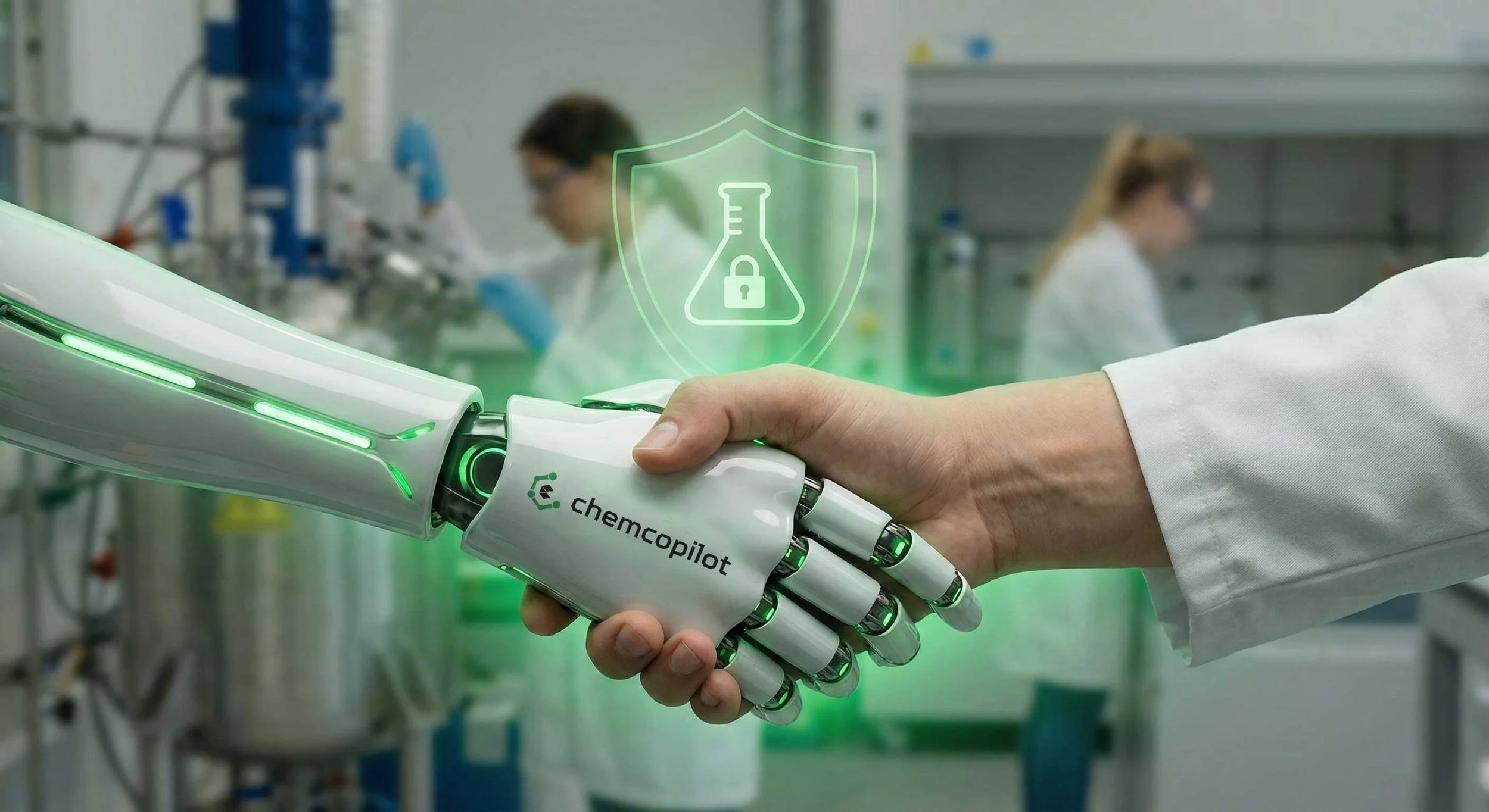
In a recent strategy session, Jonathan Woo, co-founder of ChemCopilot, outlined a vision that challenges the current industry obsession with "quick-fix" AI. The goal isn't just to solve a single formulation headache; it’s to build a continuous innovation engine that scales with the enterprise.
Here is the blueprint for how ChemCopilot is redefining the R&D framework.
1. The Philosophy: Platform over "Problem-Solving"
Most companies treat AI like a calculator—you plug in a number and get an answer. Jonathan proposes a shift: The AI Agent as a Collaborator. Instead of addressing a isolated use case, the ChemCopilot platform is inserted into the customer’s existing development framework. The objective? Continuous improvement of process yield, product robustness, and speed-to-market. It’s not a one-time transaction; it’s a dedicated environment for tuning and evolving chemistry.
2. The Intellectual Property Safe-Zone
The #1 barrier to AI adoption in chemicals is the fear of losing proprietary knowledge. Jonathan is categorical on this front:
The Customer owns the IP: Every formulation, every insight, and every piece of "knowledge" derived from the AI belongs entirely to the client.
ChemCopilot owns the tools: We provide the source code and the platform architecture.
Sovereignty: The business model utilizes dedicated licensing, ensuring that a customer’s data stays in their "private lane," never leaking into a general model.
3. The "3-Month Rule": From Data to Validation
One of the most valuable insights from the session was the realistic timeline for AI implementation. Success isn't overnight—it’s a disciplined 90-day sprint:
| Timeline | Core Focus | The Strategic Goal |
|---|---|---|
| Month 1 | Data Ingestion | Problem scoping and cleaning the "fuel" via Step Zero protocols. |
| Month 2 | Model Building | Training the agent on specific use cases and Design of Experiments (DoE). |
| Month 3 | Validation | Testing AI suggestions against real-world lab results to ensure scientific accuracy. |
4. Cross-Pollination: Leveraging Global Science
Can a paint formulation benefit from drug delivery research? Jonathan says yes.
While ChemCopilot never shares proprietary data between clients, the system is designed to leverage publicly available scientific data. By cross-referencing open-source libraries and published articles from advanced fields like pharmaceuticals, the AI brings "external intelligence" to specific industrial applications without compromising security.
5. The Low-Friction Entry: "Skin in the Game"
To prove the value of the 95% Engine, ChemCopilot advocates for a low-cost Proof of Concept (POC).
"We keep the POC pricing intentionally low. It’s not a revenue generator for us; it’s a way to ensure both parties have 'skin in the game' to validate the fit before moving to a full-scale subscription." — Jonathan Woo
Why "Generic AI" Fails the Lab Test
The reason we insist on a POC with "skin in the game" is simple: Generic data produces generic results. A standard LLM is trained on the open internet, which makes it a "word-cloud" engine, not a chemical engine. It doesn't know your specific reactor's constraints, your unique batch history, or the subtle nuances of your proprietary additives. To move from a "chatbot" to a Predictive Agent, the model must be grounded in your reality. We work in a POC framework to prove that when the AI is fueled by your specific data—secured and isolated—it stops guessing and starts innovating.
Are you ready to move past the "magic" and see real-world results? Schedule a technical briefing with our team here to explore your specific use case.
The Bottom Line
The transition to AI-native R&D is as much about process as it is about code. By focusing on data ownership, a structured 3-month setup, and a collaborative agentic model, ChemCopilot is moving the industry away from "magic tricks" and toward predictable, scalable science.