The New Border: Why the Convergence of DOE, Digital Twins, Compliance, and ESG is the Ultimate R&D Frontier
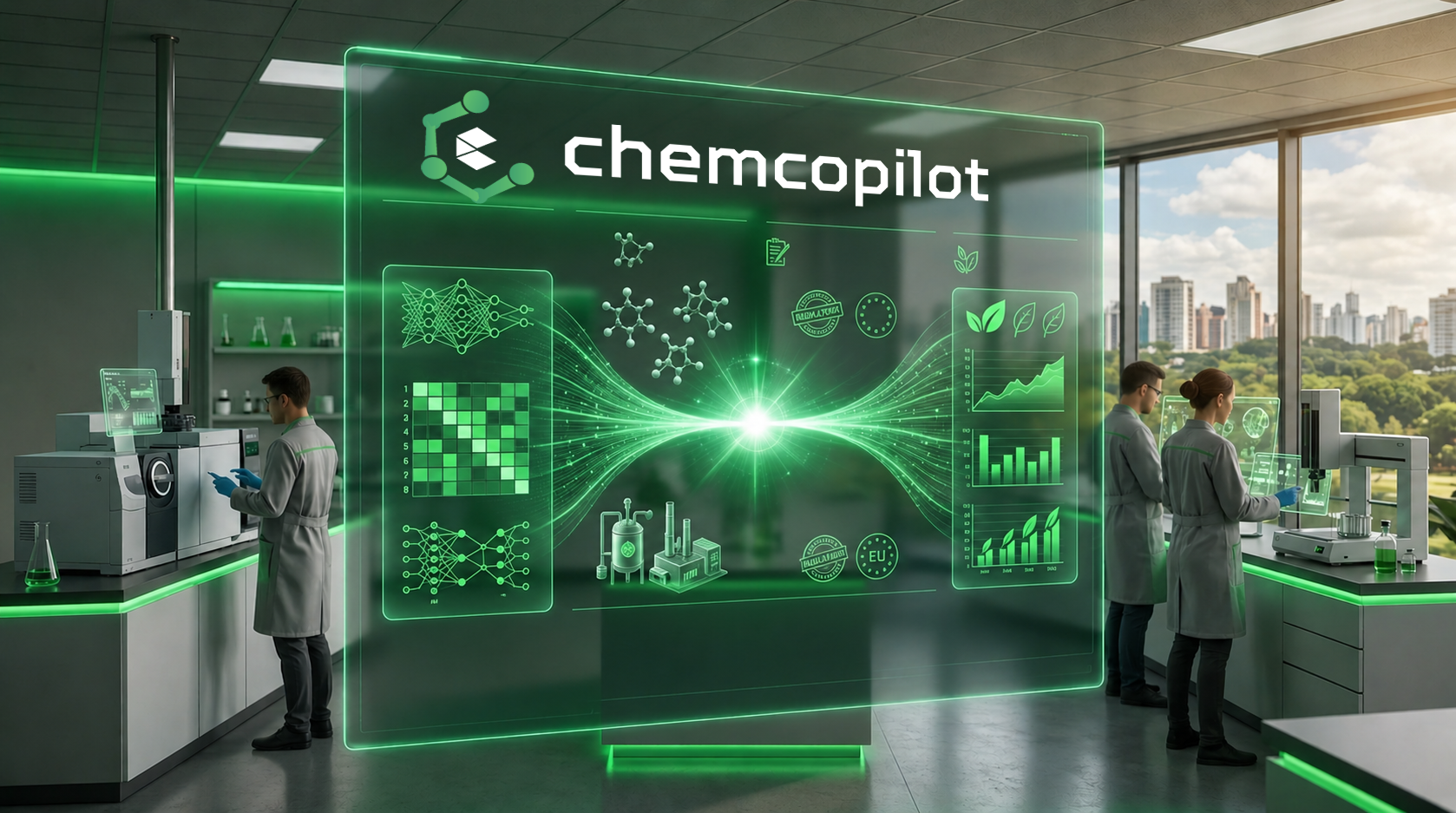
For decades, the chemical industry has operated in silos. The R&D team runs the Design of Experiments (DOE). The simulation experts manage the Digital Twins. The legal team handles Compliance. And the corporate board worries about ESG (Environmental, Social, and Governance) targets.
The problem? These silos don't talk to each other. Data is lost in translation, innovation is throttled by red tape, and sustainability is often treated as a post-production "check-the-box" exercise.
Today, we are crossing a new border. For the first time, a single AI-native ecosystem is unifying these four pillars into one engine of truth. Here is why this integration isn't just a "feature"—it’s a necessity for survival.
1. DOE + Digital Twin: From Speed to Certainty
Traditionally, DOE helps you pick which experiments to run, and Digital Twins help you model them. But when they are separate, the "learning loop" is slow.
In an AI-native environment, the DOE is the Twin. As you drag and drop variables to plan your experiments, the Digital Twin is simulating the outcome in real-time. This doesn't just make you 100x faster; it gives you the certainty to abandon dead-end formulations before they ever leave the computer.
2. Compliance as a Design Constraint, Not a Bottleneck
Most labs treat REACH and ECHA compliance as a hurdle at the end of the race. But what if compliance was a "safety rail" built directly into the DOE?
By integrating global regulatory databases into the AI core, the platform prevents you from even designing a molecule that will be banned in two years. You aren't just innovating; you are "Innovating for Approval."
3. ESG: The Green Molecule is the Profitable Molecule
In 2026, ESG is no longer optional. Carbon taxes, consumer demand for bio-based materials, and waste reduction targets are hitting the bottom line.
Nothing else in the market currently embeds ESG metrics directly into the R&D process. By calculating the carbon footprint and toxicity of a formulation at the moment of conception, AI-native platforms allow companies to meet their "Net Zero" goals without sacrificing performance.
4. The Power of AI-Native vs. Legacy "Bolt-ons"
Many legacy LIMS or ERP systems are trying to "bolt on" an AI plugin. It doesn't work. To truly decode tabular chemistry and spectral data, the AI must be the foundation, not an afterthought.
An AI-native platform treats data as a living asset. It learns from every spectrum, every factory "what-if" scenario, and every regulatory update. It doesn't just store data; it understands it.
Conclusion: Crossing the Border
The "New Border" of the chemical industry is the elimination of the gap between discovery and delivery, exactly what Chemcopilot brings to the lab. By combining DOE, Digital Twins, Compliance, and ESG into one unified platform, we are removing the "friction cost" of innovation.
The era of fragmented tools is over. The era of Unified Chemical Intelligence has arrived.
Talk With Sales Team here
You can explore a demo here