What Is AI in Chemistry? The Complete 2026 Guide for Chemical Engineers
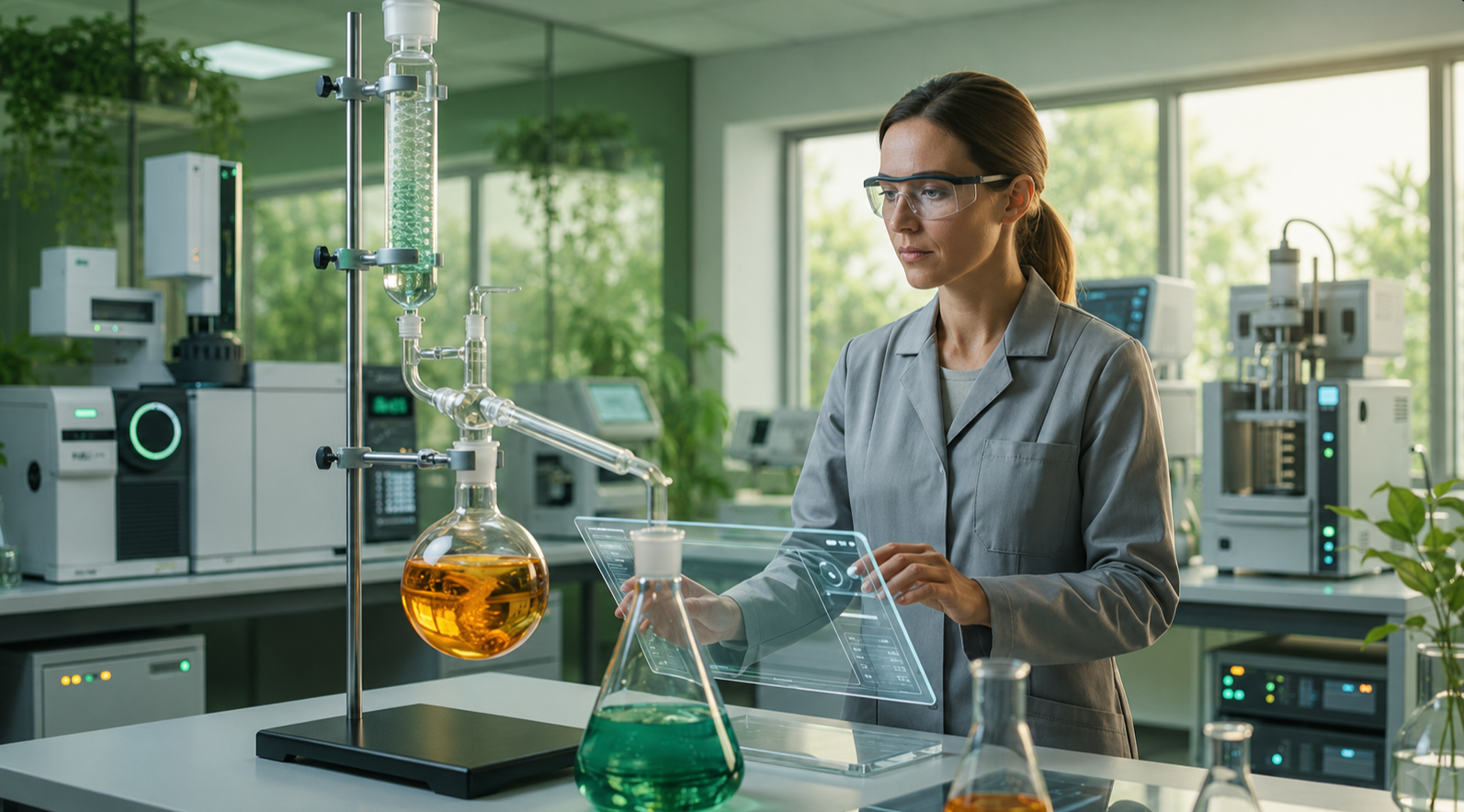
For decades, chemical engineering has relied on a foundational loop: design, synthesize, test, analyze, and repeat. It is a process governed by first principles, physical trials, and an inevitable degree of trial-and-error. But as we navigate 2026, the landscape has fundamentally shifted.
Artificial Intelligence (AI) in chemistry is no longer a theoretical concept confined to academic papers or a buzzword bolted onto legacy software. It is a mission-critical infrastructure. Today, AI is the bridge that connects the physical lab bench to the "Silicon Lab," transforming how molecules are discovered, how processes are scaled, and how compliance is managed.
If you are a chemical engineer, R&D director, or materials scientist, here is your complete guide to how AI is rewriting the rules of chemistry in 2026.
1. The Shift from Trial-and-Error to Predictive Design
Historically, reaching the "Golden Batch" meant running dozens, sometimes hundreds, of physical experiments. This traditional Design of Experiments (DoE) is resource-heavy, expensive, and slow.
AI fundamentally flips this model. Instead of relying purely on physical testing to find correlations between variables (like pH, temperature, and yield), AI-native platforms ingest your historical, often sparse lab data. Using advanced machine learning algorithms, the AI maps the multidimensional chemical space to identify non-obvious correlations that the human eye—and traditional statistical software—cannot see.
The 2026 Reality: You don't guess which trials to run. The AI guides your chemistry, suggesting a highly optimized DoE matrix. You test in the physical lab only to validate what the algorithm has already predicted, cutting lab time by up to 100x.
2. Surviving the "Valley of Death" with Digital Twins
In chemical manufacturing, the "Valley of Death" is the treacherous gap between a successful lab-scale beaker and a 10,000-liter factory reactor. A formulation that works perfectly at 50 grams often fails catastrophically at 50 tons due to heat transfer, mixing dynamics, and sheer scale.
Enter the Digital Twin: AI now allows engineers to build interactive, real-time digital replicas of their production floors.
Drag-and-Drop Scenario Modeling: Engineers can run "what-if" scenarios before a single valve is turned in the factory.
Sensitivity Analysis: You can instantly see what happens if raw material purity drops by 5% or if a supplier substitution is required.
By simulating factory-scale outcomes and process sensitivities in real-time, AI ensures that laboratory success actually translates to commercial viability.
3. Unlocking the Trap of Unstructured Data
One of the greatest bottlenecks in chemical engineering isn't a lack of data; it's that 80% of institutional knowledge is trapped in unstructured formats: decades of handwritten lab notebooks, scattered PDFs, patent filings, and isolated Excel spreadsheets.
Modern AI acts as a Smart Librarian for the enterprise. Using specialized Large Language Models (LLMs) trained on chemical and regulatory contexts, AI ingests this unstructured data and transforms it into a searchable, structured "Engine of Truth."
Instead of spending weeks cross-referencing old formulations, an engineer can simply ask their platform: "Have we ever attempted to synthesize a non-toxic alternative to this specific polymer using these three precursors?" and receive an instant, cited answer based on the company's 25-year history.
4. Compliance and ESG as Design Constraints, Not Bottlenecks
In the past, Environmental, Social, and Governance (ESG) metrics and regulatory compliance (like REACH, ECHA, or EPA guidelines) were treated as a final hurdle. You designed a great product, and then you prayed it passed the legal and environmental checks.
By 2026, the cost of redesigning a product due to a newly restricted chemical is too high. AI integrates global regulatory feeds and carbon footprint calculators directly into the R&D phase.
Predictive Compliance: The AI acts as a safety rail. It prevents you from designing a molecule that contains components likely to be banned in the next two years.
Smart Alerts: If a raw material currently used in your production line is suddenly flagged by the EPA, the AI instantly maps the restriction to your active product catalog and alerts you to the necessary reformulations.
5. The Chemical Engineer of the Future
There is a common misconception that AI will replace the chemical engineer. The reality is quite the opposite. AI replaces the tedious data-wrangling, the blind physical testing, and the manual regulatory cross-referencing.
The chemical engineer of 2026 is elevated from a "data gatherer" to a "strategic director." Armed with AI-native tools, engineers can focus entirely on high-level innovation, complex problem-solving, and sustainable design. You are no longer fighting your data; you are guiding it.
The Era of Unified Chemical Intelligence
The fragmented days of using one tool for DoE, another for process simulation, and a third for regulatory compliance are over. The new frontier is convergence. By uniting predictive lab models, factory digital twins, and global compliance data into a single AI-native ecosystem, the chemical industry is finally moving at the speed of software.
Welcome to the Silicon Lab.