Accelerating India’s Specialty Chemical Boom: How AI Trims R&D Cycles for SMEs
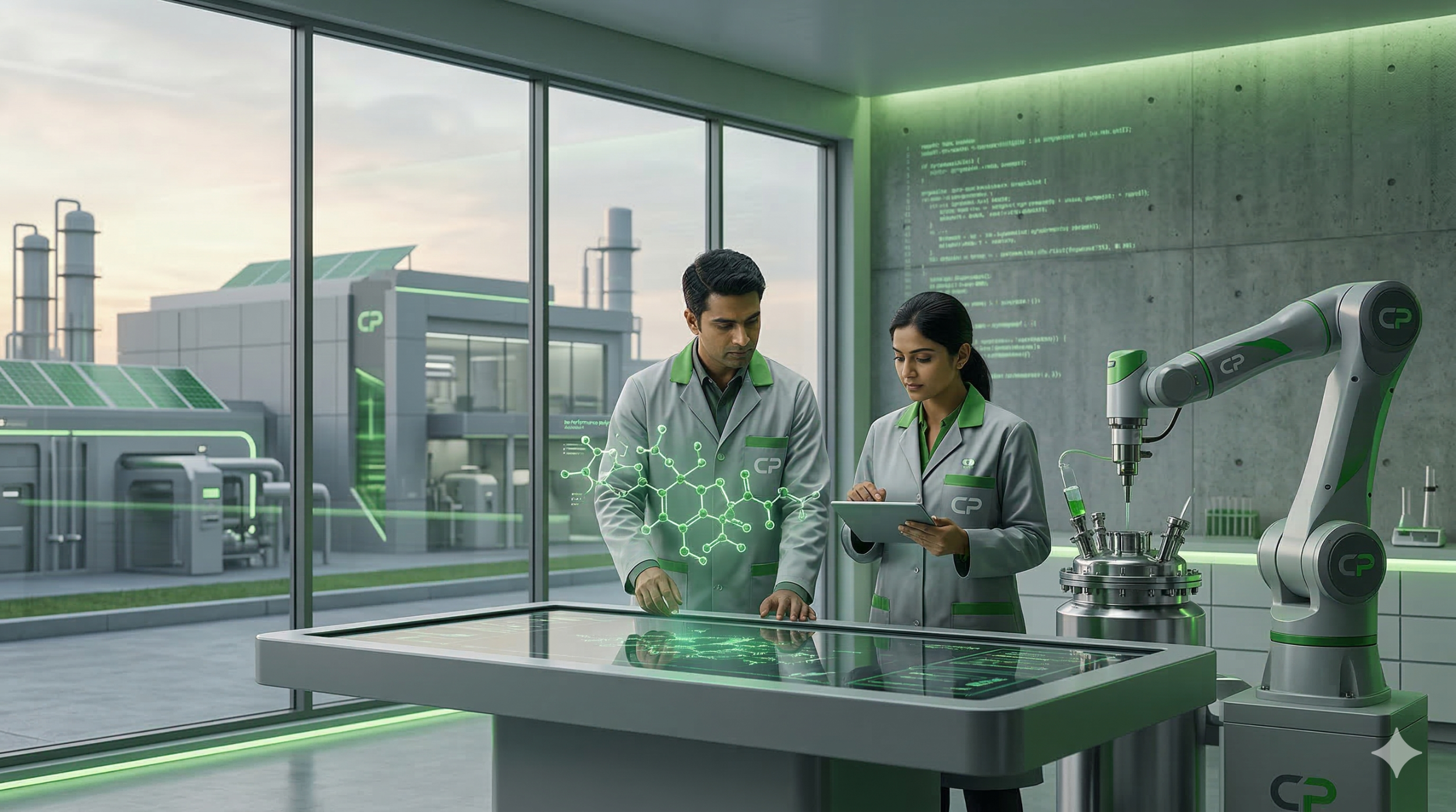
The Dawn of the Molecular Architect: India’s Strategic Pivot
The global chemical landscape is currently witnessing a historic migration of high-value manufacturing and intellectual property toward the Indian subcontinent. Traditionally viewed as a powerhouse for bulk generics and base intermediates, India is rapidly ascending the value chain into the sophisticated realm of Specialty Chemicals. This sector—defined by its low-volume, high-margin nature—demands a level of molecular precision that transcends the capabilities of conventional industrial processes.
For the thousands of Small and Medium Enterprises (SMEs) that form the backbone of this "boom," the challenge is no longer just about capacity; it is about Velocity. In the 2026 market, a lead time of three years for a new polymer or electronic chemical is a death sentence. To compete with global incumbents, Indian SMEs are bypassing traditional empirical methods and embracing the role of the "Molecular Architect." This shift is powered by a sophisticated synthesis of human expertise and AI-native Product Lifecycle Management (PLM).
The Empirical Bottleneck: Why the "Old Guard" is Slowing Down
Historically, the chemical laboratory was a place of high-stakes "educated guessing." A senior chemist would rely on thirty years of intuition to decide which catalyst might yield a higher purity or which solvent might stabilize a volatile intermediate. This "one-factor-at-a-time" (OFAT) approach is inherently limited. Chemistry is a non-linear science; changing the temperature of a reaction by 5 degrees doesn't just change the speed—it can fundamentally alter the molecular byproduct profile.
For an SME, this traditional cycle is grueling. It involves:
Literature Review: Manually scouring thousands of journals.
Synthesis: Physical trials that generate significant chemical waste.
Characterization: Waiting weeks for spectroscopy or chromatography results.
Failure: Realizing the formulation lacks thermal stability at the final stage.
In the context of India's current economic push, this "fail-late" model is a massive drain on capital. The "Silicon Catalyst"—AI—is designed to move the failure point from the physical lab to the digital workspace, where it costs nothing but a few seconds of compute time.
Physics-Informed Neural Networks: The Brains Behind the Boom
The breakthrough that is currently accelerating Indian R&D is the adoption of Physics-Informed Neural Networks (PINNs). Unlike standard AI used in retail or finance, which purely looks for patterns in data, PINNs are "chemically aware." They are programmed with the fundamental laws of thermodynamics, kinetics, and quantum mechanics.
When an Indian scientist at a specialty chemical firm in Vapi or Dahej uses a PINN-based platform like ChemCopilot, the AI doesn't just suggest a random molecule. It suggests structures that are synthesized within the constraints of real-world physics. It understands Steric Hindrance (the physical crowding of atoms) and Electronic Effects, ensuring that the "virtual" molecule can actually be built in a physical reactor. This level of predictive accuracy is what allows an SME to leapfrog the competition.
Collapsing the "Valley of Death": Scaling from Grams to Metric Tons
In specialty chemicals, the most dangerous phase of R&D is the "Scale-Up." A reaction that works perfectly in a 100ml round-bottom flask often fails catastrophically in a 5,000-liter stainless steel reactor. Heat dissipation issues, uneven mixing, and pressure gradients can lead to "runaway reactions" or degraded product quality.
AI-native PLM solves this by creating Digital Twins of the manufacturing plant. By simulating the exact geometry of the SME's equipment, the AI can predict how a new formulation will behave under industrial shear forces. This "Virtual Scale-Up" allows Indian companies to guarantee product consistency to international clients—a critical factor in securing long-term export contracts with European and American electronics and aerospace firms.
The Green Mandate: ESG as a Competitive Advantage
By 2026, sustainability is no longer a "nice-to-have." Global supply chains are now governed by strict ESG (Environmental, Social, and Governance) scores. Indian SMEs are facing increasing pressure to reduce their carbon footprint and eliminate hazardous waste.
AI-driven R&D enables "Green Chemistry by Design." Instead of trying to "clean up" a dirty process after it’s built, AI identifies bio-based solvents and low-energy catalysts at the very beginning of the design phase. ChemCopilot integrates with global regulatory databases to flag restricted substances (like certain PFAS or phthalates) before the first order of raw materials is even placed. This ensures that the product is "Future-Proofed" against upcoming international bans.
ChemCopilot: The Strategic Partner for the Indian SME
The primary barrier for most Indian SMEs is the fragmentation of their "Institutional Memory." Every time a senior researcher retires, decades of nuanced chemical knowledge leave the building. This is the "Dark Data" problem.
ChemCopilot solves this by acting as the centralized "Neural Core" of the company.
Knowledge Consolidation:We turn decades of lab notebooks and PDF reports into an active, searchable, and predictive database.
Cost Optimization:By reducing the number of physical trials by up to 80%, we allow SMEs to reallocate their capital toward high-end analytical equipment or market expansion.
Intellectual Property Protection: In a world where IP is the ultimate currency, our secure, enterprise-grade platform ensures that your molecular breakthroughs remain yours, protected by advanced encryption while allowing for global team collaboration.
A Global Vision for 2026 and Beyond
The specialty chemical boom in India is not just a domestic story; it is a global one. As the world seeks to diversify its supply chains away from single-source dependencies, India stands as the most viable alternative for complex molecular synthesis. From Agrochemicals that require precise bio-activity to Performance Polymers for EVs, the opportunities are boundless.
However, the "Indian Advantage" of low labor costs is eroding. The new advantage must be Digital Sophidelity. The companies that will dominate the 2030s are those that adopt AI-native workflows today. ChemCopilot is dedicated to ensuring that the Indian scientist is the most well-equipped, efficient, and innovative professional in the global chemical arena.
The Path Forward: From Lab Bench to Global Leadership
The acceleration of R&D cycles is more than a technical achievement; it is an economic catalyst. When an SME can bring a new specialty chemical to market in six months instead of eighteen, their internal rate of return (IRR) triples. This allows for rapid reinvestment, creating a virtuous cycle of innovation that can elevate an entire industrial cluster.
As we look at the successful implementation of these technologies in hubs across India, the message is clear: The future of chemistry is encoded in the cloud, simulated in the digital twin, and perfected in the mind of the AI-augmented chemist. ChemCopilot is here to ensure that every Indian SME has the tools to lead this molecular revolution.