AI in Chemical Education: Simulation-Driven Learning Transforming Universities Worldwide
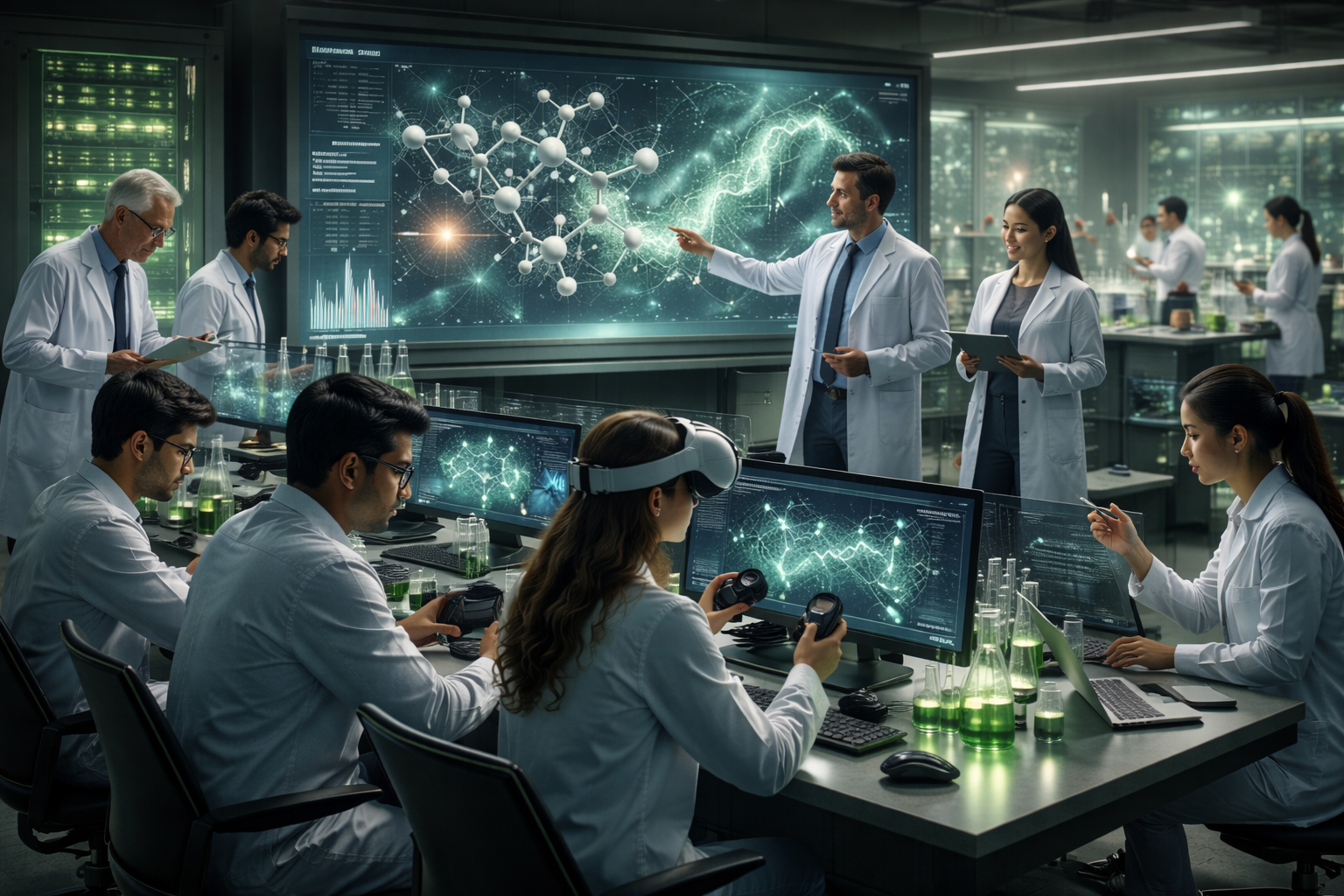
Chemical education is undergoing its most profound structural shift since the standardization of laboratory pedagogy in the twentieth century. Across universities in Asia, Europe, North America, and emerging scientific economies, artificial intelligence and simulation frameworks are redefining how chemistry is taught, practiced, and internalized. The traditional model—lecture-heavy, equation-dense, and experimentally constrained by physical infrastructure—no longer aligns with the pace and complexity of modern chemical research.
Today’s industrial and academic laboratories rely on computational modeling, real-time data analytics, machine learning-assisted reaction design, and digital twins of experimental systems. Yet many university curricula still emphasize static theoretical problem sets detached from dynamic experimentation. The result is a widening competence gap between graduates and contemporary research environments.
AI-driven simulation platforms are closing this gap by transforming chemistry education from memorization-based instruction to immersive, predictive, and systems-oriented learning.
Simulation-Driven Chemistry: From Passive Theory to Active Molecular Systems Thinking
Simulation-driven learning replaces passive absorption with interactive experimentation at scale. Students can now model reaction kinetics, explore conformational energy landscapes, and simulate electrochemical interfaces before entering physical laboratories. Molecular dynamics engines allow visualization of diffusion processes. Quantum chemical approximations demonstrate orbital interactions beyond textbook diagrams.
This shift accomplishes three pedagogical objectives:
Mechanistic Intuition Development – Students observe energy transitions rather than merely calculating them.
Risk-Free Experimentation – Hazardous or resource-intensive reactions can be explored virtually.
Systems-Level Reasoning – Multivariable optimization becomes intuitive rather than abstract.
AI enhances simulation environments by adapting difficulty levels, identifying conceptual gaps, and generating scenario-based experimental variations. Instead of grading only final numerical answers, AI systems evaluate reasoning pathways, offering corrective insights grounded in thermodynamics and kinetics.
The result is not diminished rigor. It is amplified comprehension.
Data Literacy as the New Core Competency in Chemical Training
Modern chemical research generates expansive datasets from spectroscopy, chromatography, high-throughput screening, and computational modeling. Universities that fail to embed data literacy into curricula risk producing graduates unable to interpret their own experimental outputs.
Simulation-driven education integrates:
Spectral deconvolution exercises
Reaction parameter optimization modeling
Statistical thermodynamics datasets
Multivariate analysis for materials characterization
Students learn not only to run experiments but to interrogate uncertainty, detect anomalies, and validate reproducibility. The classroom becomes a microcosm of real research ecosystems.
Importantly, this transition aligns education with industry expectations. Pharmaceutical research, advanced materials development, battery innovation, and climate-responsive chemistry all depend on integrated digital-physical workflows.
Global Momentum: Universities Restructuring Chemical Pedagogy
The transformation is not geographically isolated. Research-intensive institutions worldwide are investing in hybrid laboratories combining wet chemistry benches with high-performance computing clusters. Virtual reality modules replicate industrial reactors. AI tutors assist in organic synthesis pathway planning. Digital twins simulate scale-up processes for materials engineering.
Universities in rapidly expanding research ecosystems are particularly motivated. Large student populations combined with limited laboratory infrastructure create pressure for scalable, cost-effective training systems. Simulation platforms provide equitable access to advanced experimentation without proportionate infrastructure expansion.
Moreover, interdisciplinary education—bridging chemistry with physics, computational science, and molecular biology—requires integrated digital tools. AI-enabled platforms dissolve disciplinary silos, enabling collaborative learning environments reflective of contemporary research culture.
Structural Gaps in Current Chemical Education Models
Despite technological availability, several systemic challenges persist:
Educational Stage Traditional Limitation txtImpact on StudentsAI-Simulation SolutionUndergraduate TheoryEquation memorizationLimited mechanistic insightInteractive molecular modelingLaboratory TrainingRestricted experiment varietySurface-level understandingVirtual reaction scenario expansionData InterpretationManual spreadsheet analysisStatistical inaccuracyAI-assisted anomaly detectionResearch ProjectsTrial-based experimentationSlow iteration cyclesPredictive optimization frameworks
The common thread is fragmentation—between theory and practice, between experimentation and analysis, between student learning and industrial relevance.
ChemCopilot: Enabling Intelligent Chemical Learning Ecosystems
ChemCopilot extends beyond research laboratories into educational architecture by functioning as a structured scientific reasoning companion. Unlike generic AI tutors, ChemCopilot embeds domain-aware chemical logic, ensuring that simulation outputs align with physical plausibility and mechanistic coherence.
Within academic environments, ChemCopilot can:
Translate theoretical lectures into interactive mechanistic simulations
Assist students in mapping reaction pathways stepwise
Correlate spectral signatures with structural hypotheses
Provide structured feedback on laboratory reports grounded in chemical reasoning
Integrate computational predictions with experimental reflections
For universities transitioning toward simulation-driven models, ChemCopilot becomes a bridging intelligence layer—connecting coursework, laboratory exercises, and research modules into a continuous knowledge system.
It does not replace educators. It augments instructional precision. Faculty members retain conceptual authority while leveraging AI to scale mentorship across larger cohorts.
Ethical and Pedagogical Considerations in AI-Driven Education
The integration of AI in chemical training raises critical questions: Does automation dilute conceptual rigor? Does simulation undermine hands-on laboratory intuition?
Evidence suggests the opposite when systems are carefully implemented. Simulation supplements physical experimentation rather than substituting it. Students enter laboratories with pre-formed mechanistic hypotheses, reducing procedural error and enhancing safety compliance.
Furthermore, structured AI systems prevent misinformation by embedding scientifically validated constraints. Educational AI must be designed not as a shortcut generator, but as a reasoning amplifier.
ChemCopilot’s architecture emphasizes interpretability and traceable logic—ensuring that each computational suggestion can be linked back to chemical principles.
Toward a Predictive Educational Paradigm in Chemistry
The future chemist must be fluent in both stoichiometric equations and computational modeling environments. They must navigate spectroscopy datasets as confidently as laboratory glassware. Simulation-driven education prepares students for predictive science rather than reactive troubleshooting.
As global research increasingly integrates AI-assisted discovery, universities must align pedagogy with practice. Institutions that adopt structured, process-aware educational technologies will produce graduates capable of immediate integration into advanced research ecosystems.
ChemCopilot supports this transition by institutionalizing chemical reasoning within digital learning frameworks. It converts isolated classroom experiences into cumulative scientific intelligence.
Chemical education is no longer about transferring information. It is about cultivating predictive, interdisciplinary thinkers capable of navigating complex molecular systems.
The transformation has begun. The institutions that embrace it will define the next generation of scientific leadership.