Bio-Inspired Chemistry: Can AI Help Indian Scientists Replicate Nature’s Catalysts and Enzymes?
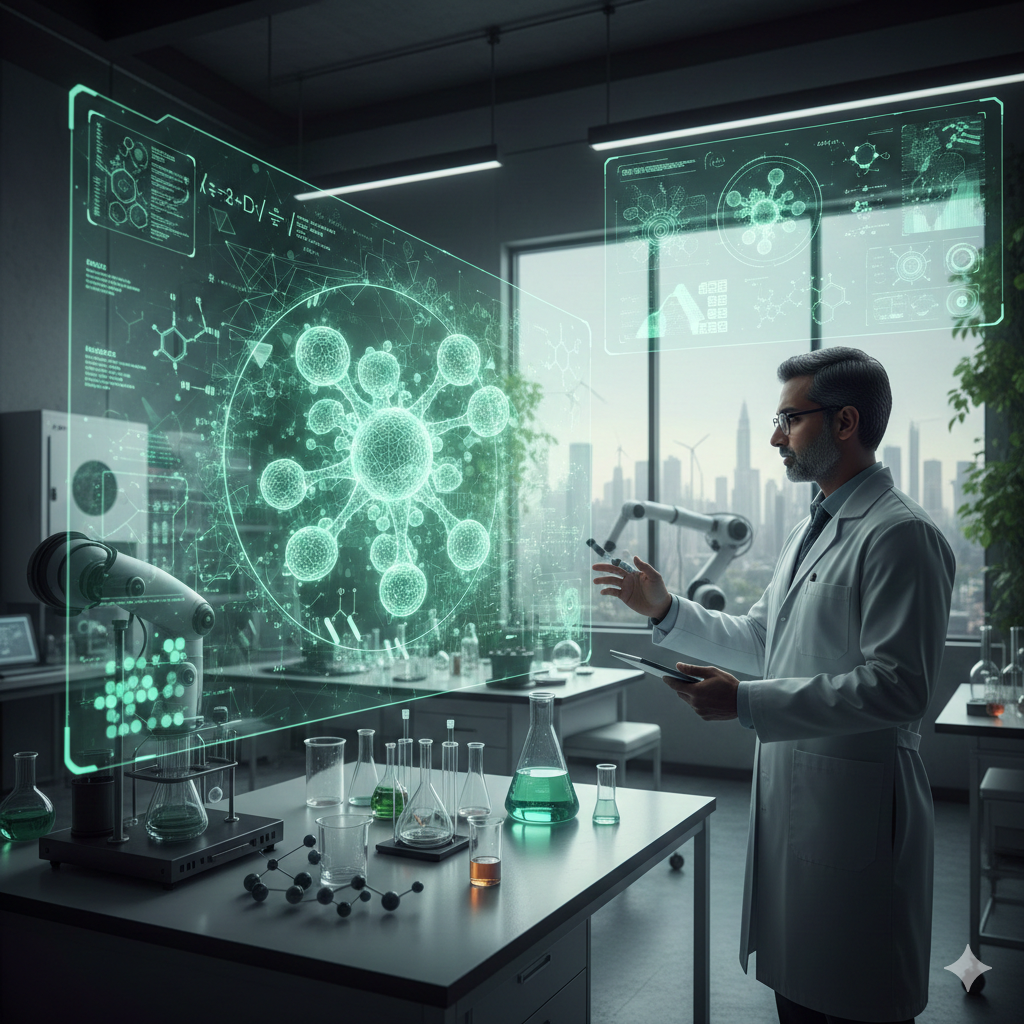
The Biomimetic Frontier: AI-Driven Catalyst Design for a Sustainable Future
The intricate dance of life, from the smallest bacterium to the largest whale, is orchestrated by a symphony of molecular machinery. At the heart of this machinery lie enzymes and catalysts, nature's master architects of chemical transformation. These biological marvels operate with unparalleled efficiency, selectivity, and sustainability, often under mild conditions that synthetic chemists can only dream of. The challenge for modern chemistry is not merely to mimic these natural processes but to understand their underlying principles deeply enough to design superior, bespoke catalysts. This pursuit, known as bio-inspired chemistry, is now being supercharged by the advent of artificial intelligence, promising to revolutionize how we approach chemical synthesis, particularly within the dynamic research landscape of India.
The inherent limitations of traditional catalyst discovery are stark. It's often a painstaking, trial-and-error process, involving extensive synthesis, characterization, and screening. This empiricism, while yielding numerous breakthroughs, is inherently inefficient and resource-intensive. Nature, however, has had billions of years to perfect its catalytic repertoire through evolution, a process driven by subtle structural modifications leading to dramatic functional enhancements. This evolutionary paradigm offers a blueprint for accelerating catalyst design, a blueprint that AI is uniquely positioned to interpret and implement.
Decoding Nature's Catalytic Secrets with AI
The complexity of enzymatic active sites, with their precisely positioned functional groups, metal centers, and dynamic conformational changes, presents a formidable challenge for synthetic replication. AI, particularly machine learning (ML) and deep learning (DL) algorithms, offers a powerful lens through which to analyze this complexity. By sifting through vast datasets of protein structures, reaction mechanisms, and kinetic parameters, AI can identify subtle patterns and correlations that are invisible to the human eye.
One of the most promising avenues is the use of AI for "forward prediction" – predicting the catalytic activity of a novel structure – and "inverse design" – designing a structure to achieve a desired catalytic outcome.
Neural networks, trained on existing enzyme data, can learn the intricate relationships between a catalyst's structure (e.g., amino acid sequence, three-dimensional fold, metal coordination environment) and its function (e.g., substrate specificity, reaction rate, enantioselectivity). This capability allows researchers to computationally screen thousands, even millions, of hypothetical catalyst structures, drastically reducing the experimental burden.
Furthermore, AI can assist in deciphering reaction mechanisms at an unprecedented level of detail. Quantum chemistry calculations, though powerful, are computationally expensive. AI can accelerate these calculations or even approximate them, allowing for rapid exploration of potential reaction pathways and transition states. This synergy between AI and computational chemistry provides a holistic approach to understanding and then mimicking the exquisite control exerted by natural catalysts.
India's AI-Powered Catalyst Research: A Global Hub
India, with its burgeoning scientific talent and increasing investment in research infrastructure, is uniquely positioned to become a global leader in AI-driven bio-inspired catalysis. Universities and research institutions across the country are actively engaging with computational chemistry and AI, fostering a new generation of interdisciplinary scientists. The focus often lies on addressing critical challenges relevant to the Indian context and global sustainability, such as:
Sustainable Chemical Production: Developing efficient catalysts for biomass conversion into valuable chemicals and fuels, reducing reliance on fossil resources.
Pharmaceutical Synthesis: Designing highly selective catalysts for the synthesis of complex drug molecules, minimizing byproducts and improving therapeutic efficacy.
Environmental Remediation: Creating robust catalysts for the degradation of pollutants in water and air, addressing pressing environmental concerns.
Nitrogen Fixation: Exploring novel catalysts to emulate the nitrogenase enzyme, offering a sustainable alternative to the energy-intensive Haber-Bosch process for ammonia production.
ChemCopilot, as a dedicated AI-powered platform, can serve as a pivotal tool in accelerating these research endeavors. Imagine a researcher in Bangalore designing a novel metallic complex for CO2 reduction. ChemCopilot could instantly access a vast database of known catalysts, predict the activity of their proposed design, suggest modifications to enhance performance, and even simulate the reaction mechanism – all within an intuitive interface. This capability empowers scientists to move from hypothesis to validated design with unprecedented speed and precision.
The ChemCopilot Advantage in Bio-Inspired Catalysis
ChemCopilot is designed to integrate seamlessly into the research workflow of bio-inspired chemists, offering a suite of AI-driven functionalities that address the core challenges of catalyst discovery and optimization:
Structure-Function Correlation: Leverage advanced ML algorithms to establish robust correlations between the structural features of natural and synthetic catalysts and their performance metrics. This allows for predictive modeling and rational design.
High-Throughput Virtual Screening: Rapidly screen millions of hypothetical catalyst structures, identifying promising candidates based on predicted activity, selectivity, and stability, thereby drastically reducing experimental costs and time.
Automated Reaction Pathway Elucidation: Utilize AI to explore potential reaction mechanisms, identify transition states, and predict kinetic parameters, providing deep insights into catalytic processes.
Synthetic Route Optimization: Suggest optimal synthetic pathways for novel catalyst designs, considering precursor availability, reaction conditions, and scalability.
Data-Driven Hypothesis Generation: Proactively generate novel hypotheses for catalyst design based on an analysis of existing literature and experimental data, pushing the boundaries of scientific discovery.
Consider a scenario where an Indian research team aims to develop a new catalyst for water splitting, inspired by the oxygen-evolving complex in photosynthesis. Traditionally, this would involve extensive experimentation with various metal complexes and ligands. With ChemCopilot, the team could input desired parameters – such as turnover frequency, overpotential, and stability – and the AI would propose novel ligand architectures and metal coordination environments predicted to meet these criteria. It could then model the electron transfer pathways and suggest optimal conditions for electrochemical testing, transforming months of lab work into a few focused experiments.
Bridging the Gap: From Nature's Blueprint to Industrial Application
The ultimate goal of bio-inspired chemistry is not just academic understanding but the translation of these natural principles into tangible, industrially relevant technologies. AI is crucial in bridging this gap. By assisting in the design of robust, scalable, and cost-effective catalysts, AI can accelerate the journey from laboratory discovery to commercial application.
For instance, the development of biocatalysts for chiral drug synthesis is an area where nature excels. Enzymes often produce single enantiomers with near-perfect selectivity, a feat that is exceedingly difficult and expensive for synthetic chemists. AI can help engineer enzymes (or design synthetic mimics) with enhanced stability, broader substrate scope, and improved turnover numbers, making them viable for industrial-scale production. This has significant implications for the pharmaceutical industry, particularly in India, a major global hub for drug manufacturing.
The synergy between human creativity and AI's analytical power will unlock unprecedented opportunities in bio-inspired catalysis. It will enable Indian scientists, and indeed the global scientific community, to move beyond merely imitating nature to truly innovating based on nature's profound wisdom. The future of sustainable chemistry will undoubtedly be written with algorithms as much as with beakers and flasks.
The Promise of a Greener Future
The vision of a future powered by clean energy, sustainable manufacturing, and pristine environments hinges significantly on the development of advanced catalysts. Bio-inspired chemistry, augmented by the transformative capabilities of AI, offers a powerful pathway to realize this vision. By accelerating the discovery of novel materials and processes that mimic the efficiency and sustainability of biological systems, we can address some of humanity's most pressing challenges.
ChemCopilot is not just a tool; it is a partner in this grand scientific endeavor, empowering researchers to build a greener, more sustainable future, one precisely designed catalyst at a time.