Author: Paulo | Chief Marketing Officer, ChemCopilot
Category: Regulatory Automation & Chemical Compliance | AI Engine Architecture
Last Updated: September 2026
About the Author: Paulo is the Chief Marketing Officer at ChemCopilot, specializing in B2B SaaS growth, regulatory tech (RegTech) integration, and AI-as-a-Service (AIaaS) strategies for enterprise chemical, materials, and industrial supply chain sectors.
In global chemical manufacturing and distribution, creating, updating, and translating Safety Data Sheets (SDS) represents one of the most labor-intensive regulatory bottlenecks. Every chemical mixture placed on the market requires a 16-section SDS fully compliant with the Globally Harmonized System of Classification and Labelling of Chemicals (GHS), as well as region-specific variations such as EU REACH/CLP, US OSHA HAZCOM 2024, and Brazil's ABNT NBR 14725.
Traditionally, chemical enterprises rely on outsourced regulatory consultants or rigid, rule-based desktop software. Authoring a single complex multi-component SDS can take up to two weeks and cost upwards of $1,000 per SKU—a timeline that paralyzes new product introduction (NPI) and market expansion.
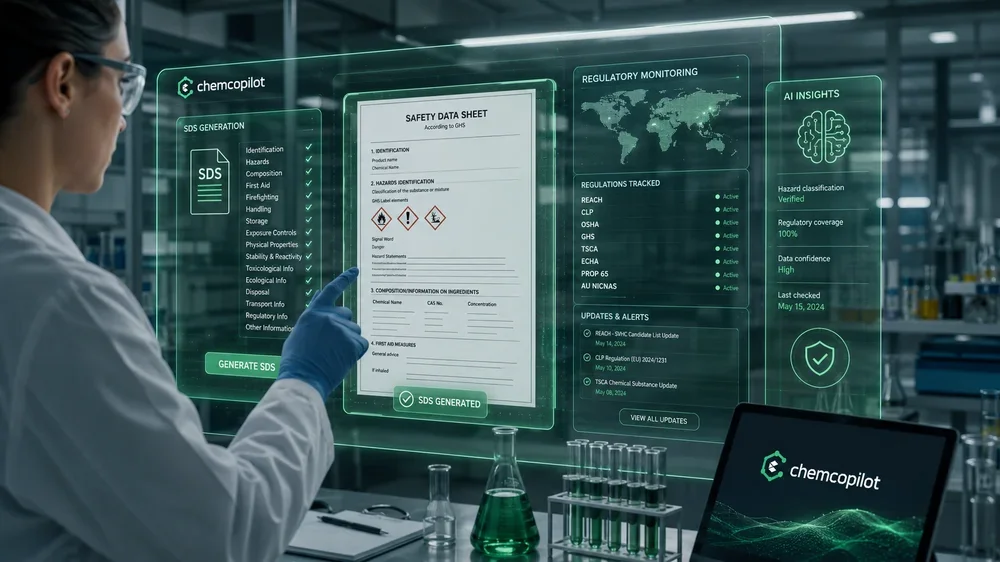
In 2026, artificial intelligence is transforming regulatory compliance. By combining Quantitative Structure-Activity Relationship (QSAR) ML models, live regulatory API synchronization, and Natural Language Generation (NLG), AI-powered SDS generation allows chemical teams to author, validate, and translate audit-ready SDS documents in seconds.
Manual & Rule-Based Silos
Slow, Expensive & Error-Prone2-week turnaround per SKU. Regulatory teams manually calculate mixture toxicity cutoffs and transcribe H/P phrases across local spreadsheets, risking supply chain holds and non-compliance fines.
Automated AI Hazard Classification
Sub-Second Multi-Jurisdiction SyncInstantly ingests CAS numbers, SMILES, and formulation ratios. Calculates GHS mixture cutoffs, assigns hazard pictograms, and auto-populates 16-section SDS formats across 40+ languages.
1. How AI Automates GHS Hazard Classification
Determining the exact hazard classification of a novel multi-component mixture requires evaluating complex toxicological and ecotoxicological thresholds. Standard linear rules fail when dealing with synergistic chemical interactions or missing raw material data sheets.
AI-driven SDS engines overcome this via three structural mechanisms:
A. Non-Linear Mixture Toxicity Calculations
GHS classification relies on calculating Acute Toxicity Estimates ($\text{ATE}_{\text{mix}}$) and applying concentration cutoffs for skin corrosion, eye damage, and aquatic toxicity:
$$\text{ATE}_{\text{mix}} = \frac{100}{\sum_{n} \frac{C_i}{\text{ATE}_i}}$$
Where $C_i$ represents the concentration of ingredient $i$, and $\text{ATE}_i$ is its acute toxicity point estimate (e.g., $LD_{50}$ oral/dermal or $LC_{50}$ inhalation). An AI engine calculates these non-linear concentration cutoffs instantaneously, mapping exact thresholds to assign correct Signal Words (DANGER / WARNING) and hazard pictograms.
B. QSAR Predictive Toxicology for Unmonitored Precursors
When an R&D team introduces a novel compound without historical $LD_{50}$ or $EC_{50}$ empirical test data, standard software breaks down. AI-powered SDS platforms utilize Quantitative Structure-Activity Relationship (QSAR) machine learning models to infer toxicological endpoints directly from 2D/3D molecular graph structures, flagging potential carcinogenic, mutagenic, or reprotoxic (CMR) hazards before physical testing.
C. Automated H-Phrase & P-Phrase Mapping
Based on classified hazard categories, the AI engine dynamically selects and pairs mandatory Hazard Statements (H-phrases) and Precautionary Statements (P-phrases) without human transcription errors, eliminating contradictory statement pairings across regional regulation sets.
2. The 4-Step AI SDS Authoring Pipeline
Formula Ingest
Ingest BOM ratios, CAS numbers, SMILES, and vendor raw material PDFs from PLM/LIMS.
Live Regulatory Check
Cross-reference ingredients against ECHA REACH, EPA TSCA, and regional SVHC registries.
GHS Classification
Execute non-linear toxicity calculations, assign pictograms, H/P phrases, and signal words.
16-Section Export
Generate localized, multi-lingual SDS PDFs and XML feeds ready for global distribution.
3. Technical Comparison: SDS Authoring Methodologies
4. Multi-Jurisdictional Translation & Continuous Compliance
A major barrier in global chemical sales is that a US OSHA HAZCOM SDS cannot be legally used in the European Union without adapting to EU REACH/CLP formatting and localized language requirements.
An AI SDS engine solves this via Phrase Library Standardization:
Official Phrase Mapping: Rather than relying on raw machine translation (which often misinterprets legal nuance), the AI uses standardized, regulatory-approved GHS phrase libraries across 40+ languages (e.g., EU Annex II compliant translations).
Dynamic Section Adaptations: Section 8 (Exposure Controls/Personal Protection) automatically adjusts Occupation Exposure Limits (OELs) based on the target destination country (e.g., WEL for the UK, AGW for Germany, OSHA PEL for the US).
Automated Re-Authoring Triggers: When ECHA updates an SVHC registry or a raw material supplier changes an ingredient ratio in PLM, the system automatically flags affected products and re-generates updated SDS revisions instantly.
Executive Insight: Scaling Regulatory Intelligence
"Compliance should never be a brake on commercial innovation. By automating GHS hazard calculations and multi-jurisdictional SDS generation at the API level, chemical companies transform regulatory management from a slow cost center into an agile competitive advantage."
— Paulo, Chief Marketing Officer at ChemCopilot
Summary: Modernizing Chemical Compliance
Adopting AI-powered SDS generation eliminates multi-week product release delays, protects against supply chain non-compliance fines, and empowers regulatory teams to manage thousands of SKUs effortlessly.
🚀 Automate Your Global SDS & GHS Workflows with ChemCopilot
Ready to replace manual SDS authoring with instant, AI-powered GHS hazard classification and live REACH/TSCA synchronization? Connect with Paulo and our regulatory solutions engineering team to evaluate ChemCopilot on your product catalog under strict IP protection.
- Instant 16-Section Generation: Author audit-ready SDS PDFs and XML feeds in under 10 seconds per SKU.
- Enterprise IP Security: Single-tenant data isolation, SOC 2 compliance, and strict zero-retention API guarantees.
- Seamless PLM/ERP/LIMS Sync: Connect directly to master formula BOMs, SAP ERP, and live ECHA databases.
Schedule a Private Enterprise Demo & Compliance Audit → | Start Your 14-Day Free Commercial Lab Trial →