Machine Learning in Chemical R&D: The Complete Guide for Research Leaders
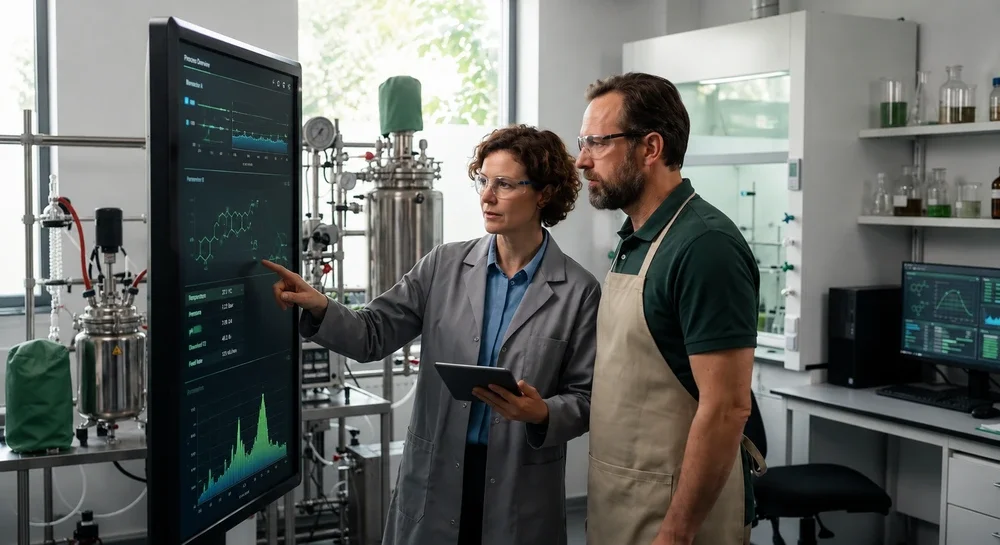
The industrial chemical sector stands at a pivotal structural inflection point. For over a century, breakthrough discoveries—whether in high-performance polymers, specialty coatings, structural adhesives, or battery electrolytes—have relied on physical trial-and-error experimentation. Formulation chemists mixed raw precursor ingredients, varied temperature profiles, cured samples, and tested physical performance metrics in linear sequence.
However, as product complexity scales, multi-component design spaces become astronomically vast. A formulation containing just six raw materials, each varied across five concentration levels and processed at three distinct temperatures, yields tens of thousands of unique physical permutations. Synthesizing even a tiny fraction of these combinations at the physical bench requires months of effort, consumes high-cost raw materials, and generates significant hazardous chemical waste.
As we navigate 2026, forward-thinking chemical enterprises are replacing linear trial-and-error with Machine Learning (ML)-driven active learning loops. By unifying structured laboratory data, molecular featurization, and active predictive algorithms, research teams can screen thousands of virtual candidate formulations in seconds—selecting only the most informative, high-performing experiments for bench validation.
This comprehensive pillar guide provides R&D directors, chief technology officers, and principal scientists with a complete strategic and technical blueprint for successfully deploying Machine Learning in chemical research and development.
- 1. The Structural Shift: Moving to the Fifth Paradigm of Science
- 2. The Technical Challenge: Modeling Sparse, Tabular Chemical Data
- 3. Building the R&D Data Flywheel & Structuring Laboratory Data
- 4. Democratizing AI: The Rise of No-Code ML for Physical Chemists
- 5. Practical Applications: Formulations, Virtual Sweeps & Route Design
- 6. Measuring R&D Velocity & ROI: The KPIs That Matter
- 7. Enterprise Implementation Roadmap for Research Leaders
Linear Bench Experimentation
Edisonian Trial & ErrorFormulators test recipes one by one. Over 85% of physical runs fail to meet target specifications, while historical data remains trapped in isolated lab books and static spreadsheets.
The R&D Data Flywheel
In-Silico Virtual ScreeningMachine learning models screen 10,000 virtual candidates in seconds. Active learning algorithms direct chemists to synthesize only the top Pareto-optimal candidates at the bench.
1. The Structural Shift: Moving to the Fifth Paradigm of Science
Scientific discovery is traditionally classified across distinct historical eras: empirical observation (the first paradigm), theoretical physical laws (the second paradigm), computational simulations (the third paradigm), and big data analytics (the fourth paradigm).
Today, industrial chemistry is entering the Fifth Paradigm: Autonomous Data Flywheels and Active Machine Learning. In this paradigm, physical experimentation and computational intelligence operate in a continuous, closed-loop feedback cycle:
- Data Capture: Physical lab trials are recorded into structured digital formats capturing ingredients, process parameters, categories, and multi-variable property outputs.
- Surrogate Modeling: Machine learning algorithms fit surrogate response surfaces over the experimental design space, mapping non-linear interactions across inputs and performance targets.
- In-Silico Screening: The model generates and evaluates thousands of virtual formulation recipes across target properties, material costs, and regulatory boundaries.
- Active Recommendation: Acquisition functions identify the single most informative physical trial to validate at the bench, updating the central intelligence engine instantly upon completion.
Organizations that successfully establish this closed loop systematically compound institutional knowledge, reducing discovery cycle times by over 70% while drastically cutting precursor material consumption.
2. The Technical Challenge: Modeling Sparse, Tabular Chemical Data
A frequent misconception among technology executives is that consumer-grade AI models (such as Large Language Models used in text generation) can be directly applied to chemical R&D. In practice, industrial chemical modeling presents unique technical challenges that require specialized machine learning architectures:
A. Small, High-Dimensional Datasets
Unlike web-scale image or text datasets containing billions of samples, chemical development project datasets are inherently sparse. A typical industrial formulation campaign might contain only 20 to 50 physical trial rows, but each row may encompass dozens of ingredient weight fractions, cure profiles, processing shear rates, and physical test outputs. Standard deep neural networks overfit severely when trained on such sparse data.
B. Non-Linear Multi-Component Interactions
Chemical formulations behave non-linearly. A minor variation in a cross-linking agent concentration or catalyst ratio can produce dramatic step-function changes in physical properties like Glass Transition Temperature ($T_g$), lap shear strength, or tensile elongation. Machine learning models must capture these sharp non-linear boundaries accurately without hallucinating physically impossible behaviors.
C. Mathematical Surrogate Modeling & Acquisition Functions
Modern chemical ML platforms resolve these challenges by deploying Tabular Foundation Models (like TabPFN) alongside advanced Gaussian Process Regression (GPR) and tree-based ensembles (XGBoost/LightGBM). The system models a target property response surface $\mu(X)$ while continuously tracking prediction uncertainty $\sigma(X)$.
To determine the next optimal experiment, the active learning engine evaluates an **Acquisition Function** (such as Upper Confidence Bound or Expected Improvement) across the virtual candidate space:
Here, $\mu(X_v)$ drives **exploitation** (targeting candidate mixtures predicted to perform well), $\sigma(X_v)$ drives **exploration** (targeting candidate regions where model uncertainty is highest), and $\beta$ balances the trade-off. This mathematical balance prevents formulators from wasting time synthesizing minor variations of known recipes.
3. Building the R&D Data Flywheel & Structuring Laboratory Data
The single greatest barrier to machine learning adoption in chemical enterprises is not algorithmic complexity—it is **unstructured data fragmentation**. In most laboratories, years of historical research remain locked inside isolated paper lab books, unstructured supplier PDFs, and inconsistent desktop spreadsheets.
To build an active machine learning ecosystem, research managers must establish standardized data ingestion frameworks. Every experiment must be captured in a machine-readable schema comprising four fundamental columns:
- 1. Inputs (Formulation Ratios): Continuous numerical variables representing exact raw material weight fractions, concentrations, or mole ratios.
- 2. Process Parameters: Operational variables such as reaction temperature, mixing shear rate, cure duration, and vacuum pressure.
- 3. Categories: Qualitative metadata including raw material vendor IDs, precursor lot numbers, chemical CAS identifiers, and polymer grade classifications.
- 4. Outputs (Performance Targets): Measured physical, chemical, or economic results (e.g., viscosity, tensile strength, $T_g$, raw material cost per kg).
Deep-Dive Resource: Mastering Data Standardization
Implementing a clean data flywheel across wet-lab teams requires practical formatting guidelines. To download ready-to-use spreadsheet structures and learn how top chemical enterprises eliminate data fragmentation, explore our detailed companion guides:
4. Democratizing AI: The Rise of No-Code ML for Physical Chemists
Historically, applying machine learning to chemistry required establishing dedicated computational data science teams. Formulators submitted experimental data to computer scientists, waited weeks for data cleaning, and received static Python model outputs that physical chemists could not easily modify or interpret.
In 2026, the paradigm has shifted toward **empowering physical chemists directly**. Modern software layers allow bench scientists to act as AI orchestrators—training, evaluating, and deploying machine learning models through intuitive graphical and conversational interfaces without writing a single line of Python code.
By placing zero-code ML directly into the hands of domain experts, research organizations eliminate data science bottlenecks, increase laboratory software adoption to over 90%, and ensure that machine learning predictions remain grounded in physical chemical reality.
Deep-Dive Resource: The 2026 No-Code Revolution
Discover how tabular foundation models and zero-code interfaces transformed chemical research workflows in our dedicated strategic analysis:
No-Code Machine Learning for Chemists: What Changed in 2026 and Who's Leading R&D
5. Practical Applications: Formulations, Virtual Sweeps & Route Design
Machine learning delivers transformative capabilities across three primary chemical research domains:
A. Multi-Objective Formulation Optimization
In real-world formulation chemistry, scientists rarely optimize a single property. A high-performance adhesive must simultaneously maximize lap shear strength, maintain low viscosity for application sprayability, survive thermal cycling, and remain under a strict Bill of Materials (BOM) cost limit. Machine learning models map these multi-variable performance envelopes, revealing the **Pareto Front**—the mathematical boundary of optimal trade-offs where no property can be improved without sacrificing another.
B. In-Silico Virtual Ingredient Sweeping
Once a surrogate model is trained on baseline trial data, formulators can execute virtual sweeps. The software generates 10,000 virtual candidate recipes across continuous concentration gradients, evaluating physical performance and raw material costs virtually before a single beaker is heated.
C. Route Optimization & Sustainable Design
Beyond formulations, active learning models optimize synthetic reaction conditions—predicting optimal catalyst loadings, solvent mixtures, and residence times in continuous flow reactors to maximize API yields while minimizing Process Mass Intensity (PMI) and Scope 3 carbon footprints.
Data Ingestion
Standardize historical lab notes, vendor cost sheets, and trial logs into structured 4-column templates.
AutoML Training
Fit tabular foundation models automatically, featurizing SMILES structures and process conditions in seconds.
Virtual Screening
Simulate 10,000 virtual candidates, filtering by Pareto-optimal cost, performance, and regulatory boundaries.
Targeted Validation
Synthesize only the single most informative candidate at the bench, feeding fresh data back to update the model.
6. Measuring R&D Velocity & ROI: The KPIs That Matter
Deploying machine learning requires clear operational metrics to evaluate return on investment. Traditional R&D metrics (such as raw number of patents filed or total bench experiments completed) fail to capture the speed and quality improvements driven by active learning.
Leading chemical enterprises evaluate machine learning success across four core metrics:
- Experiment Efficiency Index (EEI): The ratio of successful physical trials meeting commercial specifications relative to total physical runs attempted. ML adoption typically increases EEI from < 15% to over 60%.
- Cycle Time Compression: The total calendar days required to progress a new formulation from project kickoff to commercial handoff.
- Hit-Rate Improvement: The precision with which in-silico predictions match physical laboratory characterization results.
- Knowledge Compounding Factor: The degree to which data from completed projects accelerates model accuracy on adjacent formulation projects.
Deep-Dive Resource: Measuring R&D Velocity
For an in-depth framework on setting executive KPIs and measuring digital transformation ROI in chemical research, read our dedicated operational guide:
Measuring R&D Velocity: The KPIs That Tell You If AI Is Working
| Capability Dimension | Traditional Edisonian R&D | Siloed Python Data Science | Unified ChemCopilot AI Layer |
|---|---|---|---|
| Experimental Screening Capacity | 10–50 physical trials / month | 100–500 computational runs | 10,000+ virtual candidates in seconds |
| Data Structure & Reusability | Trapped in paper notes & static files | Cleaned manually in isolated scripts | Centralized multi-dimensional relational database |
| Scientist Usability | High (Familiar wet-lab routines) | Low (< 15% bench team adoption) | High (> 90% direct no-code bench adoption) |
| R&D Cycle Time Reduction | Baseline (Months of iteration) | Moderate (Data science queues) | 70%+ overall compression in development time |
7. Enterprise Implementation Roadmap for Research Leaders
For research directors seeking to transition their laboratories toward ML-driven active learning, implementation should follow a structured, phased approach to manage technical adoption and organizational change:
- Phase 1: Pilot Data Standardization (Weeks 1–4): Select an active, high-priority formulation project. Audit historical trial logs and standardize data into structured 4-column templates capturing inputs, process parameters, categories, and outputs.
- Phase 2: Deploy No-Code Infrastructure (Weeks 5–8): Integrate a unified software layer—such as the ChemCopilot AI Lab Assistant—that connects molecular structures, raw material cost sheets, vendor categories, and live regulatory feeds.
- Phase 3: Active In-Silico Screening (Weeks 9–12): Train initial surrogate models on baseline trial data. Run virtual sweeps across 10,000 candidate recipes, identifying Pareto-optimal formulation targets.
- Phase 4: Full Bench Integration & Flywheel Scaling (Week 12+): Execute AI-guided physical validation runs at the bench. Feed characterization data back into the central intelligence engine, scaling the flywheel across adjacent research units.
Deploying Machine Learning in chemical R&D is no longer a distant theoretical vision—it is an active competitive imperative. By establishing structured data flywheels, empowering physical chemists with zero-code ML tools, and replacing linear trial-and-error with in-silico virtual screening, chemical enterprises can maximize laboratory yield, reduce raw material waste, and lead the future of sustainable material discovery.