How to Evaluate AI Vendors for Chemical R&D: A 12-Point Checklist
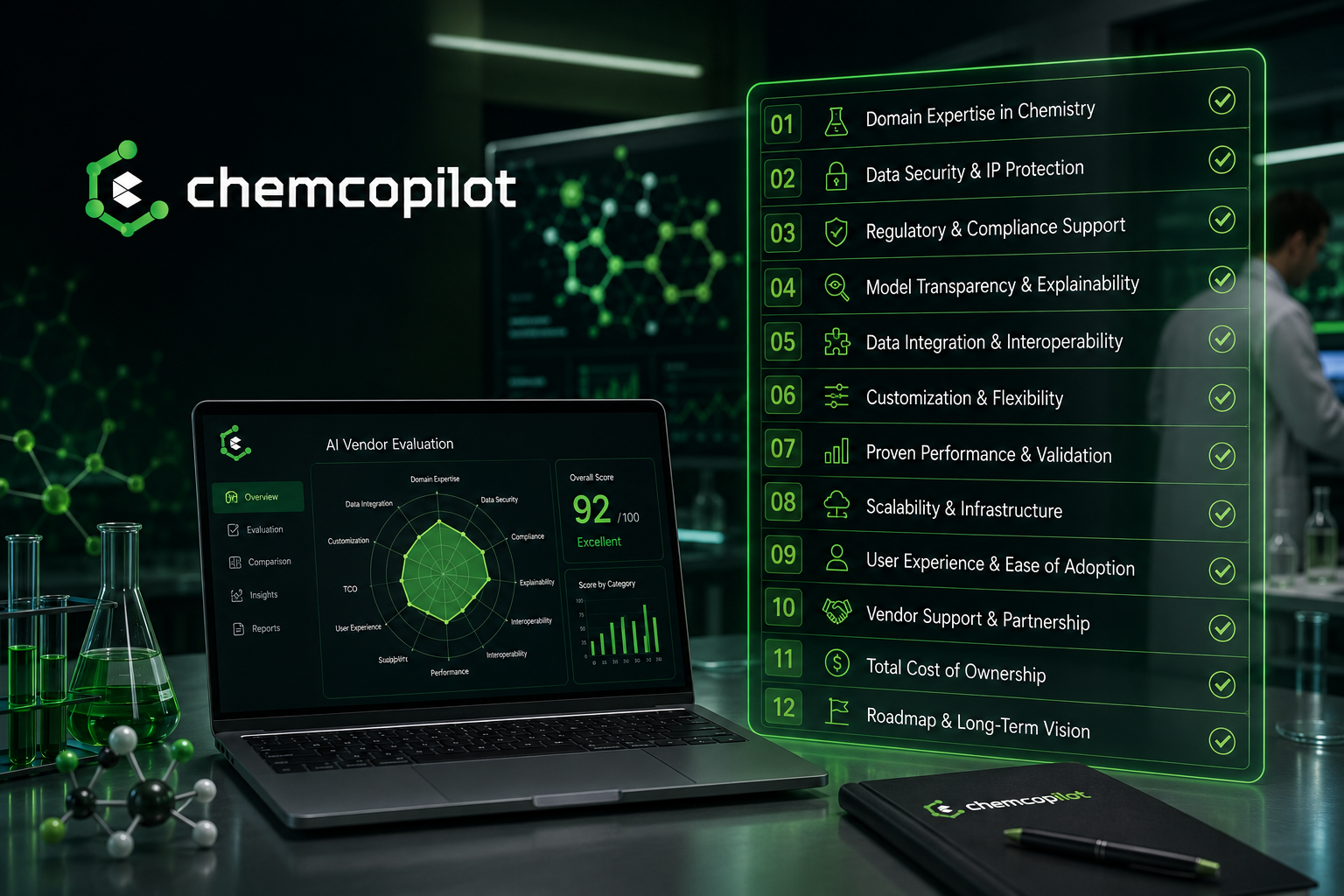
As corporate chemical and materials organizations look to accelerate their product development loops, the marketplace for laboratory software has become highly saturated. Driven by breakthroughs in generative chemistry, automated property prediction, and materials informatics, multi-million dollar software enterprise proposals frequently land on the desks of procurement departments and innovation leadership teams.
However, vetting digital architecture in this domain introduces complex challenges. General enterprise AI platforms—optimized for text processing or financial predictive analytics—frequently break down when exposed to the rigid physical constraints of the laboratory floor. As outlined in our comprehensive guide on the best AI tools for chemistry research and formulation, extracting clear operational value requires a system that bridges the gap between pure statistical algorithms and raw domain-specific physical chemistry constraints.
To protect your organization from multi-month implementation delays and expensive software shelf-ware, this comprehensive, 12-point procurement checklist provides a data-driven framework to evaluate machine learning and materials informatics vendors effectively.
Traditional Procurement: Generic Software Vetting
Feature-List Box Checking
Evaluates platforms based on generic software standards, relying on high-level UI demos while ignoring underlying data sparsity limitations or molecular graph integration constraints.
➔
2026 Procurement Framework: Domain-Grounded Auditing
Physics-Aware Validation Loops
Systematically tests vendors against multi-objective property constraints, local regulatory safety integration, and zero-code accessibility frameworks for bench scientists.
The 12-Point AI Vendor Evaluation Checklist
Pillar 1: Chemistry and Molecular Domain Awareness
Multi-Dimensional Graph Native Architecture: Does the platform process chemical entities strictly as flat textual string descriptors (like SMILES lookups), or does it map molecules natively as true mathematical graph topologies (atoms as nodes, bonds as edges)? String models frequently drop 3D structural, spatial, and stereochemical relationships during processing.
Physics and Stoichiometric Constraints: Are the underlying machine learning models bounded by fundamental physical chemistry laws (e.g., conservation of mass, thermodynamic equilibrium boundaries, and strict mass-balance limits), or do they output statistical predictions that violate chemical realities?
Simultaneous Multi-Objective Optimization: Can the software's active learning engines optimize for competing constraints concurrently? A viable tool must plan formulations that maximize performance thresholds (such as tensile strength or shear resistance) while minimizing raw material precursor costs and respecting processing viscosity constraints within a single run.
Pillar 2: Data Architecture and Learning Efficiency
Data Sparsity Competency: Traditional deep learning requires millions of data inputs. A viable chemistry framework must offer specialized algorithms (such as Gaussian Process regressions or tabular transformer presets like TabPFN) capable of generating highly accurate property estimations using sparse data lakes—frequently under 50 historical lab rows.
Semantic Ingestion of Historical "Dark Data": Can the vendor automatically parse, clean, and extract variables from your company's unstructured historical records, legacy spreadsheets, and messy technical data sheets (TDS) via contextual machine learning, or does it require manual data engineering and transcription pipelines?
Absolute Enterprise IP Isolation: Is your proprietary experimental data kept completely isolated within your secure tenant boundary, or is it combined to train public, shared foundation models? Ensure contract agreements explicitly guarantee that your unique molecular discoveries remain exclusive corporate property.
Pillar 3: Regulatory Compliance and Safety Guardrails
Live Global Regulatory Integration: Does the workspace connect via active API links to international chemical inventories and registries, such as REACH, ECHA, and TSCA? The algorithm should automatically cross-reference candidate mixtures to flag Substances of Very High Concern (SVHC) before physical synthesis begins.
Human-in-the-Loop Interventions: Can bench chemists establish hard constraint boundaries or easily apply manual overrides to the AI's recommendations, or does the platform run as an unguided, black-box loop that risks recommending hazardous exothermic runaways or un-mixable composition ratios?
Scale-Up Processing Twins: Does the tool account for physical plant manufacturing limitations (such as mixing equipment shear thresholds and reactor heat dissipation limitations), ensuring that a recipe optimized in a small lab beaker can be physically reproduced in large plant equipment?
Pillar 4: Deployment Velocity and User Enablement
Zero-Code Operational Accessibility: Is the model panel intuitive enough for physical chemical engineers to configure active learning parameters independently, or does it require a permanent internal team of dedicated computational data scientists writing custom Python code to generate everyday predictions?
Audit Trails and Version Control: Does the platform maintain a comprehensive, Git-like version history of every single molecular canvas modification, target optimization adjustment, and data matrix update to fulfill rigorous patent defense and certification standards?
Agile Trial Validation and Transparent ROI: Does the vendor lock your organization into multi-year enterprise contracts upfront, or do they offer access to a sandbox trial environment to validate model precision on a real corporate pilot project within 14 days?
Vendor Evaluation Matrix: Quick Scoring Ledger
Use the following reference framework to score and contrast competing vendors during active procurement evaluation phases:
| Evaluation Parameter | Legacy Enterprise AI Platforms | Academic Chemistry Toolkits | ChemCopilot Agent Lab |
|---|---|---|---|
| Core Domain Focus | Generic NLP & Financial Data | Narrow Molecular Modeling | Industrial Formulation & Materials |
| Data Input Requirement | Massive Datasets (Millions of rows) | Requires clean, curated structures | Sparse Tabular Data (Under 50 rows) |
| Regulatory Sync | None | Manual lookups required | Live API ECHA/REACH Controls |
| User Experience | Standard Chat Interface Box | Requires specialized Python coding | Zero-Code Graphical Workspace |
| Upfront Commitment | Heavy Initial CapEx Contracts | Complex Local Build Timeline | SaaS Cloud Access + 14-Day Trial |
How ChemCopilot Simplifies the Procurement Choice
The core philosophy of ChemCopilot is built around solving all 12 points of this technical evaluation metric without introducing infrastructure friction.
Through ChemOptimize, self-service machine learning models (such as XGBoost, Random Forest, MLP, and TabPFN architectures) are brought directly to the laboratory floor via an intuitive, zero-code interface. Bench chemists can easily generate active learning sequences, draw structures on an interactive molecular canvas, and test hypothetical mixtures virtually inside a safe "Silicon Lab" before investing physical resources.
By coupling advanced transfer learning with a semantic Knowledge Base and automated regulatory guardrails, ChemCopilot protects proprietary data assets, eliminates unauthorized "Dark IT" workarounds, and compresses R&D innovation timelines by over 70%—delivering clear, quantifiable business results from day one.