India’s Generic Pharma Industry Is Sitting on a Formulation Data Time Bomb
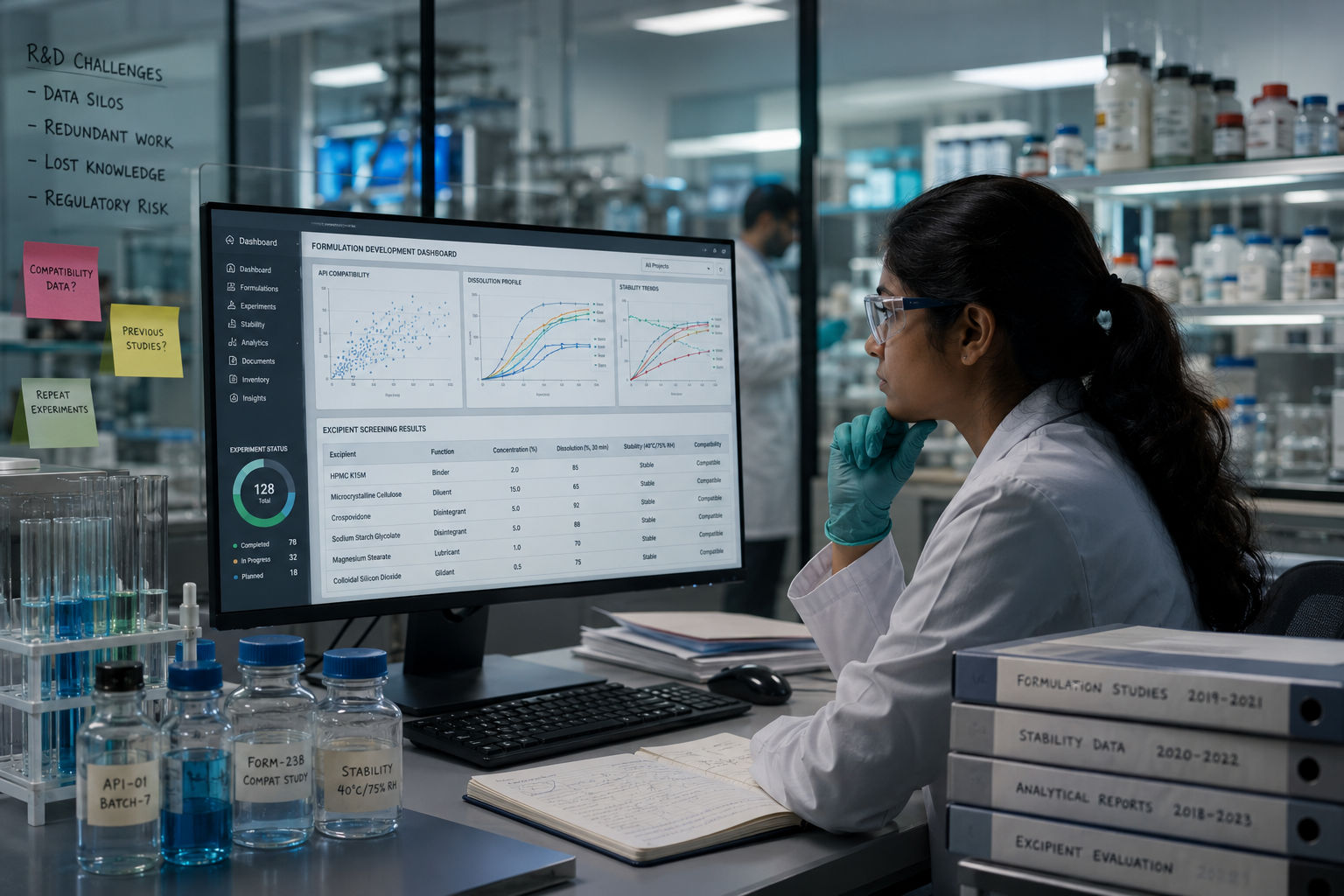
India’s pharmaceutical industry occupies a unique position in global healthcare. The country supplies roughly one-fifth of the world’s generic medicines and serves as a critical manufacturing backbone for regulated markets across the United States, Europe, Africa, and Asia. Behind this success lies an enormous scientific enterprise: thousands of formulation scientists conducting API compatibility studies, excipient screening programs, accelerated stability trials, dissolution experiments, and process optimization campaigns every year.
Yet beneath this achievement sits a growing problem that receives remarkably little attention. The majority of formulation knowledge generated during pharmaceutical development remains trapped inside disconnected spreadsheets, laboratory notebooks, shared drives, instrument files, and email threads. For many organizations, decades of experimental history exist, but very little of it is truly searchable, reusable, or connected to future development programs.
The result is not merely an information-management challenge. It is a scientific productivity challenge that directly affects development timelines, regulatory readiness, and innovation capacity.
The Hidden Data Layer Behind Every Generic Drug
When a pharmaceutical company develops a generic product, the final approved formulation is only the visible endpoint of a much larger experimental journey. Before an Abbreviated New Drug Application (ANDA) reaches regulators, researchers may have evaluated dozens—or even hundreds—of formulation variations.
Scientists investigate API–excipient compatibility, moisture sensitivity, particle-size effects, compression behavior, coating performance, dissolution kinetics, stability under multiple storage conditions, and manufacturing robustness. Each experiment generates valuable information about what works, what fails, and why.
Unfortunately, much of this knowledge becomes effectively invisible once a project concludes.
A scientist searching for previous work on a particular polymer, disintegrant, lubricant, or active ingredient often encounters fragmented records spread across multiple systems. Experimental context may be missing. Raw analytical data may be inaccessible. Critical observations may exist only in notebook comments written years earlier.
The organization possesses the data. What it lacks is institutional memory.
Why Fragmented Formulation Data Slows R&D
The consequences of fragmented scientific data extend far beyond administrative inconvenience.
Consider a common development scenario. A formulation team begins work on a generic version of a complex oral solid dosage product. Researchers initiate excipient screening studies to identify optimal combinations for dissolution performance and stability.
Unknown to the team, a similar project conducted three years earlier generated highly relevant compatibility data involving the same API class and several identical excipients.
Because the historical information cannot be easily discovered, scientists repeat experiments that have already been performed.
This pattern occurs across the industry. Valuable experimental knowledge remains isolated within individual projects rather than becoming part of a continuously expanding scientific knowledge base.
The cost is significant:
• Repeated experimental work increases development expenses.
• Formulation optimization cycles become longer.
• Technology transfer becomes more difficult.
• Knowledge is lost when experienced scientists leave organizations.
• Regulatory document preparation becomes slower and more resource-intensive.
In highly competitive generic markets where being first or second to launch can determine commercial success, these delays have meaningful financial consequences.
The Regulatory Pressure Is Increasing
The challenge becomes even more pronounced when regulatory submissions are considered.
Modern pharmaceutical development requires traceability. Regulators increasingly expect sponsors to demonstrate clear scientific justification for formulation decisions, process parameters, specification limits, and risk assessments.
Preparing an ANDA often requires researchers to revisit years of development work. Teams must reconstruct formulation histories, retrieve supporting studies, locate stability results, and connect analytical evidence to development decisions.
When information resides across disconnected systems, regulatory preparation becomes an exercise in scientific archaeology.
Scientists spend valuable time searching for data rather than interpreting it.
As product portfolios expand and regulatory expectations continue to evolve, this documentation burden grows increasingly difficult to manage through manual methods alone.
India’s Scale Magnifies the Problem
India’s generic pharmaceutical ecosystem is uniquely exposed to this challenge because of its scale.
The country hosts thousands of formulation development programs simultaneously. Large manufacturers manage extensive portfolios spanning oral solids, injectables, ophthalmics, topical products, modified-release systems, and complex generics.
Every project generates experimental datasets across chemistry, formulation science, analytical development, stability studies, process development, and manufacturing scale-up.
The volume of information grows exponentially each year.
What begins as a data-management issue gradually transforms into a knowledge-management issue. Organizations accumulate vast quantities of information but struggle to convert that information into actionable scientific intelligence.
The larger the R&D operation becomes, the more difficult manual knowledge retrieval becomes.
Why Traditional Data Systems Are No Longer Enough
Many pharmaceutical organizations have already invested in digital infrastructure. Laboratory Information Management Systems (LIMS), Electronic Laboratory Notebooks (ELNs), document repositories, and quality management platforms all play important roles.
However, these systems often solve storage problems rather than knowledge problems.
A scientist may know that compatibility data exists somewhere in the organization without knowing exactly where it resides. Even when records can be located, extracting meaningful insights across multiple projects remains difficult.
The fundamental challenge is not simply collecting data.
The challenge is connecting data.
Researchers need systems capable of linking formulation experiments, analytical outcomes, stability observations, manufacturing parameters, and regulatory documentation into a coherent scientific narrative.
The Emergence of AI-Powered Formulation Intelligence
This is where structured AI platforms are beginning to transform pharmaceutical R&D.
Unlike conventional repositories, modern formulation intelligence platforms are designed to organize experimental knowledge around scientific relationships rather than file locations.
An AI-enabled system can connect:
• API characteristics with historical formulation outcomes.
• Excipient selection decisions with stability performance.
• Dissolution profiles with manufacturing parameters.
• Development experiments with regulatory submission content.
• Historical failures with future project risk assessments.
Instead of asking where data is stored, scientists can ask what the organization already knows.
This shift fundamentally changes how formulation knowledge is accessed and reused.
Experimental history becomes searchable at the level of scientific meaning rather than document names.
From Experimental Records to Institutional Intelligence
The most significant opportunity lies not in automation alone but in cumulative learning.
Every compatibility study, every stability program, and every formulation screening experiment contributes additional knowledge to a growing organizational model.
Over time, patterns emerge.
Researchers can identify excipient combinations associated with specific degradation pathways. Teams can detect recurring formulation challenges across therapeutic categories. Development programs can benefit from lessons learned years earlier in unrelated projects.
The result is a transition from project-based knowledge generation to enterprise-wide scientific intelligence.
For an industry operating under intense cost pressure and compressed development timelines, this capability represents a substantial competitive advantage.
The Next Competitive Frontier in Generic Drug Development
India’s pharmaceutical industry has already demonstrated world-class capabilities in manufacturing scale, regulatory execution, and cost-efficient development.
The next frontier is knowledge infrastructure.
The organizations that succeed over the next decade may not simply be those generating the most experimental data. They may be the ones most capable of transforming experimental data into reusable scientific knowledge.
Formulation science is increasingly a data-intensive discipline. Every API screening study, excipient evaluation, dissolution experiment, and stability program contributes to a growing body of institutional expertise.
The question is whether that expertise remains buried inside spreadsheets and laboratory notebooks—or becomes an accessible asset that accelerates future innovation.
For India’s generic pharmaceutical sector, the formulation data challenge is no longer a future concern. It is a present reality. The companies that address it effectively will be better positioned to reduce development timelines, strengthen regulatory readiness, preserve scientific knowledge, and compete in an increasingly complex global market.
The industry has mastered the art of producing medicines at scale. The next challenge is mastering the science of managing the knowledge that creates them.