Author: Jonathan Woo | Chief Product Officer, ChemCopilot
Category: Product Lifecycle Management | Chemical R&D & Digital Transformation
Last Updated: November 2026
About the Author: Jonathan Woo is the Chief Product Officer at ChemCopilot. Former VP of Product at Noble.AI, Co-founder/CTO at Nanostellar (Quantum Simulation & Catalysts), and NASA/Harvard ACIS Software Team Leader. Over 25 years pioneering enterprise SaaS, deep-tech AI architectures, and automated materials modeling.
Most legacy Product Lifecycle Management (PLM) software was built for discrete manufacturing—tracking CAD assemblies, mechanical tolerances, and rigid Bills of Materials (BOMs) for cars, electronics, and aerospace parts.
When specialty chemical, pharmaceutical, agrochemical, and personal care enterprises force those discrete PLM platforms into their laboratories, the system breaks down. Chemical products are governed by multi-level recipes, non-linear phase behavior, mass balance stoichiometry, raw material lot-to-lot variability, and dynamic regulatory thresholds—not static mechanical parts.
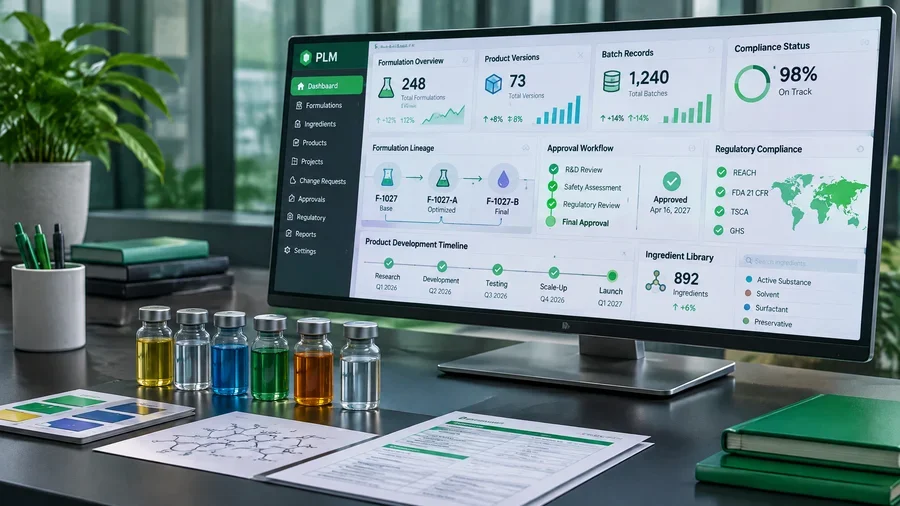
Selecting the right PLM software for chemical and formulation companies in 2027 requires platforms engineered natively for process industries—bridging early-stage R&D experimentation directly to regulatory clearance, raw material economics, and manufacturing scale-up.
Why Discrete PLM Fails Chemical & Formulation R&D
Before evaluating vendors, R&D and IT leaders must account for four structural differences between discrete parts and chemical formulations:
- Dynamic Recipes vs. Static BOMs: A mechanical BOM relies on exact part counts. A chemical formula requires dynamic weight percentages, active-matter adjustments, solvent evaporations, and stoichiometric ratios that shift based on raw material purity.
- The "Dark IT" Rejection Problem: When enterprise PLM interfaces are too rigid for daily bench work, chemists abandon them—retreating to local Excel sheets and unindexed PDFs. As detailed in our analysis on unlocking dark data and eliminating Dark IT in chemical R&D, this fragmentation destroys IP security and prevents machine learning from learning across past trials.
- Embedded Regulatory & GHS Compliance: Chemical formulations cannot wait until late-stage production for compliance review. Modern process PLMs must validate ingredients continuously against live REACH / ECHA, EPA, FDA, and GHS Safety Data Sheet (SDS) rules during bench design.
- Inseparable Process & Structure Dependencies: Changing mixing shear rates, curing temperatures, or order of addition alters physical performance just as much as changing an active ingredient.
Top 6 PLM Software Platforms for Chemical & Formulation Companies (2026)
| Platform | Core Focus & Architecture | Key Strengths | Best Enterprise Fit |
|---|---|---|---|
| 1. ChemCopilot | AI-Native R&D Suite + Formulation PLM | Structure-aware active learning, RAG dark-data ingestion, real-time REACH/ECHA & SAP cost sync, single-tenant VPC security. | Specialty chemicals, pharma, polymers & agrochemicals modernizing R&D-to-PLM. |
| 2. SAP PLM (Recipe Development) | ERP-Integrated Process PLM | Deep SAP S/4HANA integration, plant-level mass balance, global supply chain & ERP manufacturing execution. | Global chemical conglomerates heavily standardized on SAP ERP. |
| 3. Dassault Systèmes (BIOVIA + ENOVIA) | Scientific Informatics & Enterprise PLM | Comprehensive molecular modeling, Electronic Lab Notebook (ELN), and enterprise lifecycle governance. | Large pharmaceutical and life science enterprises with multi-year IT budgets. |
| 4. Siemens (Teamcenter / Opcenter) | Enterprise PLM & Manufacturing Operations | Strong specification management, plant-floor digital twin capabilities, and quality governance. | Hybrid manufacturers combining chemical formulations with packaging/devices. |
| 5. Centric PLM | Consumer Goods & Cosmetics PLM | Fast retail/CPG commercialization, packaging artwork workflows, supplier portal, and formula compliance. | Personal care, cosmetics, food & beverage, and CPG brand owners. |
| 6. Datacor (Formulator) | Mid-Market Chemical ERP & Formulation | Integrated SDS/GHS authoring, batch ticket generation, inventory tracking, and QC lab testing. | Mid-sized coatings, adhesives, lubricants, and chemical blenders. |
Detailed Evaluation: Which Chemical PLM Fits Your Organization?
1. ChemCopilot (Best for AI-Driven Formulation & R&D-to-PLM Acceleration)
ChemCopilot bridges the historic divide between bench R&D experimentation and enterprise Product Lifecycle Management. Built specifically for chemists and materials scientists, its dual R&D Suite and PLM Suite eliminate the need for disconnected spreadsheets while embedding predictive AI directly into recipe management.
- Standout Capabilities: Ingests unstructured historical lab files (PDFs, Excel logs, Word sprints) via RAG-powered Chem Agents; trains structure-aware machine learning models on SMILES and functional group descriptors; and runs multi-objective virtual sweeps balancing physical performance, SAP ERP raw material costs ($/kg), Scope-3 CO₂e footprints, and live REACH/ECHA compliance.
- Enterprise Security: Operates on single-tenant AWS Virtual Private Cloud (VPC) instances with Zero-Data Retention (ZDR) guarantees, ensuring proprietary molecular IP is never exposed to external foundation model training.
- Considerations: Designed specifically for chemical, pharmaceutical, polymer, and formulation workflows rather than discrete mechanical CAD assemblies.
2. SAP PLM (Recipe Development)
For global chemical enterprises already running SAP S/4HANA, SAP Recipe Development provides tight transactional continuity between specification management, plant-level mass balance calculations, and production bills of material.
- Standout Capabilities: Unmatched ERP synchronization for global procurement, regulatory labeling, and manufacturing execution across multi-plant networks.
- Considerations: High configuration complexity and rigid UIs often deter bench formulators during early-stage discovery, frequently requiring an agile R&D layer on top so scientists do not revert to manual spreadsheets.
3. Dassault Systèmes (BIOVIA + ENOVIA)
Dassault Systèmes combines BIOVIA (scientific informatics, ELN, and simulation) with ENOVIA (enterprise lifecycle governance) to offer one of the broadest scientific suites on the market.
- Standout Capabilities: Deep capabilities for biopharma, molecular simulation, and regulated quality workflows.
- Considerations: Heavy enterprise footprint, long implementation timelines (often 12–24 months), and high total cost of ownership make it challenging for agile formulation teams seeking rapid deployment.
4. Siemens (Teamcenter & Opcenter Formulation)
Siemens extends its flagship Teamcenter PLM and Opcenter manufacturing operations suite with specification and formulation management tools tailored for process industries.
- Standout Capabilities: Strong closed-loop integration between formulation specs, packaging engineering, and factory-floor Manufacturing Execution Systems (MES).
- Considerations: Originally architected around discrete engineering; chemical R&D teams may find early-stage iterative experimentation less intuitive compared to chemistry-native platforms.
5. Centric PLM
Centric PLM has established strong adoption in cosmetics, personal care, and food & beverage formulation—sectors where rapid seasonal product launches and packaging synchronization are critical.
- Standout Capabilities: Intuitive retail-style boards, supplier collaboration portals, and integrated packaging/labeling workflows alongside formula management.
- Considerations: Optimized primarily for consumer-facing CPG timelines rather than deep industrial chemical synthesis, polymer physics, or advanced active learning modeling.
6. Datacor (Formulator)
Datacor offers an all-in-one ERP and formulation management platform tailored specifically for mid-market chemical manufacturers, paint and coatings producers, and specialty blenders.
- Standout Capabilities: Out-of-the-box SDS/GHS authoring, batch scaling, inventory control, and basic quality control specifications without enterprise ERP complexity.
- Considerations: Lacks modern machine learning surrogate modeling, structure-aware molecular featurization, and automated patent/literature AI agents.
4 Selection Criteria for Chemical PLM Buyers in 2026
When evaluating PLM vendors for a chemical or formulation organization, prioritize four non-negotiable architectural requirements:
| Evaluation Criterion | Legacy PLM Standard | 2026 Modern Chemical PLM Standard |
|---|---|---|
| Predictive Intelligence | Passive database; stores historical recipes without predictive insights. | Active learning surrogate models predict viscosity, yield, stability & drop-in replacements. |
| Historical Data Onboarding | Manual CSV templates or costly multi-month IT migration projects. | RAG-powered Chem Agents parse legacy PDFs, Excel & LIMS logs into structured schemas. |
| Regulatory & Sustainability | Manual gate checks executed after bench formulation is complete. | Real-time REACH/ECHA screening and Scope-3 CO₂e footprinting during recipe design. |
| IP & Data Isolation | Multi-tenant cloud storage with basic role permissions. | Single-tenant VPC deployment, SSO/IAM integration, and Zero-Data Retention (ZDR) AI. |
Unifying R&D Discovery with Enterprise Lifecycle Management
The most successful chemical organizations in 2026 no longer treat R&D experimentation and Product Lifecycle Management as separate software silos. By adopting an AI-native PLM foundation built around chemical structures, automated data structuring, and no-code machine learning workspaces for chemists, enterprises eliminate Dark IT workarounds, protect proprietary formulas, and accelerate compliant products from the lab bench to commercial production.
Modernize Your Chemical R&D and PLM Workflow with ChemCopilot
Ready to replace rigid spreadsheets and disconnected legacy PLM tools with an AI-native platform built for formulation science? Connect with Jonathan Woo and our solutions engineering team to see how ChemCopilot unifies R&D active learning, SAP ERP costs, and regulatory compliance.
- R&D-to-PLM Continuity: Seamlessly transition validated bench formulations into compliant production specifications without re-entering data.
- Structure-Aware Active Learning: Predict non-linear mixture behavior and identify drop-in raw material substitutes in minutes.
- Sovereign Enterprise Security: Single-tenant AWS VPC architecture with Zero-Data Retention (ZDR) and granular role-based access controls.
Schedule a Private Chemical PLM & Architecture Briefing →
Subscribe to the Weekly Chemical AI Newsletter →