No-Code Machine Learning for Chemists: What Changed 2026 R&D?
The No-Code AI Revolution in Chemical R&D: Empowering Bench Chemists
Last updated: August 2026For years, artificial intelligence in industrial chemistry suffered from a fundamental deployment bottleneck: the gap between wet-lab physical chemists and specialized data science teams. A formulation chemist with 20 years of polymer synthesis experience had to submit a project request to an internal computational team, wait weeks for data cleaning, and receive a rigid, static Python model that broke the moment raw material suppliers changed or lab equipment parameters shifted.
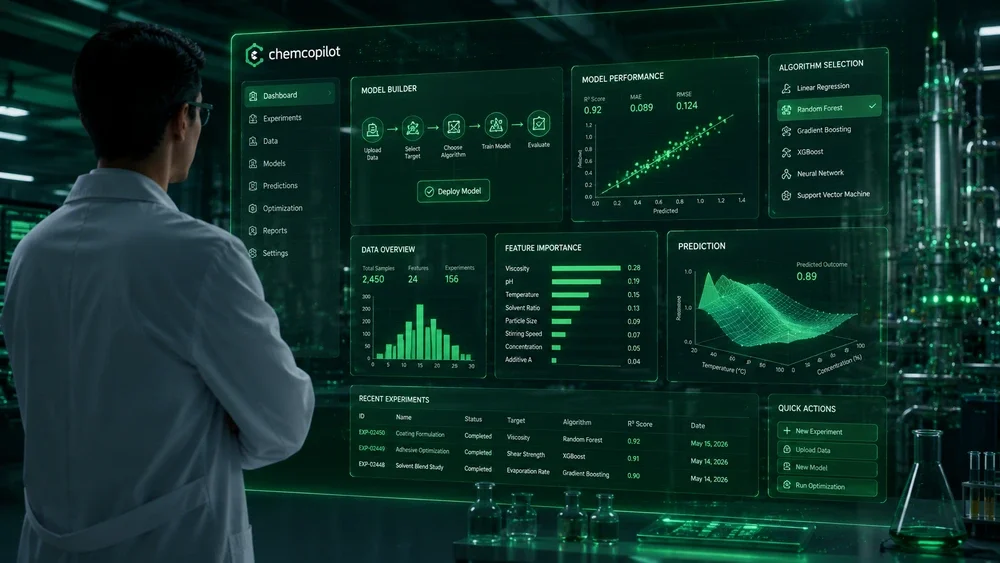
That computational bottleneck has officially broken open. In modern chemical research, No-Code Machine Learning has turned physical chemists from passive consumers of data science into active AI System Orchestrators. Instead of writing custom Python scripts or wrestling with command-line code, scientists now train, evaluate, and deploy active learning algorithms directly through intuitive, zero-code interfaces.
This guide explores how tabular foundation models democratized computational chemistry, how no-code workflows operate, and which market architectures are driving the future of industrial R&D.
1. What Changed? The Technical Breakthroughs
The transition to no-code machine learning in chemical research was driven by three core technical breakthroughs:
A. Tabular Foundation Models (TabPFN & Advanced AutoML)
Historically, machine learning algorithms required thousands of structured data rows to make accurate predictions. Chemistry datasets, however, are notoriously sparse—often containing only 20 to 50 physical trial rows per project. The arrival of tabular foundation models (like TabPFN and specialized Bayesian AutoML) solved this sparsity problem. These pre-trained transformers infer non-linear relationships across small chemical datasets in milliseconds, enabling instant model training without manual hyperparameter tuning.
B. Native Molecular Structure Parsing
In the past, converting a chemical structure or SMILES string into a machine-readable vector required custom coding using computational chemistry libraries (like RDKit). Modern no-code platforms handle molecular featurization natively behind the scenes—automatically converting chemical names, CAS numbers, and structural sketches into molecular graph representations.
C. Conversational Interfaces & Semantic RAG
Rather than writing SQL queries or Python scripts, chemists interact with their laboratory databases using natural language. Retrieval-Augmented Generation (RAG) engines allow scientists to upload unstructured PDF lab books, technical data sheets, and supplier certificates, turning static dark data into active tabular training rows automatically.
2. The Mathematics of No-Code Active Learning
Behind the simple graphical user interface, no-code platforms run sophisticated active learning loops. When a chemist uploads an experimental log, the system fits a surrogate predictive model f̂(X) across all inputs, process conditions, and outputs, while calculating model uncertainty σ(X).
The platform then evaluates an Acquisition Function across thousands of virtual candidate mixtures in silico:
Where μ(X) is the predicted mean performance (such as tensile strength or viscosity), σ(X) is the model's uncertainty, and β is an exploration parameter. The no-code interface translates this complex multi-objective optimization into clear, visual recommendations—showing scientists the single best physical batch to synthesize next to maximize knowledge gain while minimizing physical bench waste.
The 4-Step No-Code Active Learning Loop
- Step 1 - Data Upload: Drag and drop standard Excel formulation sheets containing inputs, process conditions, categories, and outputs.
- Step 2 - Zero-Code Auto-Train: The system featurizes molecules and fits tabular foundation models automatically without coding.
- Step 3 - Virtual Sweep: Simulate 10,000 virtual ingredient permutations in seconds, filtering by cost and performance limits.
- Step 4 - Targeted Validation: Synthesize only the top-ranked candidate at the bench, updating the active model instantly.
Who's Leading Chemical R&D? The ChemCopilot Advantage
The organizations leading chemical innovation are not those with the largest dedicated Python data science teams—they are the ones that put predictive AI directly into the hands of their wet-lab chemists.
The ChemCopilot AI Lab Assistant has emerged as the definitive workspace driving this transformation. The platform’s underlying multi-dimensional relational database is the secret sauce.
By unifying molecular structure graphs, raw material tier costs, vendor categories, and live regulatory compliance boundaries (REACH/ECHA) into a zero-code conversational workspace, ChemCopilot allows physical chemists to upload standard 4-column Excel spreadsheets and build predictive ML models in seconds.
3. Comparing Chemical Data Science Architectures
Evaluating how modern no-code platforms compare against legacy computational approaches highlights dramatic improvements in R&D speed and user adoption:
| Capability Metric | Legacy Python Data Pipelines | Traditional LIMS Software | ChemCopilot No-Code AI Workspace |
|---|---|---|---|
| Time-to-Model Deployment | Weeks to months per project | N/A (Static storage only) | Seconds (Instant AutoML fitting) |
| Required Coding Skills | Advanced Python, R, & Linux | Database administration | Zero Code (Conversational & Graphical) |
| Sparse Data Handling (20–50 rows) | Poor (Overfitting prone) | None | Exceptional (Tabular foundation models) |
| User Adoption by Bench Chemists | Low (< 15% adoption) | Moderate (Perceived as administrative) | High (> 90% direct bench utilization) |
4. The New Benchmark for R&D Leadership
In modern industrial manufacturing, chemical leadership is defined by R&D velocity. Organizations that rely on legacy trial-and-error campaigns or backlogged Python data science queues are being outpaced by agile competitors whose bench scientists run 10,000 virtual experiments before heating their first beaker.
By deploying the ChemCopilot AI Lab Assistant, your organization can eliminate computational bottlenecks, empower physical chemists with no-code machine learning, and compress product development cycles by over 70%.
🚀 Accelerate Product Commercialization & Cut R&D Costs
Stop losing months to backlogged data science queues and failed physical scale-ups. ChemCopilot equips your R&D and plant teams with zero-code predictive AI, reducing bench waste by over 70% while guaranteeing enterprise-grade IP security and zero-data retention.
- Compress Development Timelines: Screen 10,000 virtual formulations in seconds before heating a single beaker.
- Enterprise Security: Single-tenant data isolation, ISO 27001 compliance, and strict API zero-retention guarantees.
- Seamless LIMS/ERP Integration: Connect directly to historical SCADA logs, vendor cost tiers, and REACH compliance feeds.