
AI for Process Analytical Technology (PAT): Real-Time Reaction Monitoring in Chemical Plants
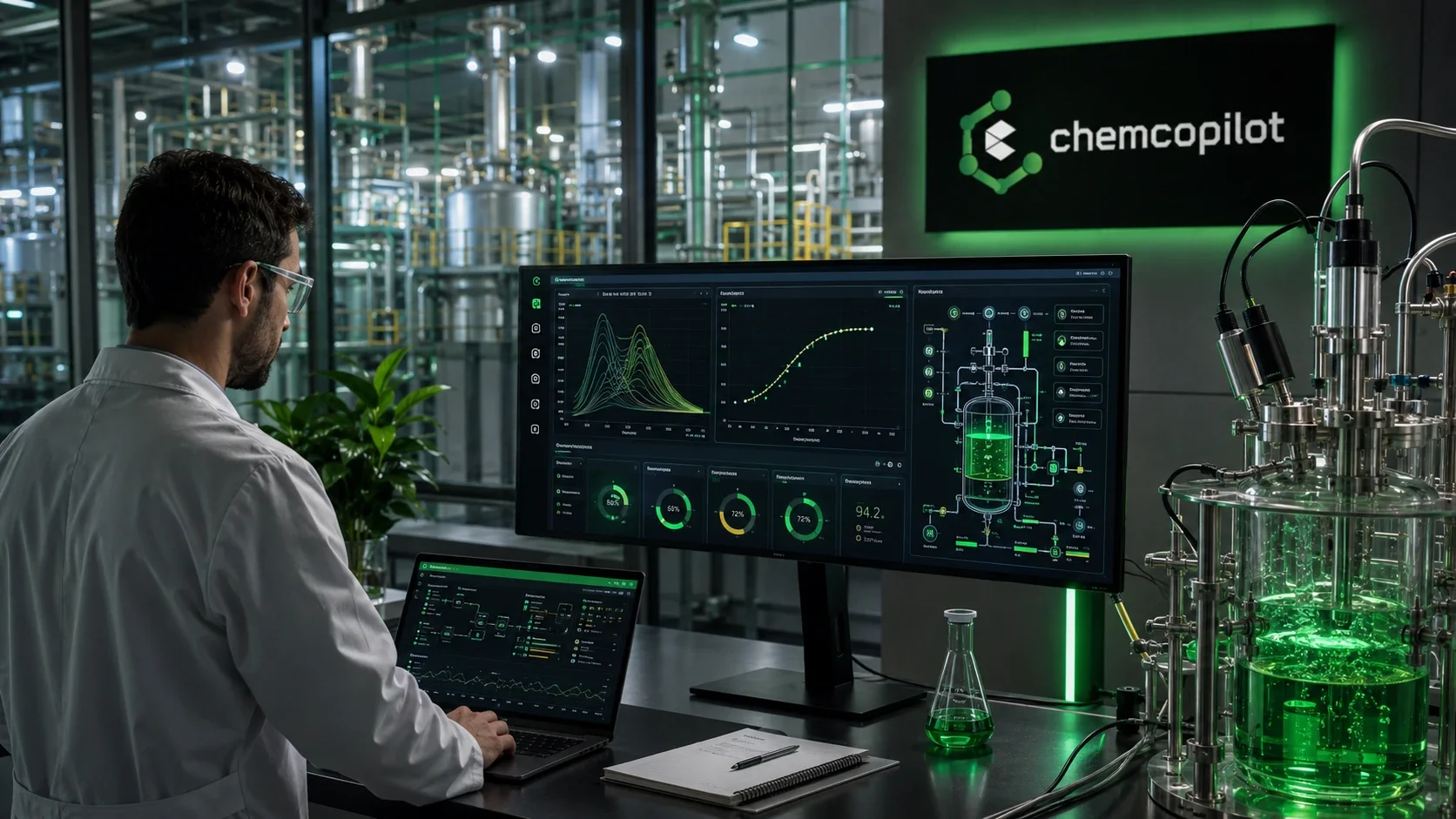
Process Analytical Technology: Real-Time In-Line Reaction Monitoring with Deep Learning

Chief Product Officer at ChemCopilot. Former VP of Product at Noble.AI, Co-founder/CTO at Nanostellar (Quantum Simulation & Catalysts), and NASA/Harvard ACIS Software Team Leader. Over 25 years pioneering AI-driven molecular design, quantum materials modeling, and enterprise SaaS.
In large-scale chemical manufacturing and fine pharmaceutical production, operating a multi-thousand-liter reactor vessel has historically resembled driving a car with a blacked-out windshield. Plant engineers set initial temperature ramps, pump in raw material feeds, and then... wait.
To verify whether a reaction is proceeding cleanly, technicians must physically draw samples from the vessel and run them through offline analytical equipment like High-Performance Liquid Chromatography (HPLC) or Gas Chromatography (GC). This traditional quality control loop introduces a massive operational gap: by the time an HPLC run finishes 45 minutes later, the reaction state inside the plant reactor has already moved on. If an unintended side-reaction, catalyst poisoning event, or thermal runaway occurs, plant operators only discover it post-facto—resulting in scrapped batches, wasted energy, and expensive plant downtime.
In modern manufacturing, Process Analytical Technology (PAT) enhanced by artificial intelligence has redefined industrial process control. By pairing in-line spectroscopic sensors (FTIR, Raman, NIR) with real-time deep learning models, plant operators can monitor molecular concentrations continuously, turning opaque chemical reactors into fully transparent, self-correcting systems.
The Paradigm Shift in Process Control Execution
- Legacy Offline Sampling (HPLC/GC): Relies on manual sample extraction and offline testing. Feedback delays of 30 to 90 minutes lead to high batch failure rates, off-spec material disposal, and unhedged safety risks.
- Real-Time In-Line Closed Loop (AI-PAT): Pairs in-situ optical probes with deep learning models to measure active species concentrations continuously, enabling automated closed-loop feed adjustments and instant fault detection.
1. The Evolution of PAT: From Linear Chemometrics to AI
The concept of Process Analytical Technology was originally formalized by regulatory agencies like the FDA to encourage continuous manufacturing and quality-by-design (QbD). However, early PAT implementations relied on traditional chemometric techniques—primarily Partial Least Squares (PLS) regression and Principal Component Analysis (PCA).
While traditional chemometrics worked well in pristine laboratory settings, it frequently failed on the factory floor. Physical reactors introduce extreme noise: bubble formation, turbidity changes, baseline drifts, temperature spikes, and overlapping spectral peaks from secondary intermediates.
Modern AI architectures solve this by replacing linear PLS models with 1D Convolutional Neural Networks (CNNs) and transformer-based spectral deconvolution models. These algorithms isolate individual chemical species from messy, highly overlapping raw spectra in real time.
2. The Mathematics of Real-Time Spectral Deconvolution
At the core of optical PAT monitoring lies the Beer-Lambert law, which relates absorbance to species concentration. However, in a complex multi-component plant reactor, the measured total absorbance spectrum A(λ) is a non-linear composite of N chemical species, ambient baseline drift, and physical light scattering S(λ):
Where εi(λ) is the molar absorptivity of component i, ci is the active concentration, l is the optical path length, and η(λ) represents non-Gaussian instrument noise.
Instead of requiring tedious manual baseline subtractions, AI deconvolution engines process the raw spectral matrix A(λ) directly at 10 Hz intervals. The deep learning model strips out scattering artifacts S(λ) and instantly calculates the exact concentration vector C = [c1, c2, ..., cN] for reactants, intermediates, products, and dangerous impurities simultaneously.
3. Closed-Loop Control & Early Fault Detection
Real-time concentration tracking unlocks true closed-loop autonomous control. When the AI PAT system detects that a primary reactant is depleting faster than expected or that an unwanted impurity is beginning to form, it does not simply trigger a passive alarm:
- Dynamic Feed Adjustment: Automatically throttles reagent dosing pumps to maintain optimal stoichiometric ratios.
- Thermal Profile Tuning: Adjusts jacket cooling loops dynamically to suppress exothermic side-reactions before temperature runaways occur.
- End-Point Determination: Pinpoints the exact millisecond a reaction achieves maximum yield, preventing over-processing or thermal degradation of the final product.
The 4-Step Closed-Loop PAT Workflow
- Step 1 - In-Situ Sensing: Optical probes (Raman / FTIR) collect raw spectral data inside the active reactor vessel at sub-second intervals.
- Step 2 - AI Deconvolution: Deep learning models strip noise, baseline drift, and scattering to calculate precise species concentrations.
- Step 3 - Digital Twin State: The system compares live concentrations against optimal kinetic trajectories to detect anomalies early.
- Step 4 - Closed-Loop Control: Automated valves adjust feeds and jacket temperatures, logging audit data instantly for compliance.
Executive Insight: Bridging R&D and Plant Operations with ChemCopilot
"Bridging the gap between a 500 mL lab bench beaker and a 10,000-liter plant reactor isn't just about scaling volume—it's about ensuring your optical spectral models adjust dynamically to turbulent industrial kinetics."
— Jonathan Woo, Chief Product Officer at ChemCopilot
The ChemCopilot AI Lab Assistant solves this scale-up disconnect. The platform’s underlying multi-dimensional database acts as the single source of truth, linking laboratory PAT spectral calibrations directly to plant execution models.
Through its zero-code operational interface, plant engineers can deploy transfer-learning-powered PAT models in minutes without writing custom code. Furthermore, because ChemCopilot connects real-time reaction tracking with raw material pricing, yield limits, and live regulatory compliance feeds (REACH/ECHA), it optimizes both chemical purity and plant operating margins concurrently.
4. Comparing Reaction Monitoring Architectures
Evaluating the operational transition from traditional quality control to AI-powered Process Analytical Technology highlights dramatic gains in asset utilization:
| Monitoring Metric | Offline Sampling (HPLC/GC) | Traditional Chemometrics (PLS) | AI-Powered PAT (ChemCopilot) |
|---|---|---|---|
| Measurement Frequency | 30 to 90 minutes per sample | Continuous (Every 10-30 seconds) | Continuous Real-Time (Sub-second) |
| Noise & Turbidity Handling | N/A (Sample is filtered manually) | Poor (Baseline drift distorts results) | Robust (AI strips non-linear scattering) |
| Closed-Loop Capabilities | None (Manual operator intervention) | Limited linear feedback loops | Automated dynamic multi-variable control |
| Regulatory Audit Readiness | Manual paper/spreadsheet logging | Basic local sensor logs | Unalterable, cloud audit trails |
5. Securing IP and Ensuring Regulatory Audit Readiness
Deploying continuous monitoring across industrial chemical facilities generates massive volumes of high-value operational data. R&D leaders and plant managers must ensure that real-time reaction streams, spectral calibration files, and proprietary process settings are protected by robust cybersecurity rails.
The ChemCopilot platform secures these assets through multi-tier role-based access permissions, ensuring that plant operators, process engineers, and external auditors view exclusively what their clearance levels permit. Furthermore, every automated feed adjustment, spectral deconvolution calculation, and batch end-point determination is recorded with an unalterable, time-stamped audit log—providing seamless compliance verification for GxP, ISO, and global environmental standards.
6. Accelerating Your Transition to Continuous Manufacturing
The era of operating chemical reactors as un-monitored "black boxes" has officially ended. By combining in-line optical sensors with deep learning spectral deconvolution, AI-powered Process Analytical Technology gives chemical manufacturers total visibility over reaction kinetics, yield parameters, and safety thresholds.
🚀 Transform Plant Process Control & Eliminate Batch Failures
Ready to deploy real-time PAT and deep learning spectral deconvolution on your production lines? Connect with Jonathan Woo and our solutions engineering team to evaluate ChemCopilot on your active process streams under enterprise-grade IP protection.
- Continuous Closed-Loop Control: Sub-second spectral analysis for dynamic feed and temperature adjustments.
- Enterprise Security: Single-tenant data isolation, SOC 2 compliance, and strict API zero-retention guarantees.
- Seamless LIMS/ERP Integration: Connect directly to historical SCADA logs, vendor cost tiers, and REACH compliance feeds.
Schedule a Private Enterprise Demo & ROI Assessment → | Start Your 14-Day Free Commercial Lab Trial →
