Bridging the Gap—How to Accelerate AI Adoption in Canadian Chemistry
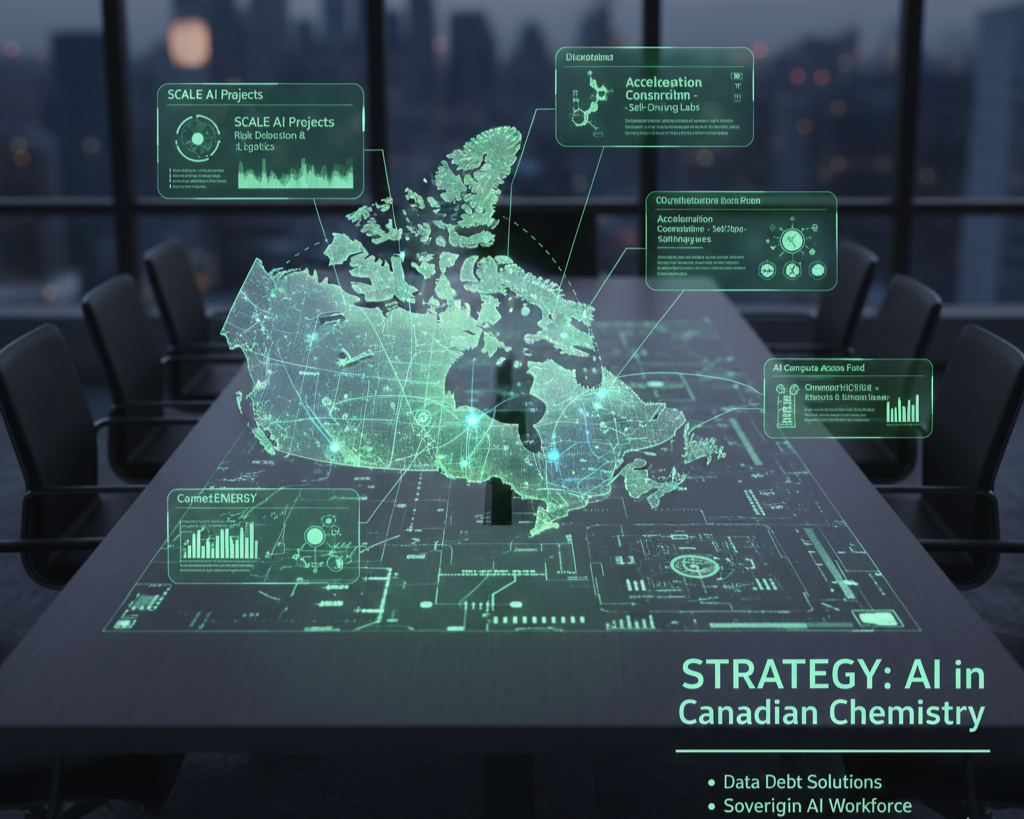
While Canada’s AI research is world-leading, a "commercialization gap" remains. Only about 26% of Canadian organizations have fully implemented AI, compared to 34% globally. For the chemical sector to stay competitive through the 2026 capital cycle, it must shift from experimentation to industrial scale.
Strategies to Increase AI Adoption
1. Erase "Data Debt" First
AI cannot function in a vacuum. Most chemical plants have decades of data locked in silos or legacy paper logs.
The Strategy: Adopt FAIR data principles (Findable, Accessible, Interoperable, and Reusable). Firms should invest in "Data Architects" before "AI Scientists" to ensure their operational data is clean and "AI-ready."
2. Tap into Federal "Sovereign AI" Funding
In late 2025, the Canadian government launched the $2 billion Sovereign AI Compute Strategy.
The Strategy: Small and Medium Enterprises (SMEs) should apply for the AI Compute Access Fund, which provides up to $300 million to help businesses access the high-performance computing power needed to run complex chemical simulations. This lowers the barrier for firms that cannot afford their own supercomputing clusters.
3. Implement "Agentic AI" for the Workforce
The chemical industry faces a looming talent shortage. AI should be positioned as a co-pilot, not a replacement.
The Strategy: Deploy "Autonomous AI Agents"—systems that can independently monitor a plant's MES (Manufacturing Execution System) and inventory. By 2026, these agents are predicted to be present in 40% of enterprise applications, allowing human engineers to focus on high-value strategy rather than routine data entry.
4. Leverage the "G7 AI Adoption Roadmap"
As part of the 2025 G7 commitments, Canada has established specific programs to help legacy industries adopt AI.
The Strategy: Partner with the National Research Council’s IRAP or regional development agencies. These bodies now offer "AI readiness" audits and matching grants specifically designed to de-risk the adoption of new technologies for manufacturing.
Conclusion: The Path Forward
The Canadian chemical industry is at a crossroads. By moving from a "fast-follower" mentality to a "first-mover" strategy, companies can unlock an estimated $80 billion to $140 billion in value across the materials sector. Those who integrate AI into their net-zero roadmaps today will be the leaders of the global circular economy tomorrow.
The lab is ready, the data is there—now it’s time to scale. Chemcopilot is a catalyst to this complex formulation.
Talk With US