From Guesswork to Guidance : Why Indian Chemical R&D Needs Process-Aware AI, Not Generic Intelligence.
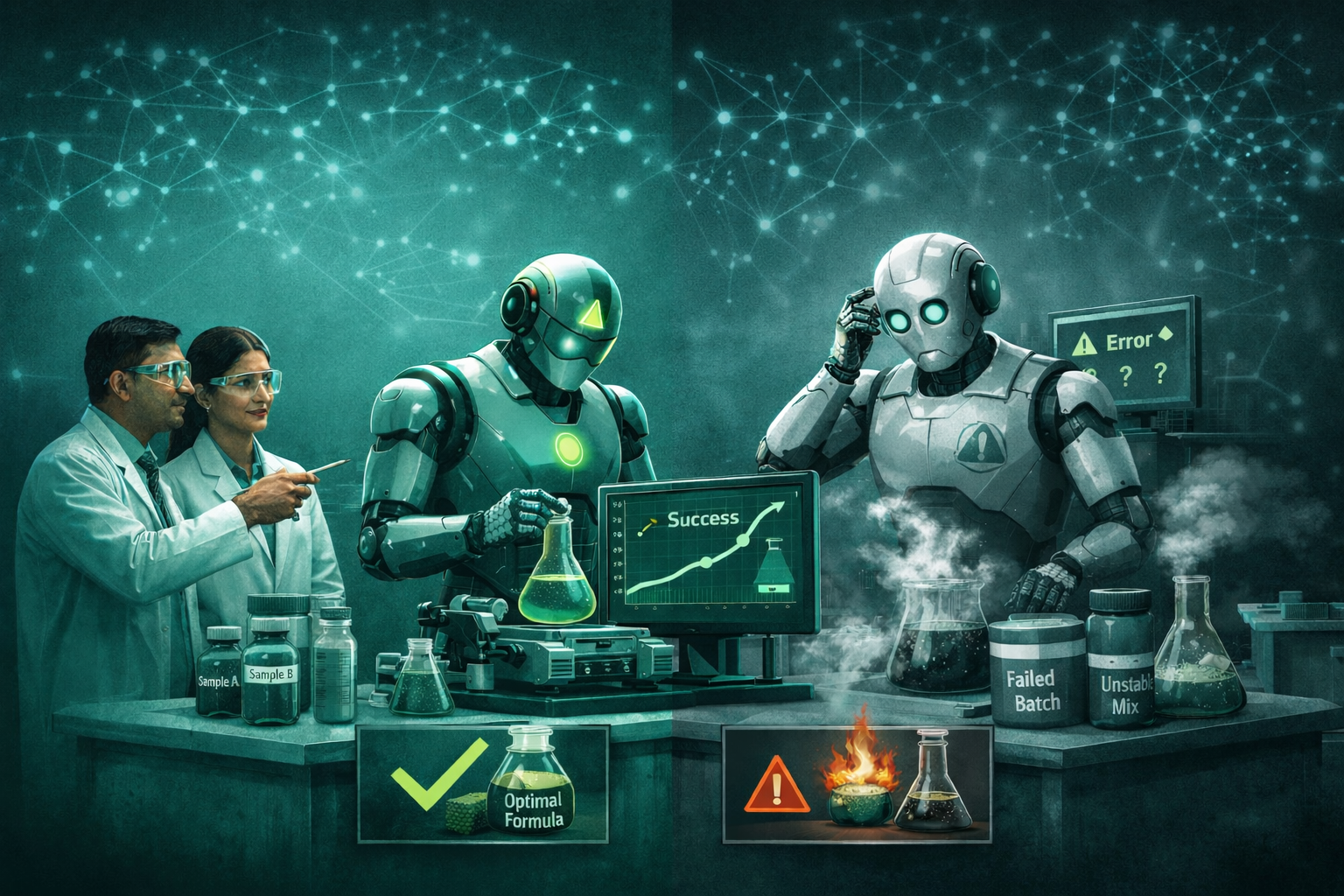
In Indian chemical laboratories, progress has rarely been accidental. It has been earned—through long hours, repeated trials, tacit knowledge passed from senior chemists to junior researchers, and an intuitive understanding of how materials behave under imperfect conditions. For decades, this intuition-driven model worked. It built industries, enabled scale, and positioned India as a global manufacturing and formulation hub.
But the context has changed.
Today’s chemical R&D landscape is shaped by compressed timelines, volatile raw material costs, stricter regulatory scrutiny, sustainability pressures, and global competition that no longer rewards slow iteration. In this new reality, intuition alone—however experienced—has become insufficient. And yet, much of Indian R&D still oscillates between two extremes: manual trial-and-error on one side, and the sudden adoption of generic AI tools on the other.
Both are incomplete answers to a far more structural problem.
The Misplaced Promise of Generic AI in Chemical R&D
The recent surge of artificial intelligence has created understandable excitement across scientific disciplines. Large language models can explain reactions, summarize literature, suggest mechanisms, and even draft experimental plans. On the surface, this appears revolutionary.
However, chemical R&D is not a linguistic problem—it is a process problem
Generic AI systems are trained to recognize patterns in text, not causality in chemical systems. They can describe what *might* happen, but they do not understand what “must” happen within a specific laboratory context. They lack awareness of:
Process sequences and dependencies
Equipment limitations and scale constraints
Material-grade variability
Thermodynamic and kinetic trade-offs
Failed experiments and why they failed
As a result, their outputs often sound intelligent while remaining operationally disconnected. In chemistry, plausibility is not enough. An answer must survive the constraints of reality: heat transfer limits, impurity tolerances, solvent compatibility, reaction time windows, safety margins, and regulatory thresholds.
Without these anchors, AI becomes articulate—but not accountable.
The Real Bottleneck: Intuition-Centric Decision Making
Indian chemical R&D has historically relied on a deeply human asset: experience. Senior scientists often “sense” when a formulation is close, when a parameter must be adjusted, or when an experiment is not worth repeating. This intuition is valuable—but it is also fragile.
It is fragile because:
It is rarely documented in structured form
It cannot be easily transferred across teams
It does not scale with growing experiment volumes
It becomes a single point of failure when people leave
Most critically, intuition-driven systems struggle under uncertainty. When raw materials change, suppliers vary, or regulations shift, experience alone cannot quickly recompute optimal decisions. The lab returns to guesswork—not due to incompetence, but due to lack of systemic memory.
This is where many R&D teams assume AI will “fix” the problem. But unless AI understands process context , it simply digitizes guesswork rather than eliminating it.
Why Process Context Is the Missing Intelligence Layer
Process context is the difference between knowing chemistry and doing chemistry.
It includes:
How experiments are sequenced, not just what reactions exist
How variables interact over time, not just in isolation
How constraints shape feasible outcomes
How past failures inform future design
A process-aware AI does not ask, “What is the best reaction?”
It asks, “Given this equipment, this material variability, this objective, and this experimental history—what is the most probable path to success?”
This distinction is fundamental.
Where generic AI treats chemistry as a static body of knowledge, process-aware AI treats it as a living system—one that evolves with every experiment, success, and failure.
From Intuition to Predictability: A Cultural Shift, Not Just a Technical One
Predictability in R&D does not mean eliminating human judgment. It means supporting it with structured intelligence .
When AI is embedded into real workflows, several transformations occur:
1. Experiments stop being isolated events
Each trial feeds into a growing knowledge graph of cause and effect.
2. Failure becomes data, not loss
Unsuccessful experiments refine boundaries rather than disappear into lab notebooks.
3. Decisions become explainable
Recommendations are tied to parameters, not probabilities alone.
4. Scale-up becomes less speculative
Process behavior is modeled across conditions before physical escalation.
This is not automation for efficiency’s sake—it is augmentation for scientific rigor.
Why India Specifically Needs Process-Aware AI
India does not operate under the same assumptions as Western R&D ecosystems. Budgets are tighter, lab resources are stretched, and timelines are unforgiving. The margin for waste—whether of materials, time, or effort—is small.
In this environment:
Repeating experiments is costly
Knowledge loss is expensive
Trial-heavy development slows competitiveness
What Indian chemical R&D needs is not more information, but more coherence —a way to connect experiments, people, and processes into a single learning system.
Process-aware AI enables exactly this: it respects the realities of Indian labs while quietly raising their global readiness.
The Real Differentiation: Intelligence That Understands Consequences
The most important distinction between generic AI and process-aware AI lies in accountability.
Generic AI answers questions - Process-aware AI models consequences .
One can suggest ideas - The other anticipates outcomes.
One sounds smart - The other reduces uncertainty.
In chemical R&D, the difference between sounding correct and being correct is measured in months, money, and missed opportunities.
Generic AI and Process-Aware AI: A Fundamental Difference in How Intelligence Operates
Generic AI systems are built to interpret and generate language. Their strength lies in identifying patterns across vast bodies of text, which allows them to summarize chemical literature, explain theoretical concepts, or suggest possible reaction pathways based on precedent. However, their understanding remains abstract. They do not operate within the physical realities of a laboratory environment, nor do they possess awareness of equipment limitations, process sequences, or material-specific constraints. As a result, while their responses may appear chemically sound, they remain detached from the operational conditions under which real experiments are conducted.
In contrast, process-aware AI is designed to function within the logic of chemical workflows rather than outside them. Instead of treating chemistry as a static collection of reactions and rules, it models R&D as a dynamic system shaped by variables, dependencies, and constraints. It understands that outcomes are not determined by reactions alone, but by how those reactions are executed—under specific temperatures, concentrations, residence times, equipment configurations, and safety limits. This grounding allows the intelligence to remain contextually relevant rather than theoretically plausible.
When it comes to experimental data, generic AI typically interacts with information in an unstructured or episodic manner. Past experiments may be referenced descriptively, but they do not systematically shape future recommendations. Failed trials are often invisible to the model, treated as noise rather than signal. Process-aware AI, by contrast, treats every experiment—successful or not—as a data point that refines understanding. Failures are not discarded; they actively inform boundary conditions, narrowing the space of viable solutions and improving predictive accuracy over time.
Decision-making support also differs fundamentally between the two. Generic AI tends to offer suggestions that resemble expert advice: useful, but ultimately dependent on human judgment to validate feasibility. Its outputs answer questions, but they do not model consequences. Process-aware AI operates one level deeper. Its recommendations are tied to cause-and-effect relationships within the process itself, enabling scientists to understand not only what might work, but why it is likely to work under specific conditions. This makes decision-making more explainable, reproducible, and defensible.
Scalability is another critical divergence. Generic AI tools struggle to transition from ideation to execution, particularly when moving from laboratory-scale experiments to pilot or production environments. The lack of embedded process logic makes scale-up speculative. Process-aware AI, however, is inherently designed to account for scale-related variables. By modeling how processes behave across conditions, it reduces uncertainty during scale-up and supports smoother transitions from research to manufacturing.
Perhaps the most important difference lies in how knowledge is retained. Generic AI operates in sessions; its intelligence resets unless explicitly retrained or re-fed information. Process-aware AI accumulates institutional knowledge over time. It becomes a living repository of how a specific organization’s chemistry behaves—capturing decisions, trade-offs, and lessons learned in a way that persists beyond individual scientists or teams.
Ultimately, generic AI functions as an assistant—informative, responsive, and broad in scope. Process-aware AI functions as an embedded intelligence layer—deeply integrated into workflows, continuously learning, and directly accountable to real-world outcomes. In chemical R&D, where plausibility is cheap but precision is priceless, this distinction determines whether AI remains a supportive accessory or becomes a transformative force.
Conclusion: Intelligence That Respects Reality
The future of Indian chemical R&D will not be defined by who adopts AI first—but by who adopts it “correctly”. Intelligence that ignores process is destined to remain superficial. Intelligence that understands process becomes transformative.
The shift from guesswork to ground truth
is not a rejection of human expertise. It is its natural evolution.
And in that evolution, process-aware AI is not a tool—it is infrastructure.