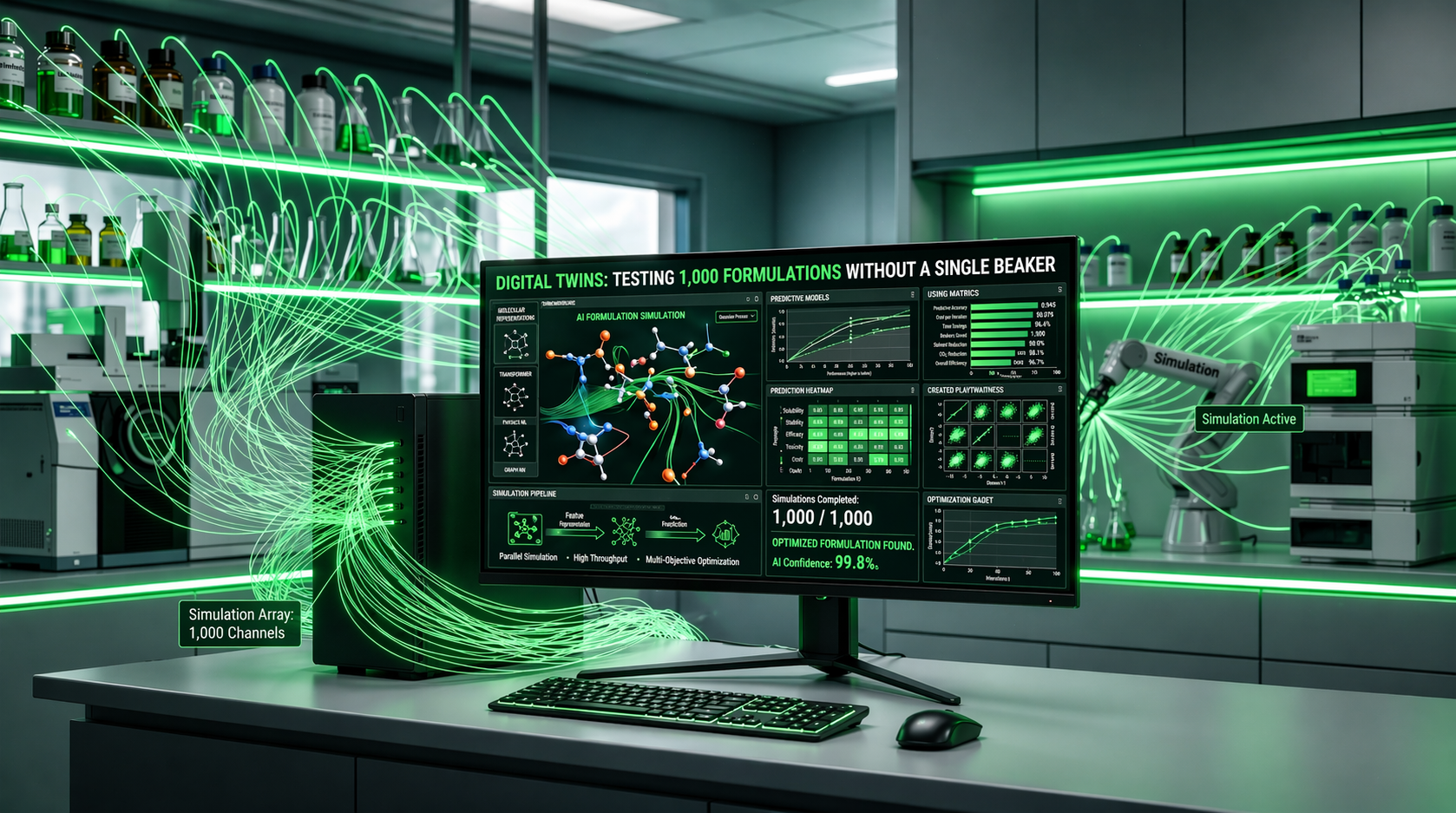
Digital Twins: Testing 1,000 Formulations Without a Single Beaker
In the traditional laboratory, innovation is often a game of attrition. A scientist develops a hypothesis, prepares reagents, runs a reaction, cleans the equipment, and analyzes the results. If the formulation fails to meet stability or performance benchmarks, the cycle repeats.
This "trial-and-error" method is the heartbeat of classical chemistry, but in a global market defined by rapid shifts in consumer demand and tightening regulations, it is too slow. The solution? The Digital Twin.
What is a Chemical Digital Twin?
In the context of R&D, a Digital Twin is a high-fidelity virtual model of a chemical formulation or process. It is not a static simulation; it is a dynamic entity powered by historical structured data, physics-informed neural networks, and AI models.
By creating a Digital Twin of a product, scientists can simulate how different concentrations, temperatures, and raw material variations will interact—all within a "Silicon Lab" before a single drop of liquid is pipetted.
1. The Power of Parallel Innovation
The physical lab is limited by space, equipment, and linear time. A scientist can perhaps test three to five variations of a complex formulation in a day.
An AI-driven Digital Twin can test 1,000 variations in seconds. This high-throughput virtual screening allows R&D teams to:
Identify the "Goldilocks" zone of performance and cost.
Predict long-term stability issues that would normally take months of shelf-life testing to discover.
Eliminate 95% of non-viable candidates before they ever reach the physical bench.
2. Radical Sustainability: "Green by Simulation"
Every failed physical experiment produces waste—spent solvents, hazardous byproducts, and consumed energy. By shifting the bulk of the "failure phase" to a virtual environment, chemical companies can drastically reduce their environmental footprint.
Digital Twins allow for "Green by Design" innovation. You can simulate the environmental impact and REACH/ECHA compliance of a formulation in the design phase, ensuring that the final physical test is not only high-performing but also eco-friendly.
3. Closing the Loop: The LIMS Connection
A Digital Twin is only as good as the data that feeds it. This is where the integration of LIMS (Laboratory Information Management Systems) and ERP systems becomes critical.
When a physical experiment is eventually performed, the results are fed back into the platform. If the physical result deviates from the Digital Twin’s prediction, the AI learns and adjusts the model. This creates a "closed-loop" engine of truth that becomes more accurate with every real-world test.
4. Moving Beyond LLMs to Multi-Agent Systems
While a standard Large Language Model (LLM) might help you write a report, it cannot predict the viscosity of a new surfactant blend. Specialized Multi-Agent AI systems are required.
In this workflow, one AI agent might focus on molecular stability, another on cost optimization, and a third on regulatory safety. Together, they "interrogate" the Digital Twin, providing the scientist with a curated shortlist of the most promising formulations.
Conclusion: Silicon First, Beaker Second
The goal of the Digital Twin is not to replace the laboratory, but to make it the venue for validation, not discovery. By testing 1,000 formulations in silicon, we ensure that when a scientist finally picks up a beaker, they are working on a solution that is already destined for success.