The Hidden Cost of Unstructured Data in Chemical Labs: Why Your R&D is Stalling
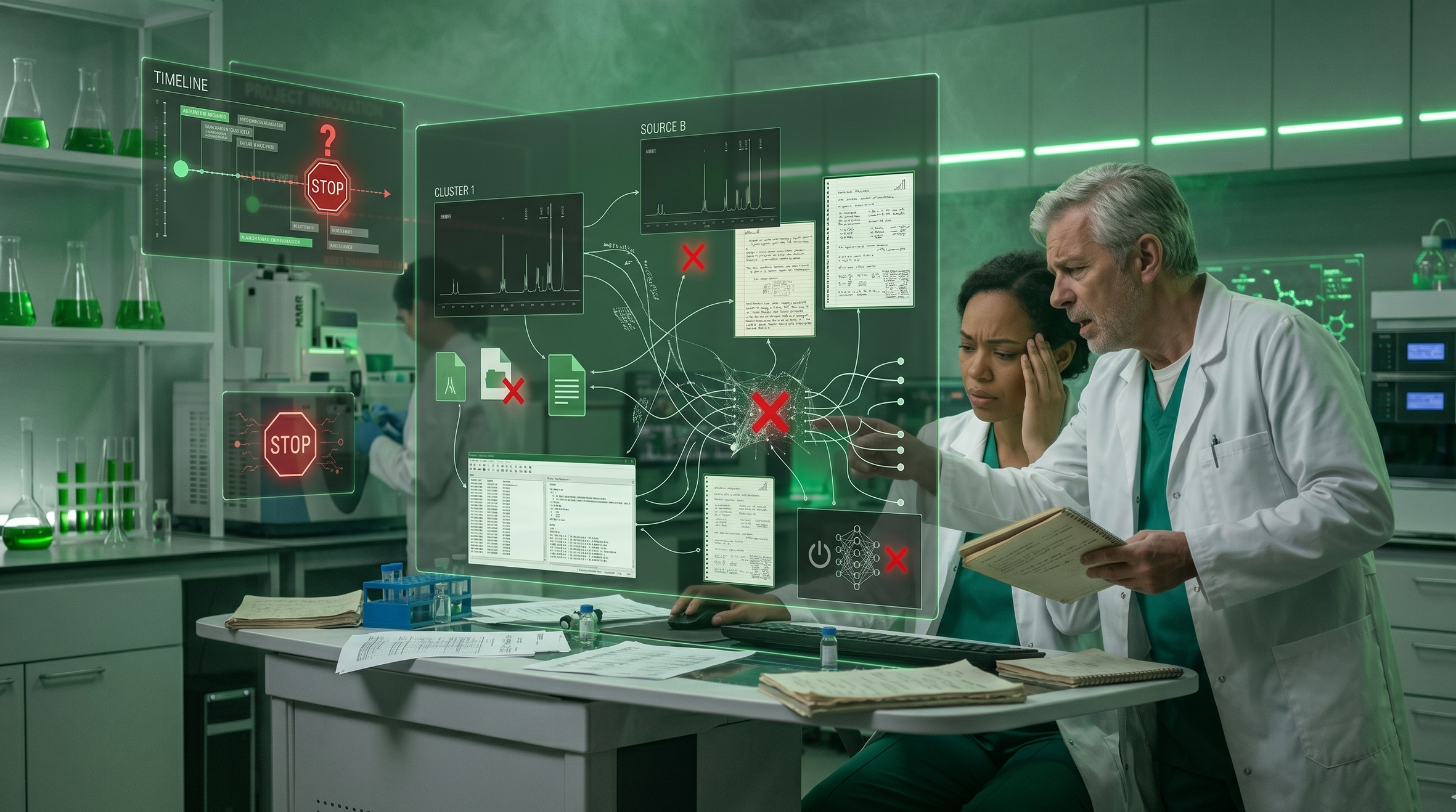
In the race to develop the next breakthrough polymer, specialty chemical, or pharmaceutical formulation, most labs believe their greatest asset is their intellectual property. But there is a silent "innovation tax" being paid every day in labs across the globe: The cost of unstructured data.
While modern labs are equipped with 21st-century sensors and instrumentation, the way that data is stored often remains stuck in the 20th century. Fragmented Excel sheets, handwritten notebooks, and disconnected PDFs aren't just an administrative headache—they are actively preventing the implementation of Artificial Intelligence.
The Anatomy of Unstructured Data
In a chemical lab, unstructured data takes many forms:
The "Shadow" Spreadsheet: Critical formulation results living on a single scientist’s desktop.
The Narrative Notebook: Observations like "the mixture turned slightly viscous" that a machine cannot quantify.
Instrumental Silos: Raw data from NMR, IR, or MS stored in proprietary formats that don't "talk" to the company’s ERP or LIMS.
1. The Financial Drain: Redundancy and "Re-Discovery"
The most immediate hidden cost is redundancy. Industry estimates suggest that up to 20% of lab experiments are repetitions of work already performed elsewhere in the same company. When data is unstructured and unsearchable, it is easier for a scientist to run a reaction again than to find the results of a similar experiment from three years ago.
Every wasted hour in the lab is a delay in the Time-to-Market (TTM). In a competitive landscape, a six-month delay in launching a new formulation can result in millions of dollars in lost revenue.
2. The Compliance Risk: REACH, ECHA, and Traceability
Regulatory bodies like ECHA (REACH) and TSCA are demanding higher levels of transparency. If your safety data and molecular fingerprints are buried in unstructured files, the cost of an audit skyrockets. Structuring your data ensures that every ingredient and intermediate is traceable in real-time, moving compliance from a reactive burden to an automated workflow.
3. The AI Barrier: You Can’t Train a Pilot on Paper
This is the most significant cost of all. AI models are hungry for structured data. If you want to use a Multi-Agent AI system to optimize a formulation, the AI needs to understand the relationship between temperature, pressure, and yield across thousands of historical points. If that data is unstructured, the AI is blind. You cannot build a Digital Twin of your lab if the "input" is a scanned PDF of a lab report.
"The difference between a leading chemical company and a struggling one in 2030 will be the quality of their data engine."
The Path Forward: From Files to Engines
To stop paying the hidden cost of unstructured data, labs must transition to a Data-First Workflow:
Standardize Inputs: Move from narrative notes to structured parameters.
Integrate Silos: Ensure LIMS, EHS, and ERP systems communicate through a unified PLM platform.
AI Readiness: Clean your historical data so that AI agents can begin predicting outcomes before the first beaker is touched.
Conclusion
The "Silicon Lab" isn't a futuristic dream; it is a necessity for survival. By unlocking the data trapped in unstructured formats, chemical companies can eliminate redundancy, ensure global compliance, and finally unleash the power of AI to innovate at the speed of thought.