Flow Chemistry & Continuous Manufacturing: Why Batch Reactors Are a 19th-Century Problem
Inside the physics of microreactors, the reactions they unlock, the FDA approvals they have already secured — and the data infrastructure challenge that still stands between the laboratory and the plant.
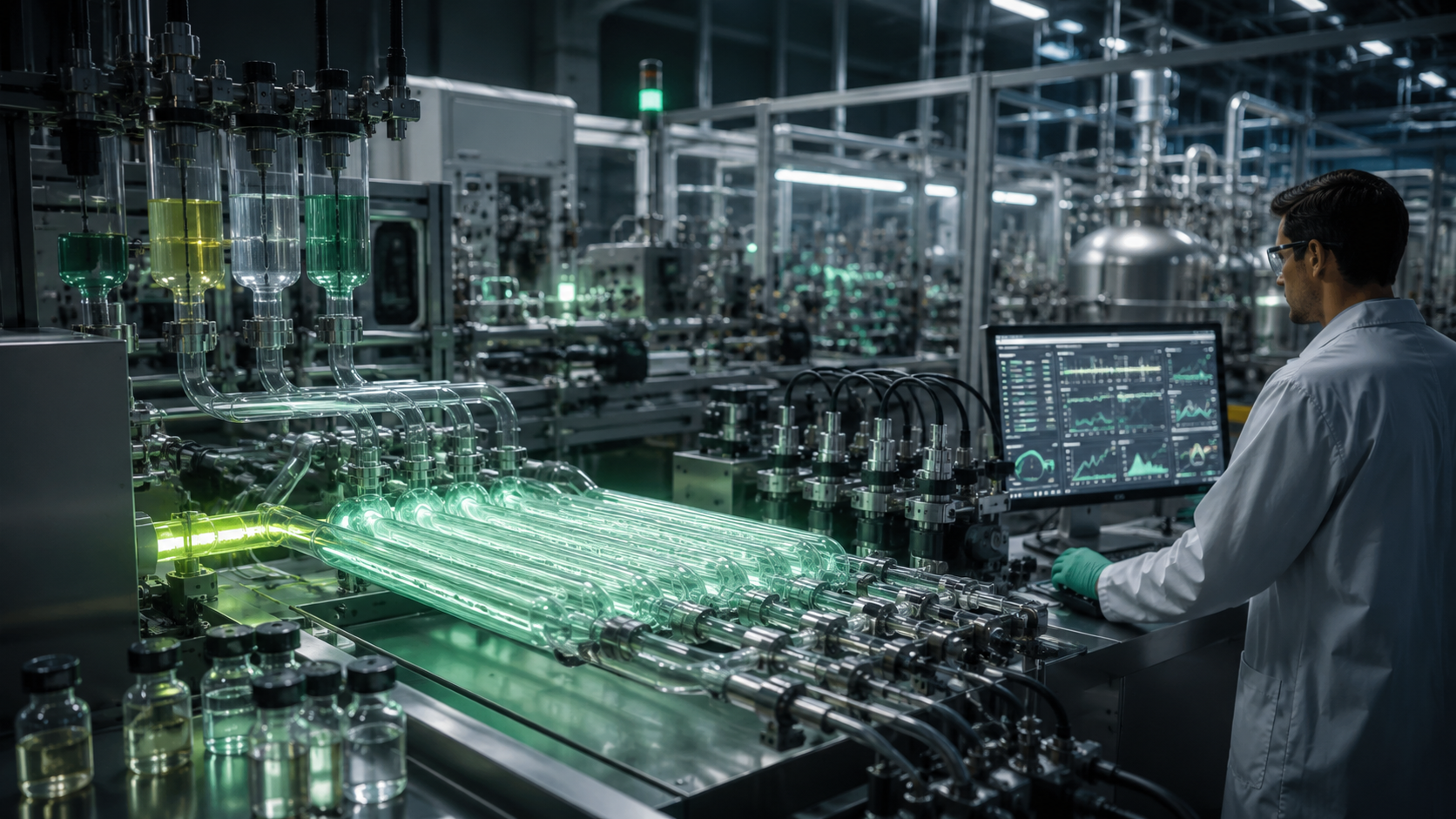
The Architecture of a Batch Reactor Is a Product of Necessity, Not Wisdom
When the first large-scale batch reactors were commissioned in the industrial era, they were engineering marvels — enormous steel vessels capable of combining reactants at quantities that no prior civilization had achieved. The chemists and engineers who designed them worked within the constraints of their moment: no electronic sensors, no real-time analytics, no computational fluid dynamics. They built what they could build, and it worked.
That was the 19th century. The batch reactor has not changed in its fundamental architecture since.
Today, a typical batch synthesis begins by loading reagents into a vessel, applying heat or cooling, agitating for a fixed duration, then sampling at the endpoint and hoping the temperature gradient across 10,000 liters of reactive mass was uniform enough to matter. It frequently was not. Batch-to-batch variability, thermal runaway in exothermic reactions, and irreproducible mixing conditions have been responsible for more R&D write-offs, failed scale-ups, and regulatory rejections than the industry cares to quantify. The batch reactor's limitations are not a secret — they are simply treated as the cost of doing chemistry.
Flow chemistry does not merely improve the batch process. It makes a different argument entirely: that the design space opened by continuous microreactors contains chemistries that batch reactors cannot perform at all, at any scale.
The Physics of the Microreactor: Why Small Geometry Changes Everything
The central advantage of continuous flow reactors is rooted in a simple geometric relationship. As a reactor's internal dimensions shrink — from the multi-meter diameter of an industrial batch vessel to the sub-millimeter channels of a microreactor — the ratio of surface area to volume increases dramatically, reaching values of 10,000 to 50,000 m²/m³ compared to the 1–10 m²/m³ typical of batch systems.
This difference is not marginal. It is transformative. Heat transfer in a flow microreactor can achieve coefficients up to 2,200 W m⁻² K⁻¹ — sufficient to hold a violently exothermic polymerization at a stable 150 °C while the equivalent batch process would surge to 371 °C before any corrective action could be taken. The thermal mass of the apparatus itself dominates, rendering runaway scenarios not merely unlikely but physically constrained by the system's geometry.
Mass transfer undergoes a parallel transformation. In the laminar flow regime characteristic of microchannels, mixing occurs through molecular diffusion across an interface whose area is maximized by the channel geometry. Reagents that would spend minutes homogenizing in a stirred batch flask achieve mixing in milliseconds inside a properly designed microchannel. The practical consequence: reactions that require cryogenic conditions in batch (organolithium chemistry routinely demands −80 °C to suppress competing pathways) become executable at or near ambient temperature in flow, because the kinetic window that cryogenics enforces in batch is provided instead by the precision of residence time control.
| Parameter | Batch Reactor | Continuous Flow Reactor | Practical Significance |
|---|---|---|---|
| Heat transfer coefficient | Low; prone to hotspots | Up to 2,200 W m⁻² K⁻¹ in optimized microchannels | Eliminates thermal runaway in exothermic reactions |
| Surface-area-to-volume ratio | Low (~1–10 m²/m³) | Very high (up to 10,000–50,000 m²/m³) | Rapid heat & mass transfer; millisecond mixing |
| Residence time control | Broad distribution; poor uniformity | Narrow, tunable (seconds to hours) | Narrow impurity profiles; higher selectivity |
| Hazardous chemistry | Often impossible at scale | Routine (diazotizations, nitrations, lithiations) | Unlocks chemistries excluded from batch R&D |
| Scale-up pathway | Bigger vessels → new problems | Numbering-up: add parallel reactors | Lab data directly informs production |
| Solvent & energy consumption | High; large inventories | Up to 4.5× lower energy; reduced solvent use | Aligned with Green Chemistry & EHS targets |
| Process data density | Sparse; batch-level snapshots | Continuous time-series at every parameter | Ideal substrate for AI optimization & digital twins |
The Reaction Classes That Batch Cannot Accommodate
The scientific literature documents several reaction classes for which continuous flow has moved from interesting alternative to only viable option at scale. Each represents a category of chemistry that pharmaceutical and fine chemical researchers have historically been unable to pursue industrially — not because the chemistry does not work, but because the batch reactor cannot safely contain it.
Nitration chemistry is perhaps the canonical example. Highly exothermic, capable of catastrophic runaway, and historically responsible for several industrial accidents, nitration reactions have been treated as batch-incompatible at commercial scale. In a microreactor, the geometry confines the reactive mass to a volume so small that thermal runaway is physically prevented — not managed, but eliminated as a possibility. The Centre for Continuous Flow Synthesis (CCFLOW) in Graz demonstrated this concretely by running fuming nitric acid and fuming sulfuric acid at concentrated conditions that would never be permitted in a batch setting, producing a key API for non-small-cell lung carcinoma treatment with clean process transfer from laboratory to pilot scale.
Diazotization reactions, which generate unstable diazonium intermediates that decompose violently if accumulated, represent a second class. In flow, these intermediates are generated on demand and consumed immediately — the intrinsically small reactor inventory means that at any given moment, only milligrams of the hazardous species exist in the system. The conceptual shift is profound: from storing dangerous intermediates to generating and consuming them faster than they can accumulate.
Photochemical reactions constitute a third category where flow chemistry's geometric advantage is decisive. Illumination depth in batch is limited by the Beer-Lambert law — light does not penetrate uniformly through more than a few millimeters of absorbing medium. In a microreactor with channel widths measured in hundreds of microns, every molecule in the reaction volume is within the illumination zone. This has enabled photoredox chemistry, metal-free arylations, and electrophotochemical synthesis to move from curiosities to scalable processes.
FDA Approval and the Industrial Credibility of Continuous Flow
The transition of flow chemistry from academic research tool to industrially validated manufacturing platform is no longer speculative. The regulatory record is unambiguous.
GSK's Dolutegravir, an antiretroviral agent central to HIV treatment regimens across sub-Saharan Africa and South Asia, received FDA approval in 2019 using a continuous flow process for drug substance manufacturing. The decision was not primarily environmental — it was economic and quality-driven. The flow process eliminated a hazardous intermediate handling step, improved impurity profiles, and reduced production costs at the scale required for global access pricing.
Since then, FDA approvals for drug products manufactured using continuous flow technology have accumulated steadily: Prezista, Verzenio, Daurismo, and Vertex Pharmaceuticals' Orkambi have all received regulatory clearance under continuous manufacturing paradigms. The FDA's own guidance documents have explicitly recommended continuous flow processing for its real-time monitoring capability and the intrinsically tighter process control it provides relative to batch — a signal that the regulator considers flow not just acceptable but preferable for quality-critical applications.
The regulatory record is not a footnote. It is evidence that continuous manufacturing is no longer a technology being evaluated — it is a technology being required.
The Open Engineering Problem: Solids in Continuous Flow
For all its demonstrated advantages, continuous flow chemistry faces one significant unsolved engineering challenge that the research community is actively working through: the handling of solid reagents and products within flow systems.
Approximately 30–40% of synthetic steps in pharmaceutical manufacturing involve a solid phase — precipitates, heterogeneous catalysts, crystalline intermediates. In batch, solids are managed by agitation. In a flow microreactor, solids present a fundamentally different problem: clogging, non-uniform packed-bed distribution, and channeling effects that destroy the residence time uniformity on which flow chemistry's advantages depend.
The 2026 review published in Nature partner journal Communications Chemistry maps the current engineering responses: continuous stirred-tank reactors (CSTRs) for suspension management, packed-bed reactors with immobilized reagents for heterogeneous catalysis, spinning disk reactors and sonicated systems for particles that resist conventional fluidization. Each solution is effective within a defined operational envelope, and none is universally applicable. The solid-handling problem is where the next decade of flow chemistry research will be concentrated.
The Data Infrastructure Problem — and Where Formulation Intelligence Comes In
Continuous flow reactors generate something batch reactors structurally cannot: dense, time-resolved process data. Temperature, pressure, flow rate, in-line IR absorption, and residence time distribution are all measurable continuously and simultaneously. A single 48-hour flow run produces a dataset orders of magnitude richer than months of batch experimentation.
This data richness is the source of flow chemistry's deepest advantage — and the source of its most common failure mode in practice. The volume and velocity of process data generated by a continuous reactor rapidly exceeds the capacity of researchers to interpret it manually. In-line spectral data from IR and Raman probes generates gigabytes of time-series measurements that require automated preprocessing before any analysis is meaningful. Without the infrastructure to receive, structure, and interrogate this data in near-real-time, the information advantage of continuous manufacturing dissolves into a records management burden.
This is precisely the gap that AI-enabled formulation lifecycle management is positioned to close. A platform that ingests continuous process data — whether from in-line sensors, automated sampling systems, or laboratory information management systems — and maps it against historical formulation records, scale-up models, and regulatory documentation transforms the data density of flow chemistry from a challenge into a compounding advantage. Each run does not merely produce a result; it refines a model. Each anomaly is not merely logged; it is cross-referenced against prior conditions that generated similar deviations.
WHERE CHEMCOPILOT IS DESIGNED TO HELP
ChemCopilot's structured data ingestion and AI formulation intelligence modules are built for the process data environment that continuous manufacturing creates.
When a flow chemistry program generates time-series datasets from in-line analytics, ChemCopilot can structure that output alongside historical batch records, design-of-experiment results, and scale-up documentation — building the kind of compound process knowledge base that accelerates optimization across runs, not just within them.
We haven't run your flow chemistry program. But we've built the infrastructure for the data it produces.
What the Batch Reactor's Persistence Actually Tells Us
The batch reactor's continued dominance in chemical manufacturing is not evidence of its technical superiority. It is evidence of institutional inertia, capital lock-in, and a regulatory environment that has historically penalized process change — even when the change improves quality. That environment is shifting. The FDA's explicit endorsement of continuous manufacturing, the accumulating record of approved drugs produced by flow processes, and the growing body of peer-reviewed literature demonstrating clear performance advantages across multiple reaction classes are collectively creating a new default expectation.
The chemists and process engineers who build deep familiarity with flow chemistry now — who understand not just that microreactors offer better heat transfer but why, not just that solids are a challenge but which engineering responses apply under which conditions — will be the ones defining process development norms a decade from now. The batch reactor will not disappear. But for a growing proportion of the most technically demanding, commercially significant, and environmentally consequential chemistries, it will be the wrong tool for the work