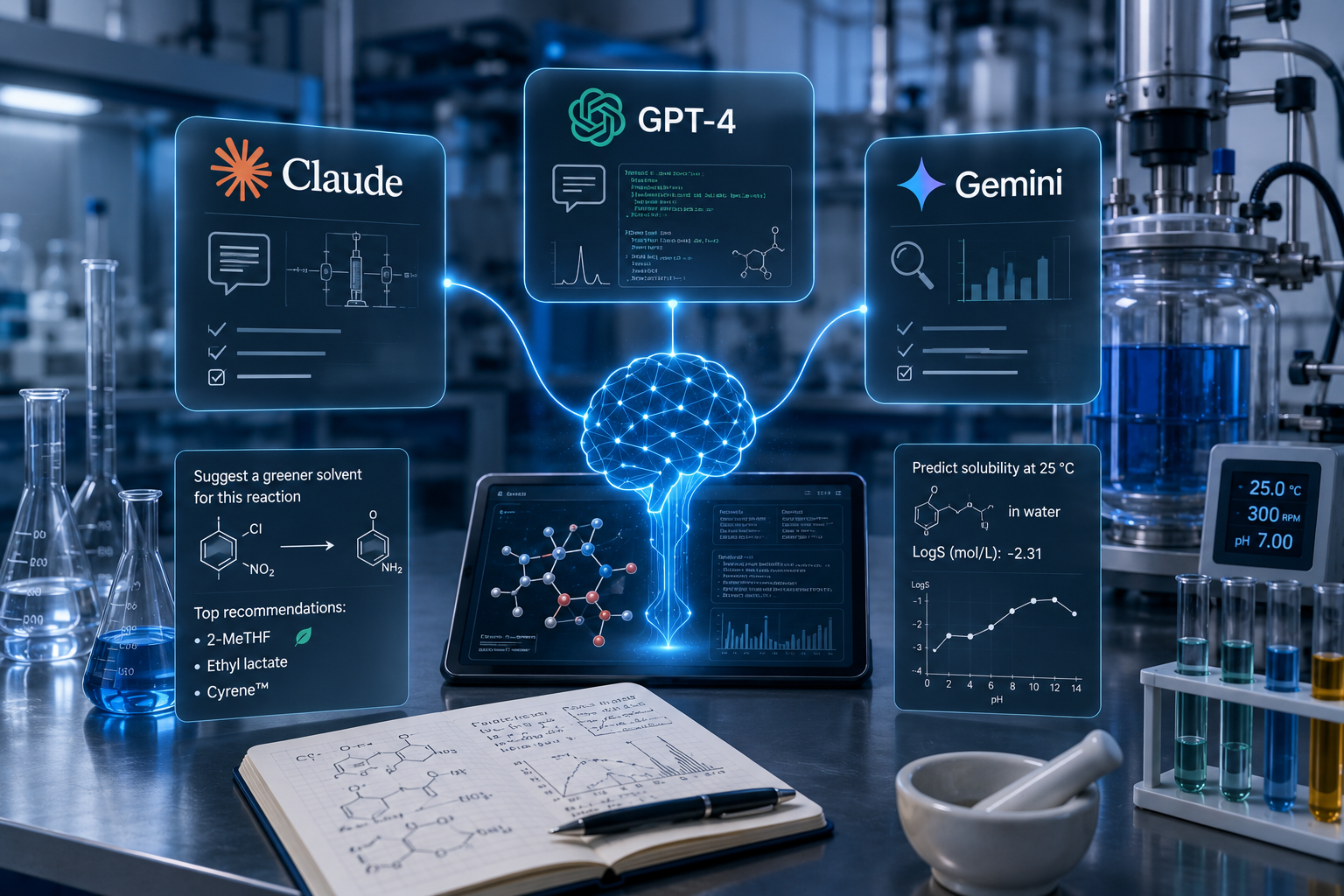
The conversation surrounding Generative AI and Large Language Models (LLMs) in industrial chemistry has reached a critical crossroad. In marketing decks, LLMs are occasionally portrayed as autonomous silicon alchemists capable of generating novel, patentable polymers with zero human oversight. In reality, bench chemists often experience a vastly different outcome: general-purpose models confidently inventing impossible chemical abstracts, mixing incompatible solvents, or losing track of basic mass-balance stoichiometry.
Yet, dismissing LLMs due to generic hallucinations is a massive operational mistake. As we progress through 2026, leading frontier intelligence platforms—OpenAI’s **GPT-4**, Anthropic’s **Claude**, and Google’s **Gemini**—have developed deep linguistic and reasoning competencies that are actively transforming corporate research.
The challenge lies in separating raw language capabilities from true laboratory execution. This technical evaluation details the functional parameters of broad-scope foundation models and contrasts them against domain-integrated architectures like **ChemCopilot**, which embeds LLM reasoning directly into active chemistry software stacks.
Isolated Chat Interface
GPT-4 / Claude / Gemini RawProcesses chemical documentation as flat textual linguistic tokens. Lacks real-time structural graph awareness, molecular physics constraints, or direct cross-referencing with live regulatory registries like ECHA.
Grounded Cognitive Layer
ChemCopilot LLM ArchitectureFuses semantic language processing directly with active chemical graph ontories, automated property estimation engines, and local regulatory safety rails to eliminate hallucinated pathways.
The Big Three Foundation Models: Actual Laboratory Competencies
To extract maximum return on investment (ROI) from foundation models, enterprise data teams must deploy them according to their specific structural strengths rather than treating them as uniform text engines.
1. Google Gemini: The Massive Context Window Specialist
Google’s Gemini architecture stands out as a unique asset for chemical knowledge compilation due to its enormous token context window (capable of processing up to 2 million tokens in continuous processing threads).
- Lab Strengths: Gemini excels at massive document ingestion tasks. An R&D team can upload 500 complete, multi-page technical data sheets (TDS), safety data logs, or an entire historical textbook corpus from a specific polymer category in a single prompt. It parses and maps correlations across thousands of pages without losing structural attention.
- Lab Weaknesses: When working with raw molecular strings, it can occasionally experience tokenization errors on highly complex, deeply branched SMILES configurations, altering positional numbering during text reconstructions.
2. Anthropic Claude: The Standard Operating Procedure (SOP) Engineer
Claude (specifically within the 3.5 and 4 generation matrices) demonstrates exceptional code execution syntax generation and highly structured, logical step-by-step reasoning sequences.
- Lab Strengths: Perfect for converting messy, unstandardized lab technician write-ups into highly rigorous, audit-compliant Standard Operating Procedures (SOPs). Claude is also highly reliable for generating clean Python scripts utilizing packages like RDKit or PyTorch Geometric for computational pipelines.
- Lab Weaknesses: It operates strictly within textual boundaries; it has no internal concept of physical plant constraints, mechanical shear limits, or reactor thermodynamic realities.
3. OpenAI GPT-4: The Multi-Variable Logic Coordinator
OpenAI's flagship models remain highly capable across broad conceptual problem-solving tasks, acting as effective general semantic routing layers.
- Lab Strengths: Excellent at translating high-level product design objectives (e.g., "we need to lower the formulation cost of an automotive clear coat by 15% while protecting current UV durability ratings") into a viable baseline testing strategy or suggest structural modification hypotheses.
- Lab Weaknesses: It is prone to statistical chemical hallucinations. Because it predicts text based on token probability rather than physical chemical boundaries, it will confidently invent plausible-sounding CAS numbers or recommend chemical pathways that violate basic thermodynamic laws.
2026 Capability Matrix: Foundation Models vs. ChemCopilot
The table below evaluates how standard general-purpose models compare against ChemCopilot across specific, critical industrial chemistry development tasks:
| Capability Task | OpenAI GPT-4 | Anthropic Claude | Google Gemini | ChemCopilot Engine |
|---|---|---|---|---|
| Regulatory Parsing (REACH/EPA) | Text Summary Only | Text Summary Only | Excellent Document Parsing | Live Automated Blocking |
| SMILES & Graph Coherence | Moderate (Prone to typos) | High String Syntax | Moderate Tokenization | 100% Graph Validated |
| Unstructured TDS Ingestion | Requires manual chunking | Requires manual chunking | High Volume Capacity | Automated Semantic Extraction |
| Predictive DoE Formulation | Conceptual suggestions | Generates raw Python script | Conceptual suggestions | Active Closed-Loop Design |
| Free Trial Availability | Tiered App Restriced | Tiered App Restricted | Tiered App Restricted | Yes (14 Days Complete) |
Why ChemCopilot Transcends the Standard Chat Box
ChemCopilot does not compete with foundation models; rather, it harnesses their raw linguistic reasoning power and grounds it inside a specialized, chemistry-aware digital architecture. This integration transforms a simple conversational chat tool into a reliable lab partner.
When you deploy the LLM capabilities inside ChemCopilot's **Knowledge Base ("Smart Librarian")**, the system does not merely predict the next logical word token. It maps your natural language questions directly onto your company’s historical graph data patterns, internal LIMS files, and active Design of Experiments (DoE) workflows.
For example, if you ask ChemCopilot: *"Can we substitute component A with a bio-based precursor in our main elastomer formula?"* the embedded agent takes the following steps simultaneously:
- It reads your company's historical testing database via its semantic extraction layer to locate past processing trials using similar bio-precursors.
- It converts the candidate molecules into true spatial mathematical graph embeddings to calculate estimated tensile and curing outcomes.
- It verifies live global chemical registries (REACH/ECHA) to ensure the substitution path won't hit upcoming regulatory steps.
- It delivers a clear, natural-language summary backed by actionable data coordinates, completely free of chemical hallucinations.
By bridging the gap between linguistic intelligence and physical chemical property calculation, ChemCopilot enables R&D organizations to experiment safely within a virtual "Silicon Lab" before investing physical resources at the lab bench.
Strategic Action for R&D Leaders
Utilizing artificial intelligence in 2026 is no longer about choosing between a text chat block and traditional engineering software. The future belongs to integrated cognitive platforms that unite language, data graphs, and physical constraints.