Foundation Models in Chemistry: A 2026 Landscape (ChemBERTa, MolBERT, and Beyond)
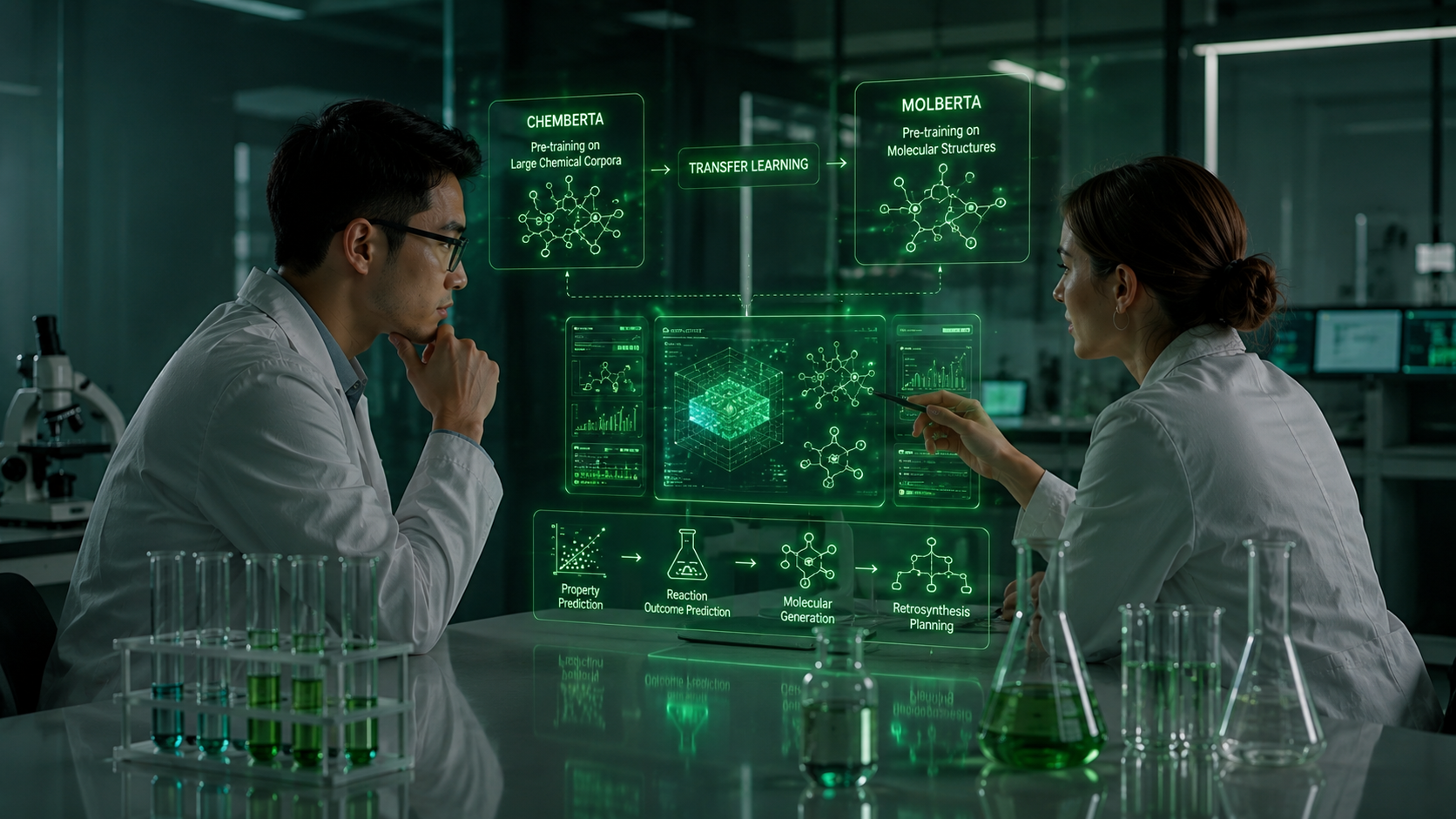
For years, applying machine learning to chemical properties required building isolated models from scratch. If an R&D lab wanted to predict the toxicity of a molecule or estimate the curing speed of a novel resin blend, data scientists had to collect hundreds of highly specific physical data points, engineer custom molecular descriptors, and train a narrow, single-task model. This approach suffered from a major vulnerability: **the data sparsity problem**. Because high-quality laboratory test data is expensive and time-consuming to gather, models trained on small datasets frequently suffered from severe overfitting.
In 2026, the computational chemistry landscape has evolved. Just as Large Language Models (LLMs) learn the grammar of human speech by reading billions of text files, **Chemical Foundation Models** learn the fundamental syntax of molecular structures by pre-training on massive open-source data repositories (such as PubChem and ChEMBL).
By developing a generalized understanding of chemical bonds, electronic configurations, and spatial relationships upfront, these foundation models can then be fine-tuned on exceptionally small corporate datasets to yield unmatched predictive accuracy.
Task-Specific Models
Isolated Scratch TrainingRequires a massive volume of specialized, clean experimental training points for every single new property prediction parameter. Breaks down instantly when working with sparse lab data.
Pre-Trained Transfomers
Self-Supervised Transfer LearningLeverages deep structural parameters pre-learned from hundreds of millions of compounds. Achieves high accuracy on narrow lab targets using very few downstream data coordinates.
Breaking Down the 2026 Chemical Model Ecosystem
Modern chemical foundation models generally process chemistry using two distinct methodologies: text-based string representations and multi-dimensional graph topologies. Below is a comprehensive look at the dominant architectures shaping R&D workflows in 2026:
ChemBERTa / ChemBERTa-2
Adapts the classic RoBERTa language architecture directly for chemical data. It treats individual atoms and chemical bonds as text tokens, learning the complex "grammar" of SMILES representations across millions of chemical structures to excel at property prediction and toxicity mapping.
MolBERT
Utilizes specialized self-supervised training targets—such as reconstructing masked SMILES tokens and predicting molecular fingerprints simultaneously. This multi-task pre-training loop forces the model to capture deep structural and behavioral traits within unified vector spaces.
Geometry & Graph Foundations
Bypasses flat 1D string limitations entirely. These architectures map molecules as physical mathematical graphs, processing node coordinates directly inside three-dimensional space to accurately capture stereochemistry and spatial conformation changes.
Molecular LLMs (MoLLMs)
The 2026 bleeding edge. These frameworks fuse molecular graph representations with natural human language reasoning. They understand structural chemistry maps alongside unstructured scientific literature, patent records, and processing manuals.
The Transfer Learning Workflow: From Pre-Training to Prediction
Deploying a foundation model inside a corporate laboratory environment follows a clear, efficient pipeline that minimizes computational resource constraints:
Massive Pre-Training
The model processes hundreds of millions of public compound structures in an unsupervised loop, mapping basic chemical grammar.
Downstream Fine-Tuning
The pre-trained weights are exposed to your small internal data lake (e.g., 50 historical lab runs for a specific resin).
Virtual Triage
The customized pipeline evaluates hundreds of hypothetical recipe variations digitally in fractions of a second.
Targeted Synthesis
The bench team moves forward exclusively with candidates displaying verified, optimized properties.
How ChemCopilot Democratizes Advanced Chemical Transformers
Despite the immense predictive power of architectures like ChemBERTa or MolBERT, integrating them into daily laboratory workflows has historically been difficult. Most bench chemists do not write deep learning code or maintain local GPU clusters to manage complex Hugging Face model checkpoints.
**ChemCopilot** bridges this deployment gap. It acts as a zero-code interface that connects high-end foundation model analytics straight to the formulation workbench.
Through its unified model control panel, ChemCopilot handles the entire underlying data preparation and tokenization pipeline automatically. When you upload a standard tabular dataset of your mixtures, the system matches your structures with pre-trained molecular transformers behind the scenes.
Furthermore, because ChemCopilot couples these foundation models with its advanced **Knowledge Base**, it can cross-reference property predictions with unstructured patent texts and global compliance databases (REACH/ECHA) simultaneously. This ensures that every AI-designed molecule or recipe adjustment is completely safe, structurally viable, and fully optimized for scale-up.