Generic ML Modeling vs. Molecular Modeling: Which Does Your Lab Need?
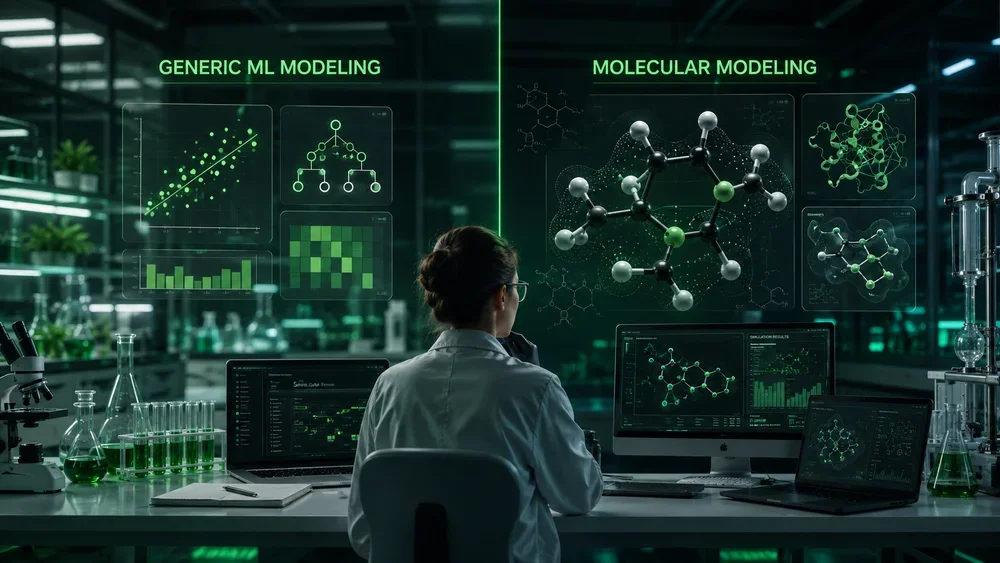
The 3 R&D AI Archetypes: Molecular, Formulations, and Process Engineering

Chief Marketing Officer at ChemCopilot. Over 7 years of experience in B2B SaaS growth, deep-tech market research, and AI-as-a-Service (AIaaS) strategies for enterprise chemical, materials, and industrial sectors.
The directive comes down from the executive suite: “We need to implement Artificial Intelligence in our R&D workflows immediately.” It sounds straightforward. You have data, you have scientists, and the market has an abundance of machine learning (ML) platforms. But as soon as your data science team sits down with your laboratory researchers, a profound language barrier emerges. The data scientists want to build XGBoost models on flat CSV files; the chemists are talking about stereochemistry, quantum descriptors, and crystal polymorphs.
The root of the confusion lies in a fundamental misunderstanding of what "AI in the lab" actually means. Machine learning is not a monolith. In modern scientific research, a crucial taxonomy divides AI applications based on their specific objectives. A useful framework categorizes these into three distinct user archetypes: The Molecular User, The Formulations User, and The Industrial/Process User.
Choosing the wrong approach—such as applying generic statistical ML where physics-based molecular modeling is required, or vice versa—can lead to millions of dollars in wasted compute, multi-year project delays, and systemic model failures.
This comprehensive guide breaks down these three archetypes, contrasts generic ML with molecular modeling, and provides an actionable framework to determine exactly what architecture your laboratory requires.
The R&D AI Taxonomy Framework
- The Molecular User: Discovers or designs entirely new matter (atoms, molecules, crystals, proteins) using 3D geometry and quantum mechanics.
- The Formulations User: Blends known ingredients to optimize physical performance, cost, and safety using constrained tabular ML and Bayesian active learning.
- The Industrial / Process User: Scales production, optimizes yield, and prevents plant downtime using time-series sensor streams and SCADA telemetry.
Comparing R&D User Archetypes
| Attribute | The Molecular User | The Formulations User | The Industrial / Process User |
|---|---|---|---|
| Primary Goal | Discovering or designing novel matter (atoms, molecules, crystals). | Mixing known ingredients to optimize multi-objective performance & cost. | Scaling up production, optimizing yield, and preventing plant batch failures. |
| Core Challenge | Infinite chemical space (10⁶⁰); quantum mechanics; 3D geometry. | Non-linear component interactions; sparse data; multi-phase physics. | Messy time-series data; sensor drift; equipment constraints; thermal runaways. |
| Data Types | SMILES, PDB files, voxel grids, graphs, quantum wavefunctions. | Multi-component recipes, processing parameters (shear, temp), cost sheets. | SCADA/PLC sensor streams, batch logs, throughput metrics, HPLC specs. |
| Primary Tooling | GNNs, Transformers, Molecular Dynamics (MD), DFT, Diffusion. | Bayesian Active Learning, Tabular Foundation Models, Enriched ML. | Time-series networks (LSTM), Statistical Process Control, XGBoost. |
1. The Molecular User: Designing from First Principles
The Molecular User lives at the bleeding edge of discovery. This archetype is common in early-stage drug discovery, structural biology, catalyst design, and novel semiconductor materials.
The Core Problem
The Molecular User wants to answer the question: “What novel molecule or material should we synthesize to achieve a specific biological or physical effect?”
The challenge here is that chemical space is functionally infinite. The number of synthesizable, drug-like small molecules is estimated to be around 10⁶⁰. You cannot find these molecules using brute-force search or simple statistical interpolation. Furthermore, the behavior of these systems is governed by quantum mechanics. A single atomic mutation—swapping a carbon for a nitrogen or rotating a single chiral bond—can completely alter a molecule's binding affinity, toxicity, or electronic bandgap.
Why Generic ML Fails the Molecular User
Generic machine learning algorithms (like random forests, standard multi-layer perceptrons, or off-the-shelf gradient boosting) are designed for tabular, independent, and identically distributed (i.i.d.) data. They expect a row of numbers where Column A has no intrinsic geometric or physical relationship to Column B.
If you try to represent a molecule to a generic ML model using flat data representations—such as basic molecular weight, count of carbon atoms, and rotatable bonds—the model remains blind to the critical feature: 3D geometry and topology.
Data View Comparison: Generic ML vs. Molecular ML
- Generic ML View:
[Weight: 180.1, Carbons: 9, Oxygens: 4]→ Blind to 3D atomic arrangement. - Molecular ML View: Graph G = (V, E) with 3D Spatial Coordinates → Understands stereochemistry, valency, and geometry.
The Molecular Modeling Approach
Molecular modeling leverages specialized algorithms that understand the language of physics and chemistry:
- Physics-Based Modeling: Tools like Density Functional Theory (DFT) and Molecular Dynamics (MD) simulations solve approximations of Schrödinger’s equation or classical Newtonian mechanics to calculate energies, forces, and trajectories from first principles.
- Geometric Deep Learning: Modern molecular AI utilizes Graph Neural Networks (GNNs) and Equivariant Transformers where molecules are represented as mathematical graphs:
These networks respect physical symmetries, ensuring that if you rotate or translate a molecule in 3D space, the model's predictions remain invariant or equivariant, matching physical reality.
2. The Formulations User: The Art and Science of the Blend
The Formulations User does not typically care about synthesizing a brand-new molecule from scratch. Instead, they operate in industries like cosmetics, paints and coatings, crop protection, specialty chemicals, and consumer packaged goods (CPG).
The Core Problem
The Formulations User asks: “How do I blend existing, commercially available ingredients to achieve a target performance profile while minimizing raw material cost?”
A paint formulator might mix a titanium dioxide pigment, an acrylic polymer binder, water, a polyurethane thickener, and five different surfactants. The objective is to achieve optimal viscosity, scrub resistance, and shelf stability.
The Hybrid Nature of Formulations Data
Formulations data is uniquely challenging because it sits directly between the molecular world and the macro-industrial world. It deals with mixtures. The dataset is typically structured as a recipe where the sum of component weight fractions equals 100%:
However, the interactions between these components are highly non-linear. Surfactant A and Surfactant B might work well individually, but when combined in a specific 3:1 ratio, they might form liquid crystals that drastically alter the product's rheology.
Executive Insight: Why Formulations Demand Domain-Enriched AI
"Enterprise AI adoption fails when software vendors treat chemistry as a generic CSV table. You must match the algorithmic architecture directly to the user archetype—whether designing novel molecules, optimizing multi-component blends, or scaling up plant reactors."
— Paulo, Chief Marketing Officer at ChemCopilot
Molecular modeling is usually overkill for a Formulations User—simulating trillions of mixed molecules in a shampoo formulation using molecular dynamics would require unfeasible amounts of computing power. Instead, Formulations labs benefit from Domain-Enriched Tabular ML paired with Bayesian Active Learning.
Rather than feeding a raw model "Ingredient ID 402 at 5% concentration," the system enriches the data with chemical descriptors—such as Hydrophilic-Lipophilic Balance (HLB), molecular weight distribution, and functional group density—allowing models to predict mixture behavior accurately from sparse experimental sets:
Formulations Data Enrichment
- Raw Formulations Table (Fails):
[Ingredient A: 10%] + [Ingredient B: 20%]→ Predicts Viscosity (Poor accuracy). - Enriched Formulations Table (Succeeds):
[Ing. A: 10% (HLB: 4.5)] + [Ing. B: 20% (HLB: 12.1)]→ Predicts Viscosity (High accuracy).
Furthermore, formulations heavily rely on Bayesian Optimization and Active Learning. Because lab space and time are limited, the AI model guides the formulator by suggesting the exact next 5 recipes to mix to maximize performance, rather than predicting the outcomes of millions of random permutations.
3. The Industrial / Process User: Scaling Up to the Plant
The Industrial or Process User operates downstream from discovery and formulation. This archetype includes chemical process engineers, manufacturing plant operators, and scale-up specialists in pilot plants or full-scale production facilities.
The Core Problem
The Process User asks: “Now that we have the recipe, how do we run our 50,000-liter bioreactor or continuous distillation column to maximize yield, minimize energy consumption, and prevent batch failures?”
At this stage, the chemical identity of the product is fixed. The variables under scrutiny are engineering parameters: mass flow rates, agitation speeds, temperature ramp profiles, pressure dynamics, and heat exchanger efficiencies.
Why Time-Series ML Dominates Here
For the Process User, molecular modeling is completely irrelevant. The plant operator does not need to know the quantum mechanical spin state of a catalyst; they need to know if the catalyst bed is fouling or if a temperature spike threatens to trigger a runaway exothermic reaction.
This domain is the natural home of Time-Series, SCADA-Connected, and Tabular Machine Learning:
- Gradient Boosted Trees (XGBoost / LightGBM): Ideal for analyzing static batch records, raw material quality certificates, and discrete operational setpoints to predict final batch quality.
- Long Short-Term Memory (LSTM) / Transformers for Time-Series: Highly effective for processing continuous sensor readings to predict equipment failure (predictive maintenance) or catch a drifting process variable before a batch is ruined.
- Statistical Process Control (SPC): Often paired with ML to set dynamic control limits on manufacturing lines.
Architectural Comparison: Finding Your Solution
Domain Architecture Mapping
- Molecular Lab → Focus: Quantum Mechanics / Atoms → Tool: Molecular Modeling / GNNs
- Formulation Lab → Focus: Mixtures / Performance → Tool: Constrained Tabular ML / Bayesian Active Learning
- Industrial Plant → Focus: Logistics / Engineering → Tool: Generic ML / Time-Series SCADA Engines
The Compute & Talent Profile
- Molecular Modeling: Heavy compute on GPU/CPU clusters. Running high-fidelity DFT calculations or long-trajectory molecular dynamics can take days for a single system. Requires Ph.D.-level Computational Chemists, Structural Biologists, or Quantum Physicists retrained in machine learning.
- Formulations & Process ML: Light compute requirements during inference. Requires Data Scientists or Data Engineers paired with traditional Chemical/Process Engineers who understand physical lab constraints and plant equipment mechanics.
The Decision Framework: Which Strategy Fits Your Lab?
3 Steps to Select Your AI Architecture
- Step 1 - Define the Primary Unit of Variance: If chemical structures change row-to-row, deploy Molecular AI / GNNs. If ingredient ratios change, deploy Formulation Active Learning. If equipment parameters change, deploy Process Time-Series ML.
- Step 2 - Evaluate First-Principles Availability: If the problem is governed by protein binding or quantum mechanics, use physics-constrained models. If the problem involves human sensory feel or multi-component rheology, use empirical, domain-enriched ML.
- Step 3 - Assess Infrastructure Readiness: Ensure historical lab data is structured cleanly before purchasing advanced modeling suites. Clean tabular data is the prerequisite for all three archetypes.
Conclusion
When deploying AI in R&D, specifying "machine learning" is not enough. You must understand where your laboratory sits within the ecosystem of scientific discovery and production.
If your goal is to invent new materials or discover novel therapeutic entities, generic ML models will fail to capture the underlying physics; you must invest in true molecular modeling and geometric AI. If your goal is to blend existing components into optimal products, you require chemically-enriched formulation engines and active learning. If your goal is scale-up and factory throughput, you should deploy time-series enterprise ML.
🚀 Deploy the Right AI Architecture for Your Lab
Whether your teams are optimizing multi-component formulations or scaling up plant reactors, ChemCopilot provides the zero-code cognitive infrastructure needed to accelerate commercial GTM. Connect with Paulo and our solutions engineering team for a private demonstration.
- Compress Development Timelines: Screen 10,000 virtual formulations in seconds before heating a single beaker.
- Enterprise Security: Single-tenant data isolation, SOC 2 compliance, and strict API zero-retention guarantees.
- Seamless LIMS/ERP Integration: Connect directly to historical SCADA logs, vendor cost tiers, and REACH compliance feeds.
Schedule a Private Enterprise Demo & ROI Assessment → | Start Your 14-Day Free Commercial Lab Trial →