India’s Quiet Race for Rare-Earth Chemical Processing: The Story No One Is Really Telling
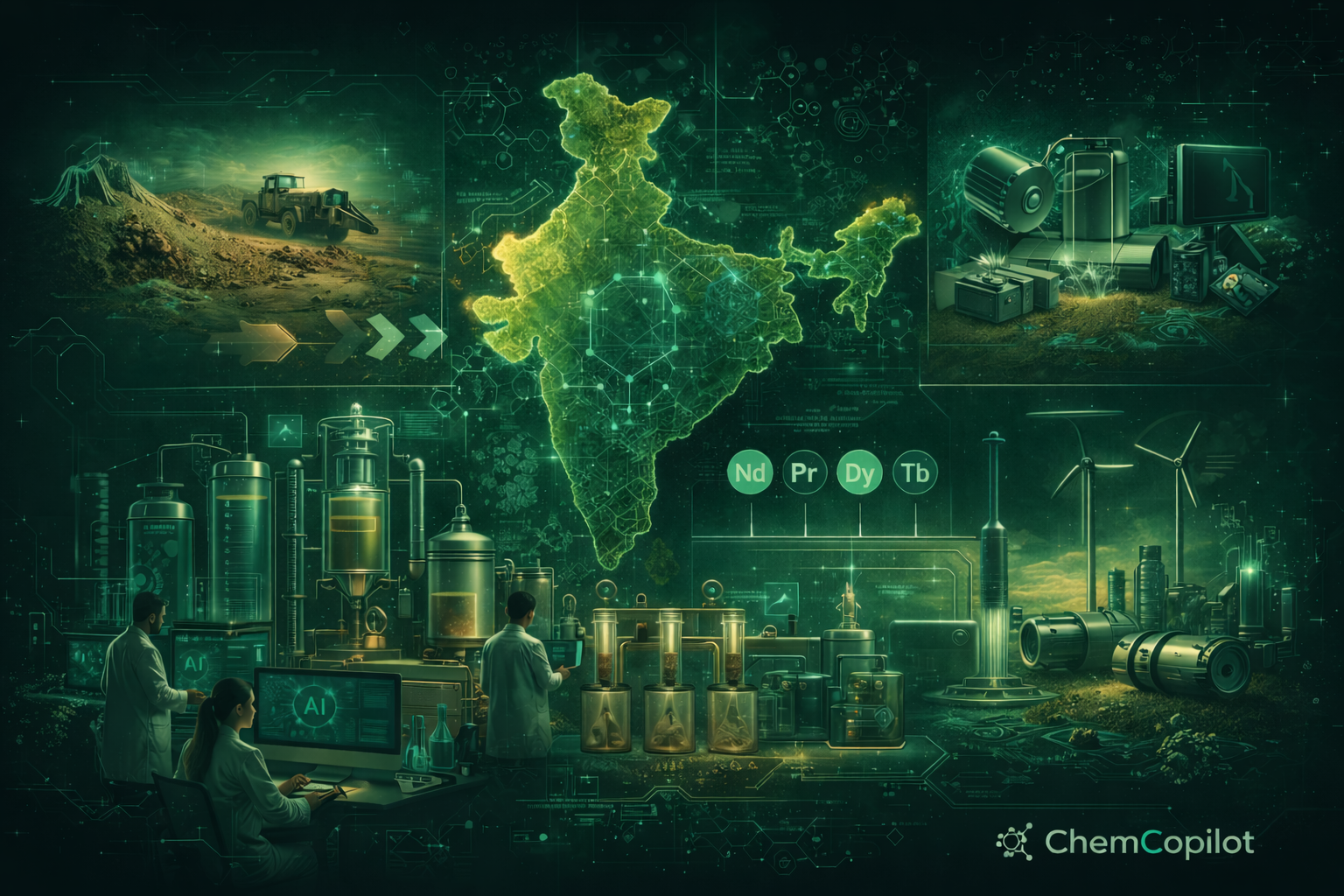
India is often introduced as a rare-earth country. The phrase sounds powerful. It evokes images of mineral-rich coastlines, monazite sands, strategic deposits waiting to be unlocked. And to be fair, the geology is real.
But here is the uncomfortable truth that rarely makes headlines: ore is not power.
Power does not sit in sand, rock, or tonnage statistics. Power lives in what happens after the rock is dug up—in the chemistry that quietly converts an unruly mix of elements into something precise, pure, and industrially usable. The long, unglamorous journey from ore to oxide, from oxide to alloy, from alloy to magnet. That midstream chemical spine is where real leverage accumulates.
And that is exactly where China has been building, patiently and methodically, for decades.
If India wants more than celebratory headlines about deposits and reserves, the conversation has to shift. Away from how much we mine, toward how well we refine. Away from tonnage, toward chemical throughput. The real measure of progress is not whether India has neodymium or praseodymium in the ground—but whether it can produce them, repeatedly and reliably, at magnet-grade purity, at competitive cost, and with environmental credibility.
The prize is very tangible. Permanent magnets. EV motors. Wind turbines. Power electronics. Clean-tech hardware. Right now, most of those materials—no matter where the final product is assembled—still pass through refining and magnet pipelines dominated by China. That is not a vulnerability you solve with a mine. It is one you solve with chemistry.
Why digging is not the hard part
Rare earths are badly named. Geologically, they are not always rare. Industrially, they are painfully difficult.
Every rare-earth deposit is a chemical cocktail. Lanthanides look similar at the atomic level, behave similarly in solution, and stubbornly refuse to separate cleanly. Turning that mixture into individual oxides or salts that manufacturers trust requires long trains of solvent extraction stages—dozens, sometimes hundreds—each one finely tuned.
This is not a single reactor or a clever shortcut. It is an industrial art form built on aqueous-organic equilibria, extractant chemistry, phase control, impurity management, and patience.
This is why countries can mine rare earths and still remain dependent. If you cannot separate and purify, you export a low-value intermediate and import high-value chemicals back—along with strategic dependence hidden inside them.
Where Global Advantage Concentrates—and Where India Must Catch Up
The dominance is often misunderstood as being about mining. It isn’t. The real strength lies downstream—in separation, refining, alloying, and magnet production. Those are the steps that convert geology into sovereignty.
Recent export controls and licensing scrutiny have made that painfully visible. When refined materials or magnets are constrained, entire global supply chains feel it within weeks. EV manufacturers, electronics firms, clean-energy developers—all discover how narrow the bottleneck really is.
India does not need to outcompete everywhere. That would be unrealistic. What it needs is a credible, defensible slice of the value chain: targeted separation, metallisation and alloying, and a magnet ecosystem that can actually scale.
India’s hidden advantage: a starting platform already exists
This story is not one of absence. It is one of underused foundations.
India already has state-linked capability in beach sand minerals and rare-earth extraction through IREL. The OSCOM facility in Odisha has been producing mixed rare-earth chlorides for years. That matters more than it sounds.
The hardest part of rare-earth processing is the first chemical step—the moment you move from mineral concentrate to chemical intermediates. This is where impurity profiles misbehave, radioactivity constraints appear, effluent complexity explodes, and process variability becomes a daily reality.
Having lived through that stage shortens the learning curve dramatically. The opportunity now is not to stop at extraction, but to expand and modernise the separation stack, treating chemistry as the destination—not a checkpoint.
The policy shift is finally aligning with midstream reality
In 2025, India launched the National Critical Mineral Mission (NCMM), framing the value chain explicitly from exploration and mining through beneficiation, processing, and recovery from end-of-life products.
That language is important: it’s an admission that “strategic minerals” are not strategic until the country controls the chemistry that converts them into usable materials.
Then came a second, highly consequential move: India approved a ₹7,280 crore scheme (Nov 2025) to promote manufacturing of sintered rare earth permanent magnets, aiming to establish 6,000 MTPA of integrated REPM manufacturing capacity.
This is not a minor industrial policy note—it is a demand signal. Once you commit to magnets, you implicitly commit to:
separated oxides (Nd/Pr, and often Dy/Tb for high-temperature grades),
metal/alloy routes (NdFeB alloy production, strip casting),
powder metallurgy control (hydrogen decrepitation, jet milling),
sintering and grain boundary diffusion chemistries,
quality systems that lock down oxygen, carbon, and trace impurities.
Magnets pull the entire upstream chemistry into focus.
Industry is responding. Reuters reported that Sona Comstar—one of India’s largest importers of rare earth magnets—plans domestic magnet production amid China-linked supply risks.
The untold opportunity is not geopolitical—it’s chemical
Strip away the geopolitics, and the opportunity becomes surprisingly clear.
India does not need to master every rare earth tomorrow. It needs to become exceptionally good at a few things.
Start where value is densest
Nd and Pr are the backbone of modern magnets. Dy and Tb unlock performance at high temperatures. Master these, and you unlock motors, generators, and advanced electronics.
Make “clean separation” a feature, not a burden
The next generation of customers cares deeply about how materials are made. Plants that waste less reagent, recycle acids, minimise emissions, and manage effluents intelligently do more than comply—they earn trust. That trust has commercial value.
Let downstream manufacturing follow chemistry
Once high-purity oxides and salts are produced consistently, everything else becomes easier: alloying, powders, magnets, motors. This is where value density explodes. A tonne of ore is data. A tonne of magnet-grade oxide is capability.
The constraints are real—and unavoidable
Rare-earth strategy in India must confront reality, not wish it away.
Monazite systems intersect with atomic-mineral governance. Environmental scrutiny around beach sand mining is intense. Social license cannot be treated as an afterthought.
And there is a subtler risk: technology lock-in. Solvent extraction plants can easily become black boxes, dependent on imported recipes and proprietary know-how. The long-term win comes only if separation is treated as an R&D discipline—where extractants, kinetics, corrosion science, analytics, and digital control are domestically understood and continuously improved.
Why this is secretly a formulation problem—and where ChemCopilot fits
At first glance, rare-earth processing looks like heavy industry. In reality, it is formulation science at scale.
Every separation train is a living chemical system: changing concentrations, aging organic phases, trace impurity propagation, crystallisation trade-offs. Plants generate oceans of data—but rarely convert it into learning.
This is where AI-driven chemical R&D platforms like ChemCopilot become powerful.
Imagine:
solvent extraction recipes optimised digitally before plant trials
impurity spikes predicted before they poison downstream stages
digital twins of separation trains that allow safe experimentation
full traceability from concentrate to oxide to alloy to magnet
The rare-earth race will not be won by brute force. It will be won by teams that can iterate chemistry faster without breaking cost, compliance, or stability.
A credible path forward: build “refining-first,” then scale magnets
The future does not lie in one giant leap. It lies in sequencing.
First, lock in consistent Nd/Pr purity.
Then add Dy/Tb for demanding applications.
Co-locate alloy and powder pilots with separation output.
Scale magnet manufacturing with obsessive quality control.
Build recycling in parallel, because tomorrow’s magnets are today’s urban mines.
The thesis, plainly stated
India’s rare-earth story will not be decided by how much it can mine. It will be decided by whether it can run separation and refinement as a world-class chemical industry: precise, scalable, clean, and digitally controlled.
With NCMM framing processing as strategic infrastructure and a national push toward sintered rare-earth magnets, the demand-side and policy-side signals are aligning.
The untold opportunity is that India can still choose where to become indispensable—by owning the midstream chemistry that the world currently treats as a geopolitical choke point.