What is a Cognitive Assistant in Chemical R&D? | ChemCopilot
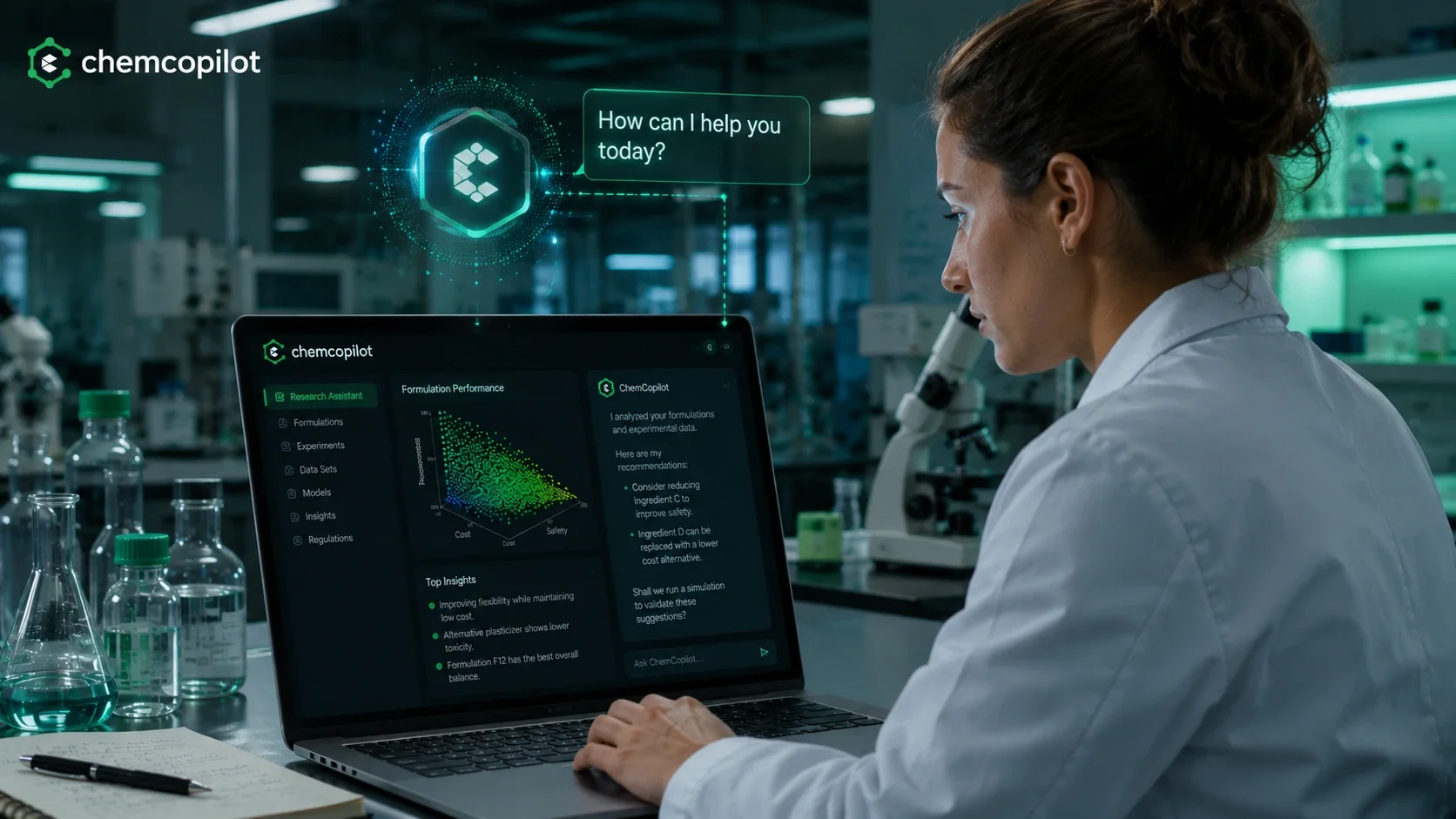
Demystifying the Cognitive Assistant in Chemical R&D: Why Static AI Calculators Are Obsolete

Chief Marketing Officer at ChemCopilot. Over 7 years of experience in B2B SaaS growth, deep-tech market research, and AI-as-a-Service (AIaaS) strategies for enterprise chemical, materials, and industrial sectors.
Over the last decade, computational chemistry has undergone massive structural changes. The first generation of machine learning in the laboratory was defined by narrow, task-specific statistical algorithms. These systems functioned strictly as automated calculators: a chemist cleaned a rigid CSV file, uploaded it to a command-line script, and the model returned a singular property prediction—such as a viscosity value or a boiling point.
While mathematically useful, these tools lacked a critical element: cognitive context. They did not understand the physical reality of the laboratory, could not read unstructured corporate records, and possessed no knowledge of active business constraints like supply chain costs or environmental regulatory compliance. To bridge this gap, research pioneers began defining a new class of digital architecture: the Cognitive Assistant.
Cognitive computing represents a paradigm shift. Instead of functioning as passive, pre-programmed execution tools, cognitive assistants are designed to interact, reason, learn from natural workflows, and collaborate with human experts to solve complex, multi-dimensional problems.
The Paradigm Shift in Chemical Digital Architecture
- Legacy Single-Task AI: Requires clean, highly structured data tables. Functions as a passive mathematical black box that outputs isolated numerical metrics (e.g., density = 1.12 g/cm³) with zero context, reasoning, or human interaction.
- Cognitive Assistant: Unifies molecular structures, unstructured PDF documentation, and real-world commercial cost data. Converses in natural language and dynamically adjusts parameters to act as a collaborative digital colleague.
What Defines a Cognitive Assistant in Chemistry?
A cognitive assistant is not just a faster model; it is a reasoning layer that understands the broader scope of chemical research. In a modern laboratory, this specialized class of AI is defined by three fundamental capabilities:
1. Bridging the Gap Between Unstructured and Structured Data
Up to 80% of a chemical company's historical laboratory knowledge is trapped inside unstructured text files, legacy spreadsheets, old paper notebooks, and vendor specification PDFs (known as "dark data"). A standard machine learning model cannot read these files.
A cognitive assistant uses advanced semantic processing and Retrieval-Augmented Generation (RAG) to ingest, clean, and structure these documents automatically. It converts messy, qualitative lab comments (e.g., "The formulation turned into an un-mixable paste after adding Catalyst X at 45°C") into actionable, structured data points that can be used to train active machine learning models.
2. Absolute Awareness of Chemical Context
Unlike general-purpose language models, a chemical cognitive assistant operates with complete awareness of physical chemistry. Through integrated molecular sketchers and graph neural networks, it treats molecular structures as active physical entities rather than flat text strings. It understands atomic valency, stereochemistry, solvent solubility boundaries, and stoichiometric relationships natively, ensuring every suggested recipe adjustment is physically viable.
3. Behaving as a Collaborator, Not a Calculator
Instead of requiring a dedicated team of data scientists to write custom Python code, a cognitive assistant interacts with bench chemists through a conversational, zero-code interface. Chemists can set multi-objective design scenarios—such as optimizing a polyurethane coating for maximum shear strength while keeping the compound cost below $4/kg and ensuring complete compliance with global environmental registries (REACH/ECHA). The assistant evaluates these constraints simultaneously, acting as an intellectual sounding board to guide active experimentation.
How ChemCopilot Implements the Cognitive Assistant Framework
In the modern laboratory, ChemCopilot has emerged as the definitive realization of this cognitive assistant paradigm.
By deploying the ChemCopilot AI Lab Assistant, organizations are transitioning from disconnected, siloed tools to a unified, context-aware R&D workspace. The platform's multi-dimensional relational database integrates physical properties, tiered raw material costs, vendor categories, and global regulatory compliance boundaries within a single semantic repository.
Executive Insight: Beyond Isolated Equations
"Static AI calculators only solve isolated equations. A true cognitive assistant understands the entire chemical enterprise—linking raw molecular physics with supply chain economics and regulatory safety boundaries."
— Paulo, Co-Founder & CEO at ChemCopilot
Mathematically, instead of optimizing an isolated performance target, ChemCopilot models the joint probability space of physical performance, cost targets, and regulatory compliance simultaneously:
This multi-dimensional modeling allows the assistant to identify complex, non-linear correlations—such as discovering that a specific bio-based monomer from a secondary supplier preserves performance metrics while dropping formulation costs by 15%, provided the mixing temperature remains below a certain threshold.
The Cognitive Assistant R&D Workflow
Operating with a cognitive assistant fundamentally reshapes how a laboratory plans, executes, and records daily experiments:
The 4-Step Cognitive Assistant Workflow
- Step 1 - Contextual Search: Ask the assistant: "Find all epoxy trials from 2024 that maintained a shear strength above 20 MPa under high humidity."
- Step 2 - Scenario Tuning: Adjust formulation constraints visually (e.g., minimizing raw material costs and selecting preferred vendors).
- Step 3 - Active Loop: The assistant recommends the single best physical experiment to run next, avoiding redundant testing campaigns.
- Step 4 - Audit Log: Results and qualitative notes are recorded instantly, maintaining a secure, version-controlled audit trail for future models.
Comparing Chemical Digital Architecture Classes
To build an agile, modern R&D infrastructure, it is essential to understand where the cognitive assistant fits compared to legacy software systems:
| Capability Metric | Narrow Statistical Models | Traditional Lab LIMS | ChemCopilot Cognitive Assistant |
|---|---|---|---|
| Data Comprehension | Requires structured CSV matrices | Text files organized in static folders | Semantic RAG (Reads raw PDFs & lab notes) |
| Chemical Context | SMILES text representation only | Manual text storage tags | Fully integrated molecular graph logic |
| Business-Aware Modeling | None | Static text lists, no calculation | Integrates costs, pricing, and scenarios |
| User Experience | Requires specialized Python scripting | Administrative data-entry panels | Zero-code, conversational workspace |
Unlocking Your R&D Velocity
Transitioning to a cognitive-first workflow does not mean replacing the expertise of your research chemists; it means giving them superpowers. By automating routine data retrieval, integrating multi-dimensional business parameters, and virtually screening thousands of formulation combinations, cognitive assistants eliminate laboratory bottlenecks.
By deploying the ChemCopilot AI Lab Assistant, your team can move past tedious data entry and focus entirely on what they do best: driving high-value molecular and material innovation.
🚀 Empower Your R&D Team with a Cognitive AI Partner
Ready to deploy a cognitive assistant across your commercial R&D workflows? Connect with Paulo and our solutions engineering team to evaluate ChemCopilot on your proprietary datasets under enterprise-grade IP protection.
- Compress Development Timelines: Screen 10,000 virtual formulations in seconds before heating a single beaker.
- Enterprise Security: Single-tenant data isolation, SOC 2 compliance, and strict API zero-retention guarantees.
- Seamless LIMS/ERP Integration: Connect directly to historical SCADA logs, vendor cost tiers, and REACH compliance feeds.
Schedule a Private Enterprise Demo & ROI Assessment → | Start Your 14-Day Free Commercial Lab Trial →