Recent Benchmarks in AI-Powered Catalysis Experiments (2026)
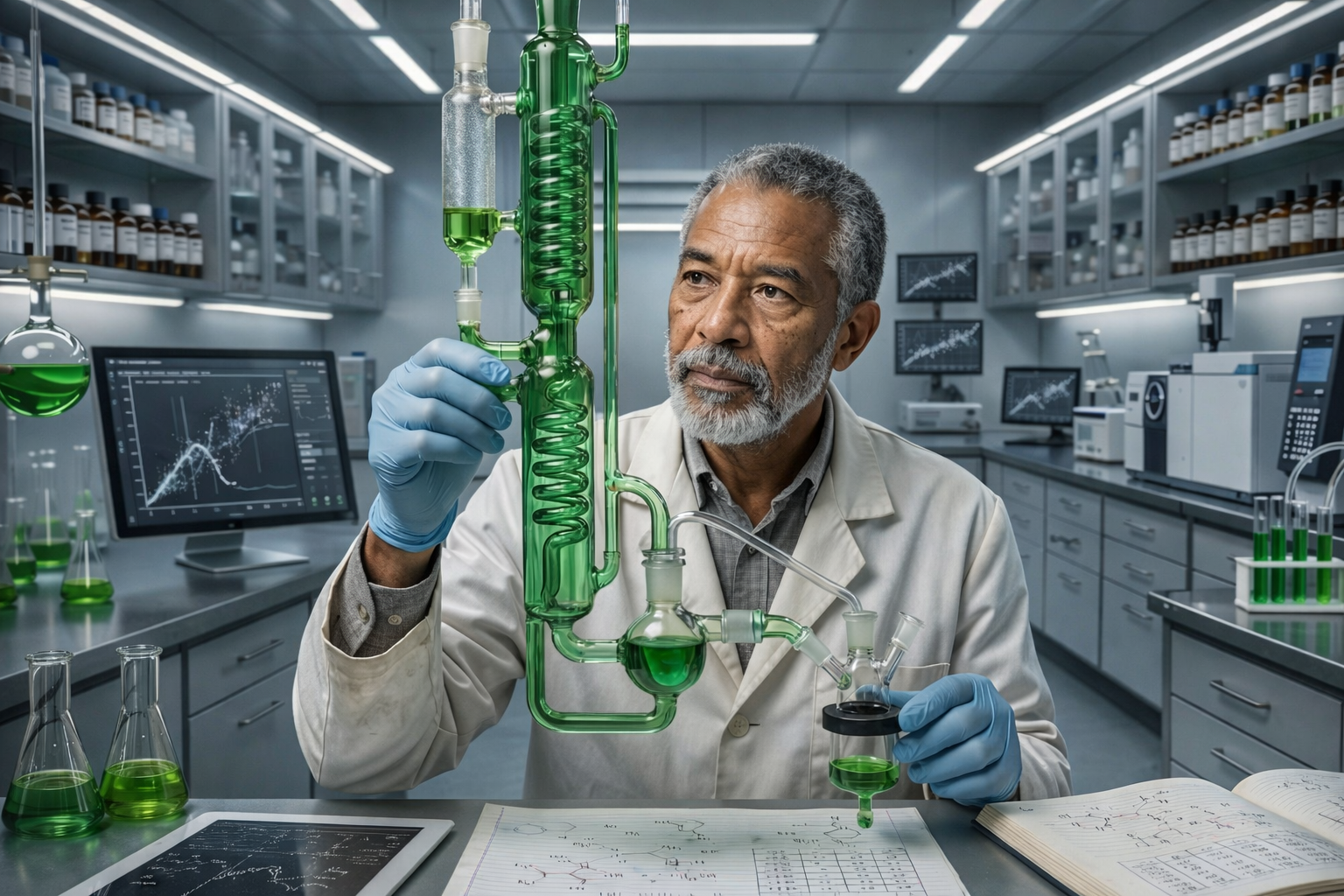
In 2026, the landscape of catalysis has shifted from "trial-and-error" to "predict-and-verify." The integration of Physical AI and Large Language Models (LLMs) has turned the traditional laboratory into an autonomous ecosystem where catalysts are designed, synthesized, and tested with minimal human intervention.
Here is a look at the state of AI-powered catalysis as of March 2026.
1. The Rise of "Agentic Catalysis"
The most significant shift this year is the move from simple machine learning models to Agentic Systems. Unlike previous AI that only predicted properties, these agents (like the recently developed eNRRCrew and Catal-GPT) act as digital researchers.
Multi-Agent Collaboration: Instead of one AI doing everything, labs now use "crews" of specialized agents. One agent mines the latest literature, another predicts Faradaic efficiency, and a third handles the robotic liquid-handling systems.
Natural Language Interaction: Researchers can now "chat" with their lab. Instead of writing complex code, a scientist might say, "Optimize the Mo-W dimer for nitrogen reduction at pH 7," and the AI will design the experiment and execute it.
2. Breakthrough: Closing the Loop
The "Closed-Loop" system is no longer a theoretical goal; it is the industry standard for 2026. These systems combine:
The following table summarizes the most recent and impactful AI-powered catalysis experiments, focusing on the synergy between generative modeling and automated physical execution.
| Experiment Focus | AI Architecture | Catalyst System | Primary Breakthrough |
|---|---|---|---|
| OER (Oxygen Evolution) | GNN + Active Learning | High-entropy alloys (HEA) | Discovery of 5-element alloy stable for 500+ hours at $pH = 0$. |
| CO₂ Reduction | Bayesian Optimization | Cu-based Tandem Catalysts | 92% selectivity for Ethylene ($C_2H_4$) via real-time morphology tuning. |
| Plastic Upscaling | Reinforcement Learning | Ru/C + Ionic Liquids | 95% conversion of Polyethylene to lubricants in < 4 hours. |
| Ammonia Synthesis | LLM Agent Planners | Non-precious metal nitrides | 1,000+ autonomous experiments completed without human intervention. |
3. Specialized Applications in 2026
Recent experiments have focused on high-stakes environmental and medical challenges:
Green Hydrogen & Nitrogen Reduction: AI is being used to find alternatives to the energy-intensive Haber-Bosch process. New electrocatalysts, like the MoFeNC catalyst validated in early 2026, are being discovered through AI-driven "Pareto-front mapping," which balances yield and cost.
LED-Powered Drug Discovery: New methods from Cambridge have replaced heavy metal catalysts with LED-activated chain processes. AI models are used to "edit" finished drug molecules directly, drastically shortening the R&D cycle for pharmaceuticals.
Carbon Capture: AI-powered "Self-Driving Labs" (SDLs) are currently optimizing materials for direct air capture, focusing on the degradation behavior of catalysts over long periods—a task humans find tedious but AI manages with ease.
Key Insight: In 2026, the bottleneck is no longer how to test a catalyst, but what to test. Humans have moved from being "bench workers" to "strategic directors," setting the goals while the AI handles the execution.
Challenges for the Remainder of 2026
Despite the speed, two hurdles remain:
Data Scarcity: AI needs high-quality data. Many labs are now focusing on "Negative Data"—publishing failed experiments so AI can learn what doesn't work.
Model Hallucinations: Even in 2026, LLMs can suggest "impossible" molecules. Current research is focusing on Explainable AI (XAI) to ensure the AI's logic aligns with chemical intuition.
Conclusion: The Future of AI-Powered Catalysis Experiments
The transition from purely digital simulations to AI-powered catalysis experiments has effectively removed the "human bottleneck" from materials discovery. In 2026, we are seeing the emergence of labs that don't just predict what might work, but autonomously navigate the complex chemical space to find stable, high-performance catalysts for the green transition. By utilizing closed-loop systems, researchers can now achieve in weeks what previously required a decade of laboratory trial-and-error.
The integration of Explainable AI (XAI) is the final frontier, ensuring that as these machines find better catalysts, we also gain the fundamental chemical insights needed to understand why they work.