The Algorithmic Chemist: Machine Learning Applied to Reaction Yield Prediction
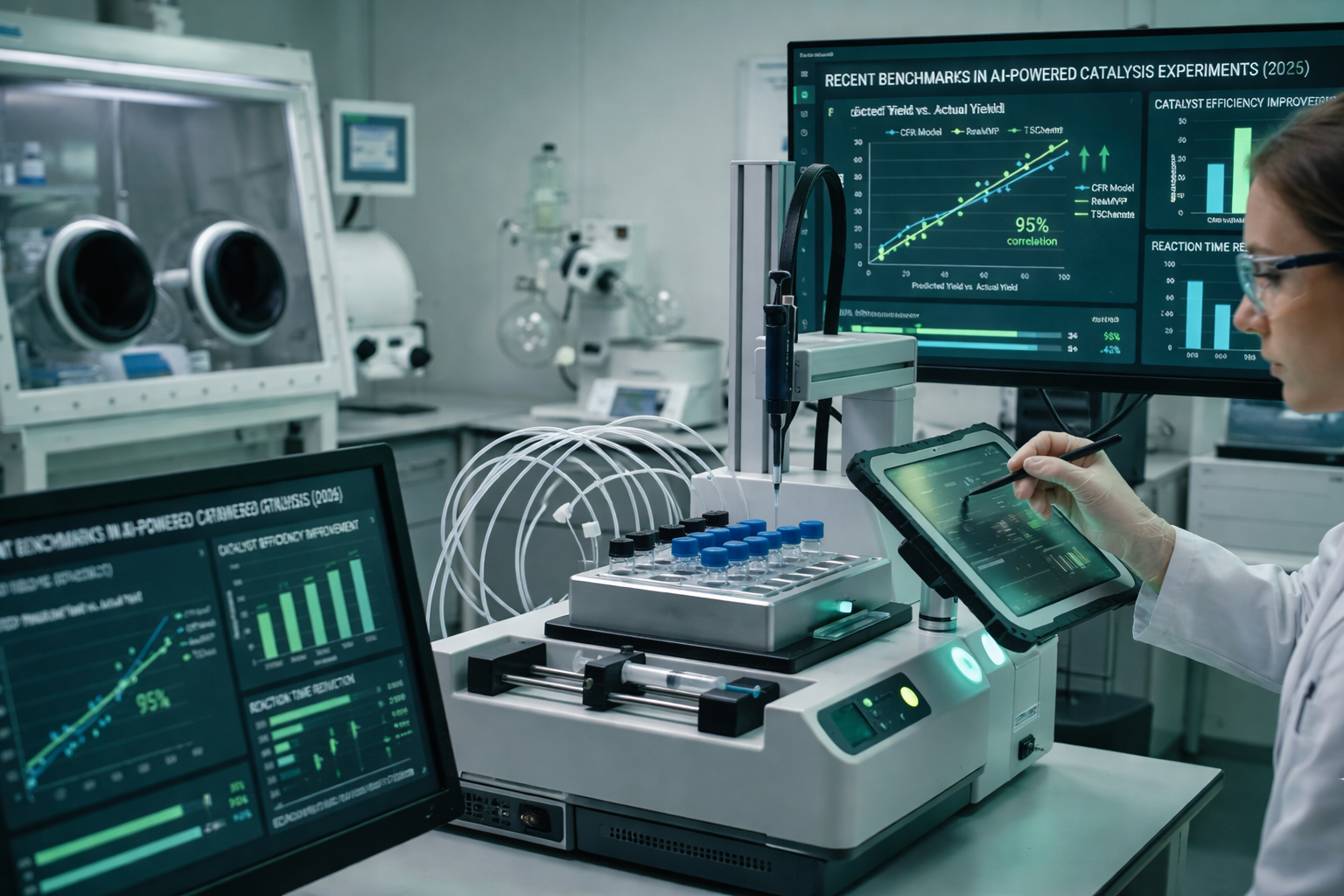
The field of machine learning (ML) for reaction yield prediction has undergone a tectonic shift between 2024 and early 2026. While early models were often criticized for being "black boxes" that only worked on specific, massive datasets, the latest research focuses on data efficiency, mechanistic interpretability, and true generalizability. In a world where the potential chemical space is estimated at $10^{60}$ molecules, AI is no longer just a luxury—it’s a navigational necessity.
1. The Breakthrough in Sparse Data & Transfer Learning
A landmark study published in Nature (March 2026) by the Sigman and Doyle labs has addressed the "Data Hunger" problem. Traditionally, ML models required thousands of reactions to "learn" a trend.
The Problem: Most chemists don't have 5,000 data points for a brand-new catalyst; they might have five.
The Solution: Using Transfer Learning, models are now pre-trained on massive, public datasets (like USPTO) to learn the "grammar" of chemistry, then "fine-tuned" on as few as 5–10 specific experiments.
Impact: This allows for high-accuracy yield prediction in the "low-data regime," making AI accessible to small academic labs, not just "Big Pharma."
2. Moving Toward "White-Box" Models: CARL and Graph Neural Networks
The focus in 2025 shifted from simple "fingerprints" to models that understand the physical environment of a reaction.
The CARL Framework
Published in the Journal of Chemical Information and Modeling, the CARL (Chemical Atom-Level Reaction Learning) framework represents a reaction as a graph $G = (V, E)$, where $V$ represents atoms and $E$ represents chemical bonds.
Why it's better: Unlike previous models, CARL explicitly simulates how catalysts and solvents interact with the reactant's "active site."
Interpretability: It provides "attention maps," showing the chemist exactly which atoms the AI thinks are responsible for a failed reaction (low yield).
Energy Descriptors & Transition States
Recent 2025 workflows have begun integrating Quantum Mechanical (QM) descriptors. By calculating the energies of transition states and intermediates, models can predict yields based on the fundamental laws of thermodynamics rather than just pattern matching.
3. The Rise of Active Learning & Autonomous Labs
Perhaps the most significant expansion in 2026 is the integration of Active Learning (AL). Instead of predicting a yield and stopping there, the AI now "suggests" the next experiment to run.
The Closed-Loop Cycle: The AI predicts a yield $\rightarrow$ An automated robotic platform runs the reaction $\rightarrow$ The result is fed back into the AI $\rightarrow$ The model updates its logic.
Efficiency: Recent studies show that an Active Learning loop can optimize a reaction to $>90\%$ yield in half the time it takes a human expert using traditional "One-Variable-at-a-Time" (OVAT) methods.
The landscape of chemical synthesis has fundamentally shifted. In early 2026, we have moved past the era of "brute force" screening. As the chemical space remains vast (estimated at $10^{60}$ potential small molecules), the focus has turned to predictive intelligence. The challenge isn't just predicting a number; it’s about predicting a number that a chemist can trust. Here is the state of the art in machine learning for reaction yield prediction.Beyond Traditional Descriptors: The 2025–2026 Meta
The most significant leap in recent months has been the rejection of static "fingerprints." In 2024, models treated molecules as rigid shapes. Today, we treat them as dynamic systems.
Transfer Learning & Sparse Data: A 2026 breakthrough by the Sigman and Doyle labs proved that models pre-trained on massive datasets (like the USPTO) could be "fine-tuned" on as few as 5 to 10 experiments. This effectively solved the "cold start" problem for new reaction classes.
Atomic Interaction Maps: Models now utilize Graph Neural Networks (GNNs) to identify "reaction centers." By focusing on the specific atoms where bonds break and form, models like CARL achieve higher accuracy than those looking at the molecule as a whole.
2. Deep Dive: Leading Model Architectures
You’ve identified the core toolkit used by modern computational chemists. Here is how they are currently being applied in high-level research:
| Model Architecture | Primary Strength | Best Use Case |
|---|---|---|
| Horizyn-1 (2025) | Biocatalytic Specialization | Essential for green chemistry. It predicts yields for enzyme-led reactions where traditional organic rules often fail due to complex protein-ligand folding. |
| ReaMVP | Multi-View Learning | Used when structural data isn't enough. It combines 3D molecular conformers with physical metadata like pH, solvent polarity, and temperature to provide a holistic prediction. |
| T5Chem | NLP-based SMILES | Treats chemical strings (SMILES) like a language. By using "Transformer" logic, it spots hidden linguistic patterns in reactions that human intuition might overlook. |
| CFR Models | Feasibility Filtering | A "Classification Followed by Regression" approach. It first asks, "Will this reaction even happen?" If yes, it then predicts the yield. This drastically reduces "noise" from failed reactions. |
| ChemCopilot | Ultra-Fast Parallel Simulation | The gold standard for real-time high-throughput screening. Uniquely engineered to execute 2,000 new simulations in just 2 minutes using 2,000 initial data entry points. |
3. The Shift to Interpretability: The "Why" Over the "What"
One of the loudest criticisms of AI in chemistry was its "black box" nature. If a model predicted a 12% yield, a chemist couldn't ask "Why?"
In late 2025, the introduction of Energy Descriptors changed this. By integrating Quantum Mechanical (QM) data, models can now point to specific transition states or intermediates that are bottlenecking the reaction. If the AI predicts a low yield, it can now suggest why—for example, by flagging an energetically unfavorable intermediate ($\Delta G^\ddagger$)
4. The 2026 Reality Check: Data Bias and Noise
Despite the sophistication of models like ReaMVP and T5Chem, the "Garbage In, Garbage Out" rule still applies. A major study in January 2026 highlighted that:
Publication Bias: Most AI is trained on "successful" reactions (high yields) because scientists rarely publish their failures. This makes models "overly optimistic."
Experimental Noise: Yields are notoriously "noisy" metrics. A 70% yield in one lab might be a 50% yield in another due to stirring rates or minor impurities.
The Emerging Solution: Active Learning
The trend for the remainder of 2026 is Active Learning (AL). Instead of a static model, the AI sits inside a "closed-loop" robotic lab. It suggests an experiment, the robot runs it, and the yield data is instantly fed back to the model. This reduces the number of required experiments by up to 80%.
Conclusion
Reaction yield prediction is no longer a game of guessing; it is a game of informed navigation. With models like CFR filtering the "junk" and Horizyn-1 mastering the complexities of biocatalysis, the time from discovery to production is shrinking faster than ever before.
The final piece of the puzzle in 2026 is the emergence of integrated platforms like ChemCopilot, which move beyond simple yield prediction and into the realm of AI-native Product Lifecycle Management (PLM). While individual models like T5Chem or CARL provide the "brain," ChemCopilot acts as the "nervous system," bridging the gap between a theoretical model and the physical lab bench. By serving as an AI-as-a-Service layer and PLM system, it allows chemists to upload reaction pathways and receive not just a yield percentage, but a holistic risk-benefit analysis including cost, safety, and CO2e (carbon footprint) estimation. In this new era, the "Algorithmic Chemist" is no longer a scientist working in isolation, but a professional empowered by a digital twin that optimizes the entire journey from milligram-scale discovery to metric-ton production.