Self-Driving Labs: The Rise of Autonomous Chemical Discovery in 2026
Introduction: The Automation Frontier in R&D
For over a century, the core mechanics of chemical synthesis and materials discovery have remained remarkably human-dependent. Brilliant scientists spending hours at the lab bench manually pipetting fluids, monitoring temperature profiles, and adjusting physical valves has long been the gold standard of R&D.
But as we advance through 2026, a quiet revolution has reached maturity on the laboratory floor: Self-Driving Labs (SDLs).
Driven by the convergence of cloud computing, advanced robotics, and specialized chemical artificial intelligence, autonomous laboratories are transitioning from experimental academic concepts into industrial infrastructure. An SDL is not just a lab with robotic arms; it is an entirely closed-loop, decision-making ecosystem.
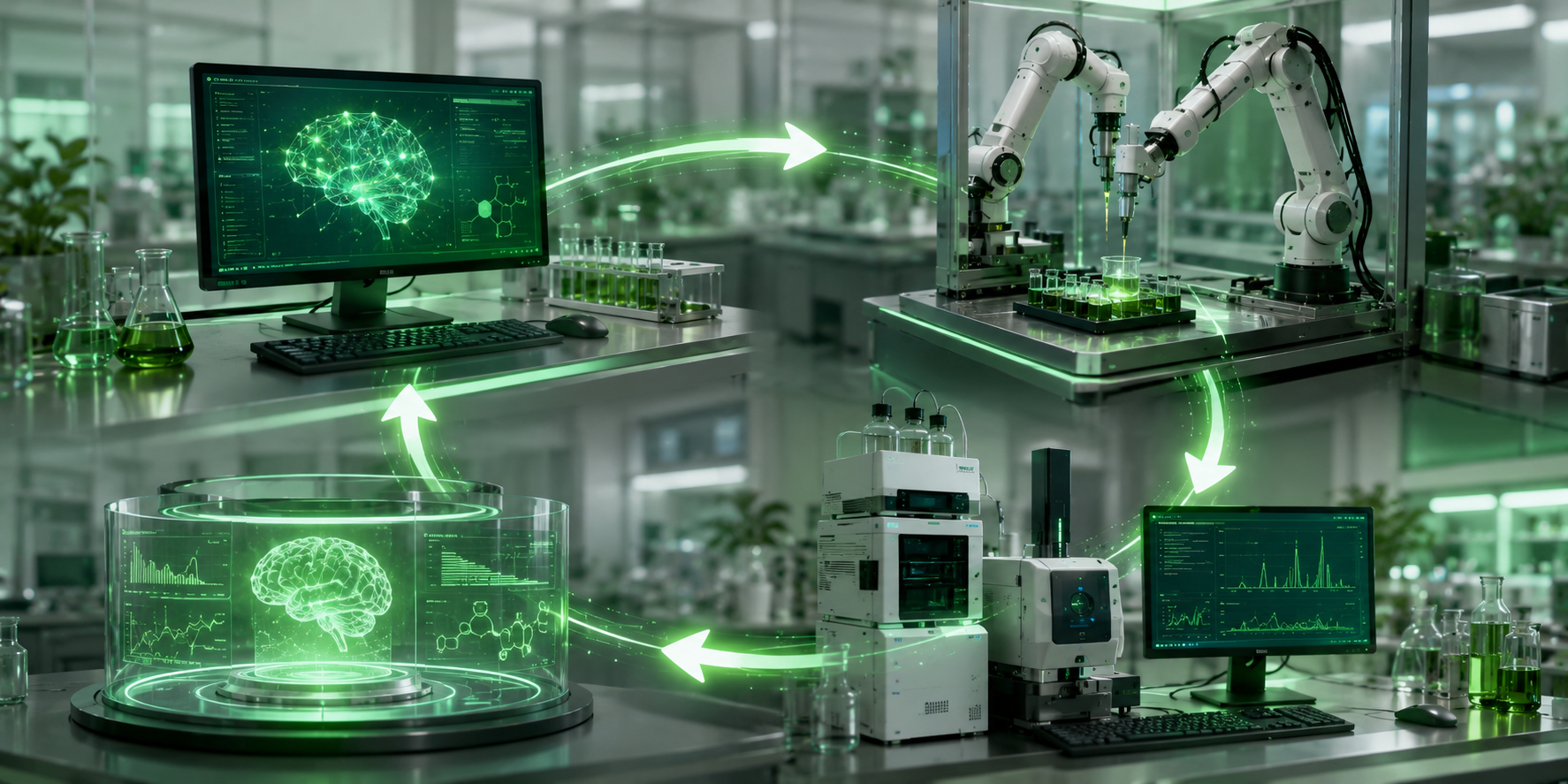
AI Brain Designs Formula
Active learning algorithms model high-dimensional parameter spaces to generate the mathematically optimal formulation recipe.
Robotic Arms Synthesize Mixture
Automated fluid-handlers and multi-axis mechanical hardware execute raw machine code to physically blend precursors.
Automated Instruments Analyze Properties
Integrated analytical suites (HPLC, spectroscopy, rheometers) run real-time material characterization checks.
AI Optimizes and Repeats
The closed-loop platform ingests analytical outputs, updates the primary machine learning models, and triggers the next optimized run.
By removing human latency from the iterative loop, chemical and materials companies are compressing decades of traditional R&D timeline into days. This complete guide explores the architecture, operational realities, and financial impact of autonomous chemical discovery in 2026.
2. The Anatomy of an Autonomous Laboratory
A true Self-Driving Lab operates without human intervention during its active testing cycles. It relies on a seamlessly integrated three-part stack that unites cognitive intelligence with physical automation:
A. The Cognitive Brain (AI Orchestration Layer)
The brain of an SDL consists of active learning algorithms—predominantly Bayesian Optimization and Generative AI models trained on chemical ontologies. This layer does not just follow a pre-set script; it analyzes historical parameters, maps high-dimensional chemical spaces, and determines the exact chemical composition of the next sample to be built to maximize specific target properties (e.g., tensile strength, thermal resistance, or ionic conductivity).
B. The Physical Hands (Robotic Synthesis Layer)
Once the AI determines the optimal next experiment, it translates that recipe into operational machine code. This code controls automated hardware platforms:
Automated Liquid/Powder Handlers: High-precision dispensing systems that measure precursors down to microliter or milligram scales.
Flow Chemistry Modules: Continuous-flow reactors that precisely control temperature, pressure, and residence times, altering synthesis parameters in real-time between runs.
Robotic Transport Integration: Multi-axis robotic arms or magnetic tracks that physically move sample vials between mixing, heating, and testing stations.
C. The Analytical Eyes (Automated Characterization Layer)
After synthesis, the sample is automatically routed to integrated analytical hardware—such as High-Performance Liquid Chromatography (HPLC), Mass Spectrometry (MS), Nuclear Magnetic Resonance (NMR), or UV-Vis spectroscopy. The raw output is immediately digitized, processed, and fed directly back into the AI Orchestration Layer, closing the loop.
3. The Closed-Loop Autonomous Workflow
The following flowchart illustrates the continuous optimization loop that defines next-generation autonomous discovery:
Internal Data Mapping
Audit legacy systems, unlock trapped R&D silos, and ingest unstructured historical data logs into the AI engine.
Focused Use-Case Pilot
Select a narrow, high-priority target formulation parameter to test, validate, and train predictive models over 30 days.
Automated Active Learning & Scale
Integrate verified data models with enterprise core ERPs and deploy continuous, autonomous live feedback testing loops.
4. The Business Value of Material Autonomy
Implementing an autonomous chemical framework represents a significant technological shift, yielding massive operational advantages for enterprise R&D groups:
I. Hyper-Compression of Innovation Timelines
In a traditional laboratory, running a 500-iteration Design of Experiments (DoE) matrix can consume months of manual labor, logging data, preparing solutions, and cleaning equipment. An SDL runs around the clock. By scheduling continuous robotic operations, a 500-step closed-loop exploration can be completed over a single weekend.
II. Optimization of Multi-Objective Constraints
Human experimentation tends to focus on optimizing one variable at a time (e.g., maximizing tensile strength). Autonomous labs excel at balancing complex, multi-objective constraints simultaneously. An active learning engine can design a compound that achieves maximum performance, minimum raw material cost, and zero restricted chemicals (REACH/EPA compliance) all within the same iterative run.
III. Unlocking the "Dark Data" of Lab Failures
When a manual experiment fails, the human chemist often throws out the sample and logs minimal details. To an AI engine, a failed experiment is incredibly valuable data. Self-Driving Labs capture every single run, anomaly, and negative result with perfect precision, mapping out boundaries where formulations cannot function, which protects future algorithmic paths.
5. The 2026 Operational Reality: Capital vs. Cloud
A common misconception is that transitioning to autonomous discovery requires spending millions of dollars building proprietary robotic laboratory facilities. In 2026, the marketplace has divided into two distinct implementation models:
Model A: On-Premise Modular Workcells
For organizations with specialized safety protocols, sensitive intellectual property, or specific process requirements, builders deploy modular, turn-key automation workcells. These systems pack synthesis, fluidic transport, and testing modules into a compact footprint that plugs directly into existing laboratory ventilation hoods.
Model B: The "Cloud Lab" SaaS Model
Smaller operations, agile startups, and specialized R&D divisions increasingly access autonomy via a decentralized infrastructure model. Similar to renting server capacity on Amazon Web Services (AWS), companies use AI tools to design formulas, then push the machine commands via cloud links to remote automated facility hubs. These centralized cloud labs execute the physical synthesis, test the materials, and return the raw chemical properties digitally to the user's dashboard.
6. How ChemCopilot Orchestrates the Autonomous Lab
A primary friction point in autonomous chemistry has historically been the custom programming required to get the AI software talking to the physical robotic hardware.
ChemCopilot solves this fragmentation bottleneck. It acts as the centralized, hardware-agnostic cognitive operating system for the modern lab.
Unified Active Learning Platform: Through ChemOptimize, ChemCopilot acts as the primary brain layer, mapping the multi-variable optimization matrices and continuously deciding the next best trial path.
Semantic Device Ingestion: Rather than requiring complex custom Python drivers for every instrument in your facility, ChemCopilot reads device outputs—such as raw HPLC text logs or spectroscopy graphs—interpreting data automatically via its semantic engine.
Day-One Compliance Safety Rails: By linking international regulatory databases directly into the cloud loop, ChemCopilot protects your automated pipelines from accidentally synthesizing banned chemical variants, halting non-compliant paths before a single valve is turned.
7. Summary: Preparing for the Autonomous Transition
The integration of artificial intelligence with hardware robotics marks a major shift in materials and molecular discovery. Self-Driving Labs do not replace the ingenuity of chemical engineers; rather, they liberate scientists from the manual routine of physical pipetting and data transcription, allowing them to focus entirely on high-level strategy and molecule selection.
For massive corporations maintaining rigid, high-throughput chemical production networks, custom on-premise automation workcells linked to large enterprise structures provide long-term operational scaling.
For agile research groups looking to immediately experience the speed of closed-loop discovery without the capital expense of custom facility builds, combining ChemCopilot's predictive orchestration platform with modular cloud automation provides a modern, fast, and accessible pathway forward in 2026.
Talk with sales
or
I want academic access - waitlist