TDS = Technical Data Sheet: The Blueprint for AI-Native PLM in 2026
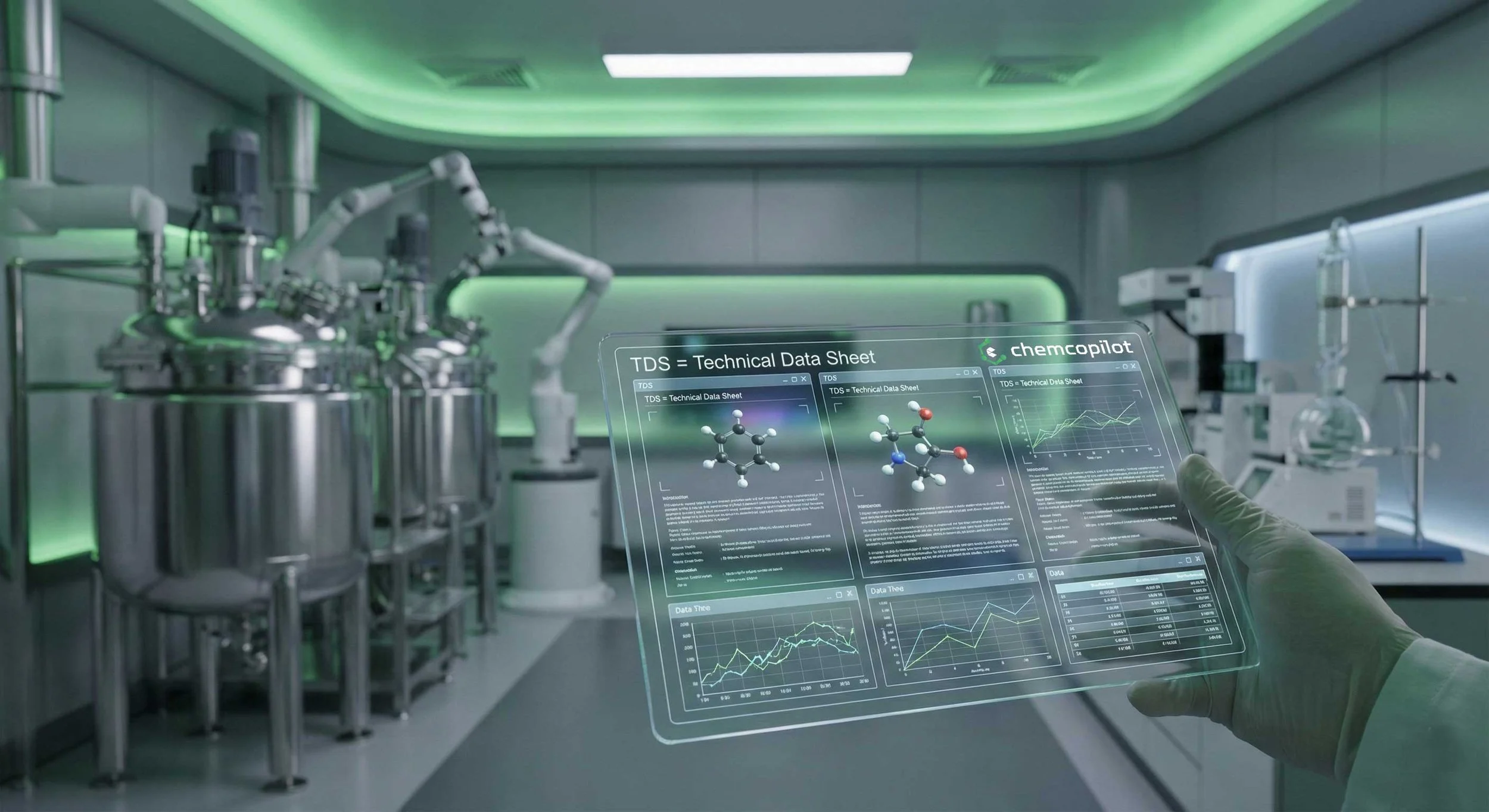
In the modern chemical landscape, the document that traditionally sat at the end of the production line is now moving to the very center of the strategy. The TDS = Technical Data Sheet is no longer just a static record of what was made; in an AI-native ecosystem, it is a living blueprint that dictates how products evolve, scale, and survive a volatile global market.
TDS = Technical Data Sheet Evolution: From Static PDF to Dynamic Intelligence
For decades, the industry treated the TDS = Technical Data Sheet as a finalized "receipt." You ran your experiments, you settled on a formula, and you printed the specifications. However, this approach creates a massive bottleneck when variables change. If a tariff forces a raw material swap or a manufacturing agitator underperforms, the static TDS becomes obsolete instantly.
ChemCopilot redefines this through an AI-native Product Lifecycle Management (PLM) approach. By integrating AI directly into the versioning process, the TDS = Technical Data Sheet becomes a dynamic data point that updates as the "Digital Twin" of the product matures.
The Architecture of ChemFlow and Versioning
At the core of this transformation is ChemFlow. This isn't just a storage folder; it is an integrated data management engine that centralizes every iteration of a product’s Bill of Materials (BoM).
1. Contextualized Versioning
Traditional PLM systems struggle with "version soup"—multiple files labeled "Final_v2" or "Corrected_v3." ChemCopilot utilizes Contextualized AI Agents to track the intent behind every change.
Did the pH shift because of a new supplier?
Was the temperature adjusted to compensate for a specific reactor’s performance?
The system records these nuances, ensuring that the TDS = Technical Data Sheet reflects the most optimized and compliant version of the product at all times.
1.1 Automated Data Ingestion: The Immutable Digital Record
In an AI-native PLM, the TDS = Technical Data Sheet is only as reliable as the data fed into it. Traditional record-keeping fails because it relies on human entry—a process prone to lag, typos, and "selective memory." ChemCopilot replaces this with Automated Data Ingestion to create an audit-proof history of every molecule.
Here is how ingestion serves as the backbone for your "Golden Version" records:
Real-Time Traceability: Data is ingested directly from lab sensors (IoT), ERPs, and the DOE API. This means every temperature spike or pH adjustment is recorded the millisecond it happens. You aren't just keeping a record; you’re capturing the "pulse" of the experiment.
The End of "Dark Data": Much of the value in chemical R&D is lost in unstructured formats like emails or handwritten notes. Our ingestion engine utilizes NLP (Natural Language Processing) to categorize and store this "dark data," ensuring that the TDS = Technical Data Sheet accounts for every insight, not just the ones that made it into a formal report.
Audit-Ready Compliance: In the 2026 regulatory environment (especially with the SBCE in Brazil or REACH in Europe), having a record isn't enough—you need to prove its origin. Automated ingestion provides a timestamped, encrypted trail that shows exactly when and where data was pulled, making your TDS = Technical Data Sheet a legally robust document.
The "Memory" Factor: By automating ingestion, the system builds a long-term memory. If a project is shelved for two years and then restarted, the AI can look back at the ingested records to tell you exactly why a specific catalyst was rejected—saving you from repeating the same failed experiments.
2. The Digital Twin Synthesis
Instead of relying on physical trial and error, we build digital models of both the formulation and the manufacturing process. This allows for micro-optimization. The AI can simulate thousands of versions of a product in a virtual environment before a single drop of chemical is used in the lab. When the physical batch is finally run, the TDS = Technical Data Sheet is already backed by high-confidence synthetic data.
Industry Case Studies: Real-World Performance
Lithium Battery Recycling (EV Sector)
In the high-stakes world of EV battery recycling, the chemical composition of "black mass" is never consistent. An AI-native PLM allows recyclers to adjust their processes on the fly. As the AI monitors metal recovery rates, it updates the internal TDS = Technical Data Sheet and manufacturing parameters to ensure maximum efficiency, regardless of the input material's variability.
Pharma Oncology and the DOE API
For oncological pharmaceuticals, precision is the only metric that matters. By integrating with the DOE API (Design of Experiments), ChemCopilot ensures that every version of a drug candidate is statistically validated. The TDS = Technical Data Sheet for these complex molecules includes full traceability of every experimental branch, providing a bulletproof audit trail for regulatory bodies.
Petrochemicals and "Tariff-Proof" Sourcing
In the "World War of Tariffs," being locked into a single supplier is a liability. Our Chemoptimize agents allow manufacturers to identify functional alternatives for metals, carbon, and specialized polymers. When a substitution is made—such as switching a specific solvent source—the AI automatically generates a revised TDS = Technical Data Sheet, ensuring the new version meets all performance and safety requirements without missing a beat in production.
Security: Protecting the "Golden Version"
A critical concern in 2026 is the security of Intellectual Property (IP). When using ChemCopilot, your data and AI training results are strictly isolated. The "Golden Version" of your TDS = Technical Data Sheet stays within your secure environment. Our architecture ensures that while the AI gets smarter at optimizing your chemistry, that knowledge never leaks to the outside world.
Conclusion: A New Standard for Product Development
The move toward an AI-native PLM is a move toward resilience. By turning the TDS = Technical Data Sheet into a dynamic, data-driven document, chemical companies can finally bridge the gap between fragmented research data and high-performance manufacturing.
We are moving away from a world of "guesswork and documentation" toward a world of "prediction and optimization." In this new era, the company with the best data flow—not just the biggest lab—wins.
Talk With our team to test