Chemical Industry Digital Transformation: Manufacturing Intelligence vs Automation
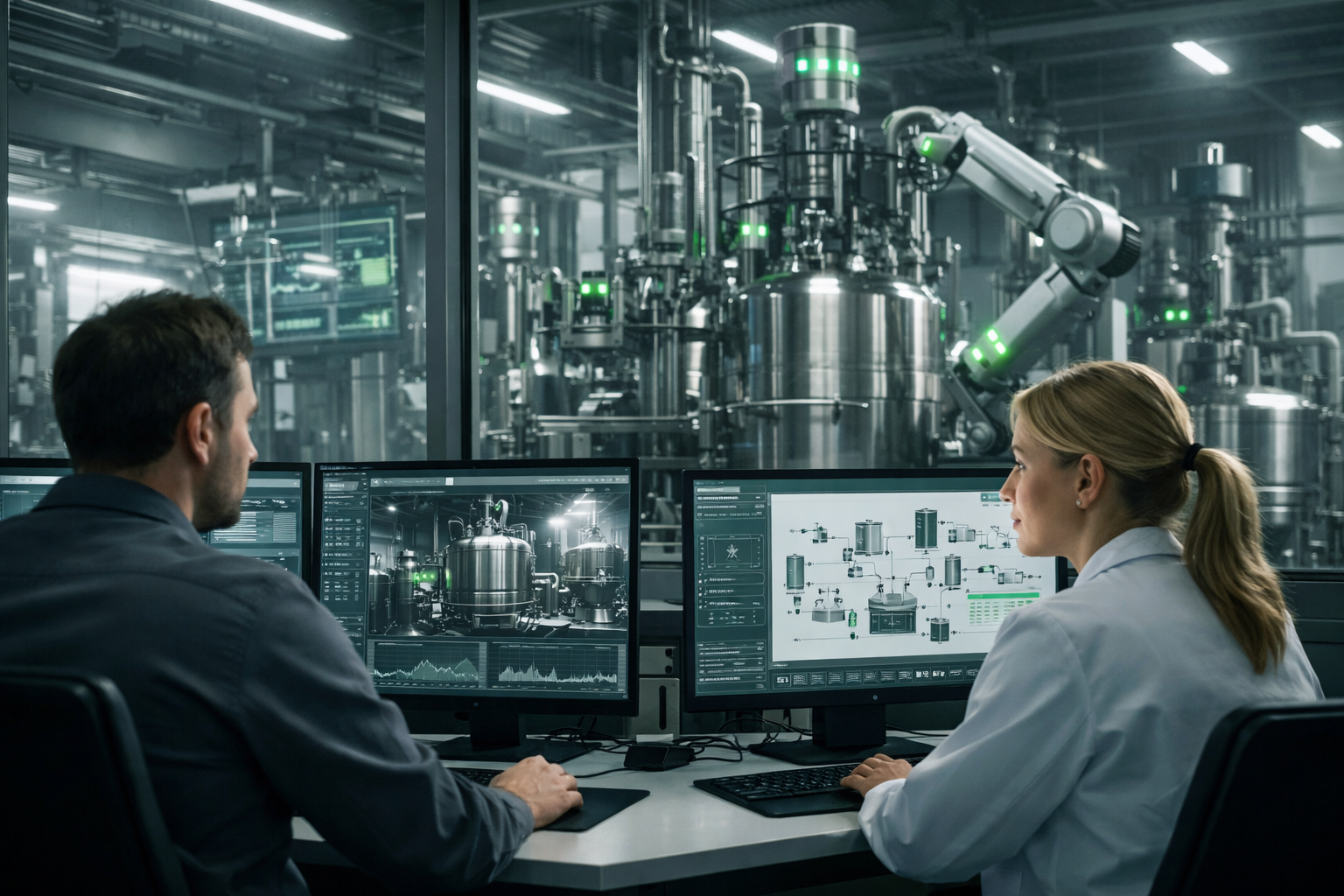
The chemical industry is no stranger to automation. Distributed control systems, programmable logic controllers, and advanced instrumentation have long formed the backbone of modern plants. Valves respond within milliseconds, reactors self-regulate temperature and pressure, and deviations trigger alarms with mechanical precision. Yet despite decades of investment in automation, the sector continues to grapple with persistent challenges: stalled innovation, slow scale-up, fragmented knowledge, and decision-making that remains heavily dependent on human intuition rather than structured insight.
This paradox exposes a critical distinction that is often blurred in industry discourse—process automation is not the same as manufacturing intelligence. One executes instructions with speed and reliability; the other interprets, contextualizes, and learns. For chemical companies navigating increasingly complex molecules, tighter regulations, and global competition, understanding this difference is no longer academic—it is existential.
The Limits of Automation-Centric Thinking
Automation was designed to stabilize and repeat. Its purpose is control: maintaining setpoints, reducing human error, and ensuring operational consistency. This paradigm works exceptionally well once a process is mature, fully characterized, and economically optimized. However, most contemporary chemical challenges do not exist in this steady-state ideal.
Modern chemical manufacturing increasingly operates in environments marked by uncertainty—novel chemistries, accelerated timelines, sustainability constraints, and frequent regulatory shifts. Automation systems, by design, do not reason about why a deviation occurs, how upstream research decisions influence downstream performance, or whether a process should exist in its current form at all. They act, but they do not understand.
As a result, automation-heavy plants often generate enormous volumes of data that remain underutilized. Information is logged, archived, and audited—but rarely synthesized into knowledge that informs strategic decisions. The plant runs, yet insight stagnates.
Manufacturing Intelligence: A Different Order of Capability
Manufacturing intelligence addresses a fundamentally different question: how should decisions be made across the chemical value chain when information is incomplete, distributed, and dynamic?
Rather than focusing on real-time control, manufacturing intelligence integrates signals across domains—research literature, experimental data, historical production outcomes, regulatory frameworks, and material properties. Its strength lies not in execution, but in interpretation. It enables chemical teams to recognize patterns that are invisible within isolated systems, anticipate constraints before they surface on the shop floor, and evaluate alternatives without costly trial-and-error.
Crucially, manufacturing intelligence does not seek to replace automation. It sits upstream and alongside it, shaping what gets automated and why. In this sense, it functions as a cognitive layer—translating raw data into structured understanding that guides human and machine decisions alike.
Why the Industry Is Shifting—Quietly but Irreversibly
Across the globe, chemical companies are confronting pressures that automation alone cannot resolve. Sustainability mandates demand new process routes. Specialty chemicals require rapid customization. Advanced materials challenge classical scale-up assumptions. Meanwhile, talent shortages mean that institutional knowledge—once carried by experienced engineers—is increasingly fragile.
These forces have triggered a subtle but profound shift. The most forward-looking organizations are no longer asking how to automate faster, but how to learn faster. They recognize that competitive advantage now emerges from the ability to connect disparate knowledge domains—linking what is known in research with what is feasible in manufacturing, and what is permissible under regulation.
Manufacturing intelligence becomes the connective tissue in this landscape, enabling continuity of understanding from laboratory conception to commercial realization.
Where Traditional Systems Fall Short
Legacy digital tools in the chemical sector tend to mirror organizational silos. Laboratory systems speak one language, production systems another, and regulatory documentation yet another. Even when data is technically accessible, it remains semantically fragmented. Engineers search reports; scientists scan journals; compliance teams track guidelines—often in isolation.
This fragmentation slows innovation and amplifies risk. Decisions are made with partial visibility, forcing teams to rely on precedent rather than possibility. Automation systems, no matter how advanced, cannot reconcile these conceptual gaps because they were never designed to.
What is missing is not more sensors or tighter feedback loops, but context-aware intelligence capable of reasoning across chemical knowledge itself.
How ChemCopilot Fits Into This Equation
ChemCopilot is built for this precise inflection point. Rather than operating as a control-layer technology, it functions as an intelligence engine that synthesizes chemical knowledge across research, development, and manufacturing contexts.
Its contribution to manufacturing is deliberately indirect yet profoundly impactful. By enabling scientists and engineers to interrogate chemical processes through structured reasoning—drawing from global literature, experimental precedents, and process-aware insights—ChemCopilot informs decisions long before they are codified into automated systems.
In this way, manufacturing process understanding becomes proactive rather than reactive. Teams gain the ability to evaluate feasibility, anticipate constraints, and refine strategies without waiting for plant-level failures to reveal them.
Importantly, this capability represents only a fraction of ChemCopilot’s broader scope. Manufacturing intelligence is not treated as an endpoint, but as one outcome of a deeper commitment to chemical cognition—supporting discovery, interpretation, and decision-making across the lifecycle.
A Global Perspective on Chemical Progress
From advanced catalysis research in East Asia to sustainable polymer development in Europe, and from energy-transition chemistry in the Middle East to pharmaceutical innovation in North America, the future of chemical manufacturing is being shaped by knowledge intensity rather than mechanical complexity.
Across these domains, the pattern is consistent: success depends less on how efficiently processes are automated, and more on how intelligently they are conceived, adapted, and governed. Manufacturing intelligence becomes the common denominator—allowing diverse teams to speak a shared chemical language despite differences in geography, scale, or application.
Platforms like ChemCopilot align naturally with this global trajectory, offering a way to democratize high-level chemical reasoning without constraining it to specific plant architectures or regulatory regimes.
Rethinking What “Digital Transformation” Really Means
For decades, digital transformation in chemicals was synonymous with automation. Today, that definition is expanding. True transformation is no longer measured by how little human intervention a plant requires, but by how effectively human expertise is amplified.
Manufacturing intelligence does not eliminate the need for skilled scientists and engineers; it elevates their capacity to reason, explore, and decide. It transforms data into dialogue, systems into collaborators, and complexity into navigable structure.
In this emerging paradigm, automation executes—but intelligence guides.
Conclusion: Choosing Insight Over Illusion
Chemical companies do not face a binary choice between manufacturing intelligence and process automation. The real decision lies in recognizing their distinct roles. Automation ensures stability; intelligence ensures relevance. One preserves performance; the other enables progress.
As the industry confronts unprecedented scientific and societal demands, the companies that thrive will be those that invest not only in faster systems, but in deeper understanding. Manufacturing intelligence is not an upgrade to automation—it is a redefinition of what it means to manufacture chemicals in a knowledge-driven world.
ChemCopilot exists within this redefinition: not as a controller of processes, but as a catalyst for informed, responsible, and forward-looking chemical decision-making.