The Chemistry Behind India's Water Crisis:How Researchers Are Reinventing Treatment Formulations
India treats over 20 billion litres of water every day using chemical formulations that have remained essentially unchanged for decades. With rising contamination profiles, over-stretched infrastructure, and an urgent need for sustainable inputs, research groups at IIT Kanpur, NIT Warangal, and NEIST are pioneering bio-derived coagulant alternatives. This article examines the formulation science underpinning modern water treatment, the data-management challenges inherent to variable feedstocks, and how AI-driven tools are accelerating the journey from bench experiment to scalable, regulatory-compliant product.
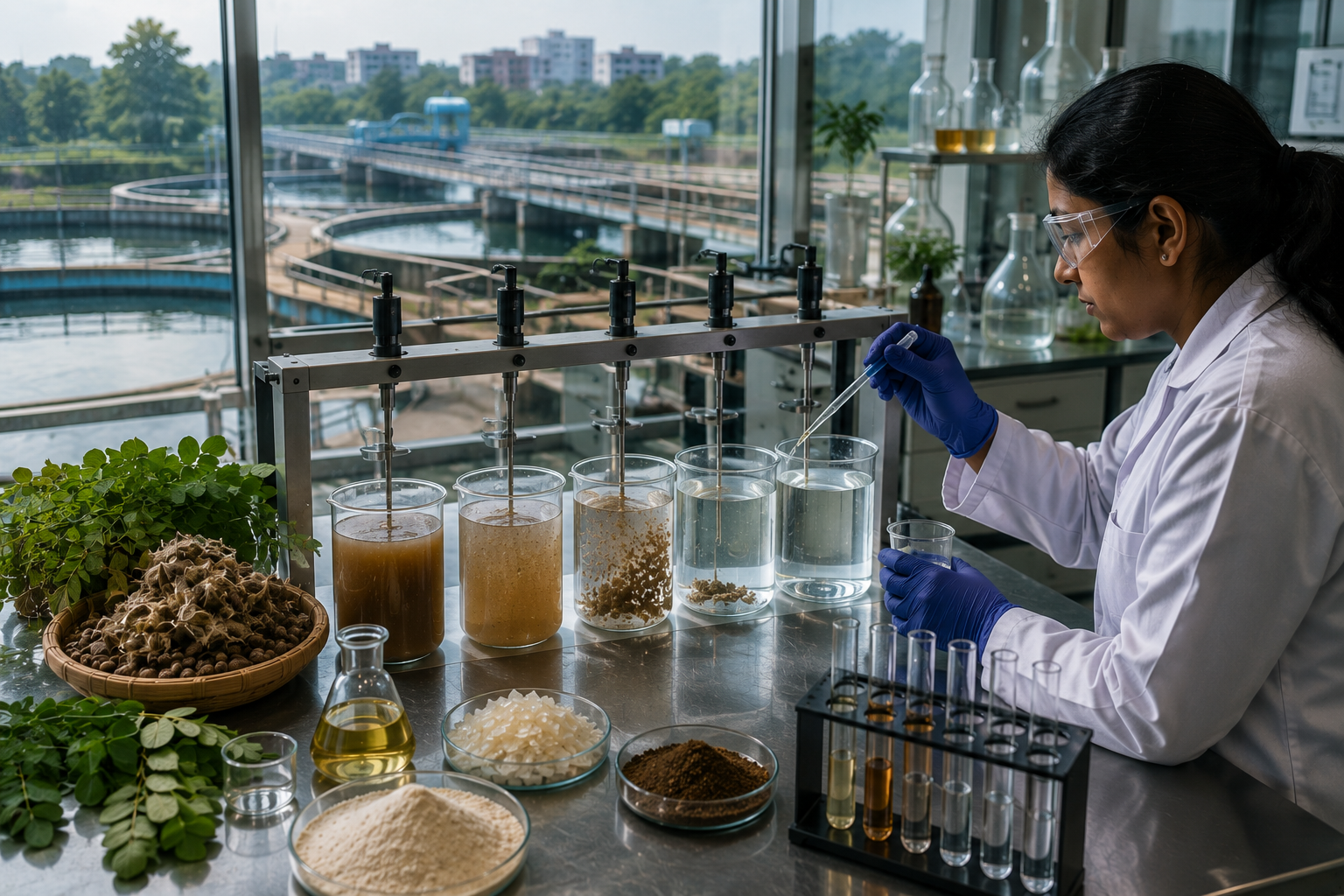
1. India's Water Treatment Landscape: Scale, Strain, and Chemistry
India's municipal water treatment infrastructure is among the largest in the world by sheer volume — and among the most chemically conservative. The dominant treatment train is conceptually unchanged from the early twentieth century: coagulation with aluminium sulphate (alum) or ferric chloride, flocculation in clarifier tanks, sedimentation, rapid sand filtration, and terminal disinfection with chlorine. This sequence, replicated across thousands of urban water treatment plants (WTPs), handles an estimated 22–24 billion litres per day in a country where 600 million people face high water stress.
The chemistry is deceptively simple on the surface. Trivalent aluminium or iron ions hydrolyse in water to form positively charged polynuclear hydroxo complexes — Al₁₃O₄(OH)₂₄⁷⁺ being the most well-characterised species — which destabilise negatively charged suspended colloids through charge neutralisation and sweep-floc mechanisms. The resulting macro-flocs are buoyant enough to sediment under gravity within the hydraulic residence time of the clarifier.
Yet this elegant chemistry carries substantial liabilities at the scale India operates. Alum dosage is notoriously sensitive to raw-water turbidity, pH, temperature, and dissolved organic carbon (DOC) — parameters that vary dramatically between the Ganges basin and Peninsular river systems, between monsoon and summer months, and even hour to hour within a single intake. Overdosing increases residual aluminium in the treated effluent, a recognised neurotoxin associated with dialysis encephalopathy and, epidemiologically, with cognitive decline. Aluminium-laden sludge is voluminous, difficult to dewater, and has no straightforward disposal pathway in most Indian municipalities. Ferric chloride is corrosive to plant infrastructure and generates iron-rich sludge with its own disposal constraints.
“Residual aluminium in drinking water at concentrations above 0.2 mg/L is now considered a design failure, not an operational norm — yet many Indian WTPs routinely exceed this threshold during high-turbidity monsoon events.”
For chemists and process engineers working in this space, the core formulation challenge is not finding a coagulant that works in the laboratory — it is finding one that works reliably across the astonishing variability of Indian raw-water quality, can be manufactured at scale from domestically available feedstocks, and meets the Bureau of Indian Standards (BIS) IS:10500 drinking water quality norms.
2. The Bio-Coagulant Movement: From Moringa Seed to Engineered Polymer
The search for alum alternatives is not new — Pliny the Elder noted the clarifying properties of crushed seeds of Moringa oleifera in turbid Nile water — but the scientific rigour now being applied to bio-coagulants is distinctly modern. Three categories dominate active Indian research programmes:
Cationic seed proteins from Moringa oleifera: The 2S albumin protein fraction (particularly the ~6.5 kDa dimeric protein bearing 18 cationic residues) acts as a cationic polyelectrolyte that bridges and flocculates suspended particles through a mechanism distinct from traditional charge neutralisation. The IIT Kanpur group has published extensively on the dose–response kinetics and demonstrated turbidity removal exceeding 98% in Ganga river water samples at optimal pH (6.5–8.0).
Tannin-based coagulants: Plant-derived hydrolysable tannins (tannic acid, gallotannins) form coordination complexes with heavy metal ions and act as bridging flocculants for colloidal silica. NIT Warangal researchers have explored Terminalia chebula (haritaki) and Acacia nilotica tannin extracts for treating textile effluents prior to municipal discharge, achieving COD reductions of 60–75% without the sludge volumes associated with iron-based coagulation.
Modified chitosan derivatives: Chitosan — deacetylated chitin derived from crustacean and fungal biomass — is a naturally cationic biopolymer that functions simultaneously as a coagulant, flocculant, and antimicrobial agent. NEIST Jorhat has investigated quaternary ammonium-functionalised chitosan for treating the characteristically high-DOC waters of the Brahmaputra system, where conventional alum creates prohibitive sludge loads during the six-month high-turbidity season.
The formulation science challenge across all three categories is the same: biological raw materials are inherently variable. The cationic protein yield in Moringa seeds varies with cultivar, growing region, soil nitrogen, post-harvest storage conditions, and processing method (aqueous extraction vs. cold-press vs. solvent fractionation). A formulation optimised on one seed batch may underperform on the next. This is not a peripheral concern — it is the central obstacle between laboratory demonstration and industrial deployment.
3. Feedstock Variability: The Data Problem That Stops Scale-Up
Water treatment chemists who have attempted to translate bio-coagulant bench results into pilot-scale trials will recognise an uncomfortable pattern: results that are reproducible in the literature are frequently irreproducible in the plant. The proximate cause is almost always feedstock variability — and the deeper cause is the absence of systematic tools to characterise, document, and compensate for it.
Consider the analytical profile of a Moringa seed extract intended for use as a coagulant formulation. The active-protein concentration must be determined by Bradford or BCA assay, but the relationship between total protein and functional cationic activity depends on the degree of hydrolysis during extraction, which in turn depends on water temperature, pH, and ionic strength — none of which are standardised across laboratories. The zeta potential of the resulting solution, which predicts coagulation efficacy, must be measured at pH-adjusted conditions matching the target raw water. DOC in the extract can itself act as a flocculant or as a coagulation inhibitor depending on molecular weight distribution, quantifiable by LC-OCD but rarely performed in resource-limited laboratories.
The result is a data-management landscape of extraordinary complexity: dozens of physicochemical parameters that co-determine product performance, measured by different methods across different facilities, often recorded in disconnected laboratory notebooks or non-standardised spreadsheets. Statistical process control is practically impossible without a unified data layer. Design of Experiments (DoE) — the gold standard for multi-variable formulation optimisation — is severely limited when historical data cannot be retrieved in a structured format.
“In multi-variable coagulant formulation, the experimental space is at minimum a 6–8 factor problem. A full factorial design is computationally tractable; building the experimental data infrastructure to feed it is not — unless the laboratory information architecture was designed with that intent from the outset.”
4. AI-Assisted Formulation: Closing the Gap Between Bench and Scale
This is precisely where artificial intelligence tools are beginning to deliver measurable value in water treatment chemistry research — not by replacing the formulation chemist, but by transforming the data environment in which they work.
The most immediate application is structured experimental data capture. AI-assisted laboratory platforms can ingest unstructured experimental notes, spectroscopic outputs, and instrument data files and return structured, searchable records with standardised parameter fields. For a research group running parallel Jar Test optimisation on five bio-coagulant candidates across three raw water matrices, this converts weeks of retrospective data normalisation into a real-time output.
Predictive modelling represents the second tier of value. Trained on curated historical datasets linking feedstock characterisation parameters (protein concentration, zeta potential, molecular weight distribution, DOC level) to Jar Test outcomes (turbidity removal %, residual DOC, sludge volume index), machine learning models — Gaussian Process Regression and Gradient Boosted Trees are the most interpretable for this application — can propose optimal dosing ranges for a new feedstock batch without requiring a full DoE campaign. This is not formulation by algorithm; it is formulation hypotheses generated at machine speed, validated by the chemist.
KEY APPLICATION: AI in Bio-Coagulant R&D Workflows
Structured data capture from Jar Test records and spectroscopic outputs ▸ Predictive dosage modelling from feedstock analytical profiles ▸ Automated BIS IS:10500 compliance flagging against treated-water quality outputs ▸ Literature mining for analogous formulation case studies across global water quality matrices ▸ Regulatory documentation drafting for CPCB submission packages
Regulatory compliance is the third — and commercially decisive — application. Any water treatment chemical intended for municipal use in India requires clearance against BIS IS:10500 (drinking water quality standards) and, depending on end use, Central Pollution Control Board (CPCB) effluent discharge norms. Generating the documentation package for a novel bio-coagulant formulation — toxicological data, process impurity profiles, stability data, environmental fate assessments — is a substantial workload that has historically fallen entirely on the formulation chemist. AI tools that can audit an experimental dataset against regulatory checklists, identify gaps in the submission package, and draft standardised sections of technical dossiers reduce this burden from months to weeks.
5. Case Perspectives: Research in Progress
While proprietary constraints limit detailed disclosure of ongoing work, the research directions emerging from India's premier technical institutions sketch a coherent picture of the field's trajectory.
IIT Kanpur has published process intensification studies examining continuous-flow coagulation-flocculation reactors designed to accommodate the high-turbidity, high-DOC character of Ganges water during the July–September monsoon window. The key formulation insight from this work is that bio-coagulant performance is far more pH-sensitive than alum — effective pH windows of ±0.5 units are common — which places a premium on real-time pH monitoring and automated correction as part of the treatment formulation package rather than the hardware package alone.
NIT Warangal researchers have pioneered hybrid formulations combining tannin-based primary coagulants with synthetic polyacrylamide flocculants as secondary aids. This approach addresses the single greatest operational limitation of pure bio-coagulant systems: slow floc formation kinetics that are incompatible with the hydraulic residence times of existing WTP clarifiers without capital-intensive retrofitting. Hybrid formulations achieve 70–80% of the turbidity removal performance of pure bio-coagulant systems at twice the floc settling velocity — a commercially relevant trade-off that moves bio-coagulants meaningfully closer to direct substitution viability.
NEIST Jorhat has focused on the northeast India water quality challenge, where high dissolved iron, arsenic, and fluoride concentrations — inherited from the volcanic geology of the Brahmaputra valley — require formulation approaches that go beyond turbidity removal. Modified chitosan-iron oxide nanocomposites developed at NEIST demonstrate simultaneous coagulation, flocculation, and adsorptive removal of arsenic(III) and arsenic(V) at ppb concentrations, a multi-functionality that conventional alum-based systems cannot match without multi-stage treatment trains.
6. The Path Forward: From Discovery to Deployment
The scientific case for bio-derived coagulants in Indian water treatment is compelling and growing stronger with each publication cycle. The barriers to adoption are not chemical — they are systemic. Feedstock supply chains for Moringa protein extracts, tannin concentrates, and chitosan derivatives need to be established at the scale required for municipal procurement. Quality specifications need to be codified into BIS standards so that procurement officers can write performance-based tenders rather than chemistry-agnostic volume tenders. Pilot plant data from independent third-party validation needs to accumulate before municipal engineers will risk plant performance on novel inputs.
Each of these barriers is tractable — and each is accelerated by better data infrastructure. The research community can close the pathway from discovery to deployment faster when experimental data is structured at the point of generation, when regulatory compliance is checked iteratively rather than retrospectively, and when the formulation insights accumulated across dozens of research groups are accessible in a unified, searchable knowledge base rather than locked in journal PDFs and laboratory notebooks.
“The chemistry is ready. The data infrastructure is not — yet. Building it is now the most important formulation challenge facing India’s water treatment research community.”
This is the mission space that AI-assisted R&D platforms are built for. The formulation chemist working on bio-coagulant scale-up does not need artificial intelligence to tell them what chemistry to run — they need tools that compress the distance between a promising Jar Test result and a submission-ready technical dossier. They need data environments that make multi-variable feedstock variability tractable rather than paralysing. They need literature synthesis that pulls relevant precedent from the global water treatment literature in minutes, not weeks.
India's water treatment challenge is urgent, and its chemistry research community is capable. The tools to support that capability have arrived. The question is now one of adoption — and the researchers reading this are the ones who will answer it.