Japan’s Monozukuri Chemistry: Why Precision Formulation Is a Cultural Obsession — and a Data Problem
Japan’s specialty chemical industry — anchored by global leaders Shin-Etsu Chemical, Toray Industries, JSR, and Sumitomo Chemical — is an expression of monozukuri: the Japanese philosophy of crafting things with exacting precision and relentless improvement. Japanese formulation chemists produce materials of extraordinary quality and performance consistency. Yet beneath this output lies a structural paradox: the experimental data that encodes decades of formulation mastery is predominantly locked in paper notebooks, legacy LIMS systems, and institutional memory — inaccessible to the machine learning models and AI-driven R&D platforms that are redefining competitive speed globally. This article examines Japan’s specialty chemical strengths in precise detail, the cultural and structural roots of its data problem, and how AI platforms like ChemCopilot are positioned to augment — not disrupt — the monozukuri tradition.
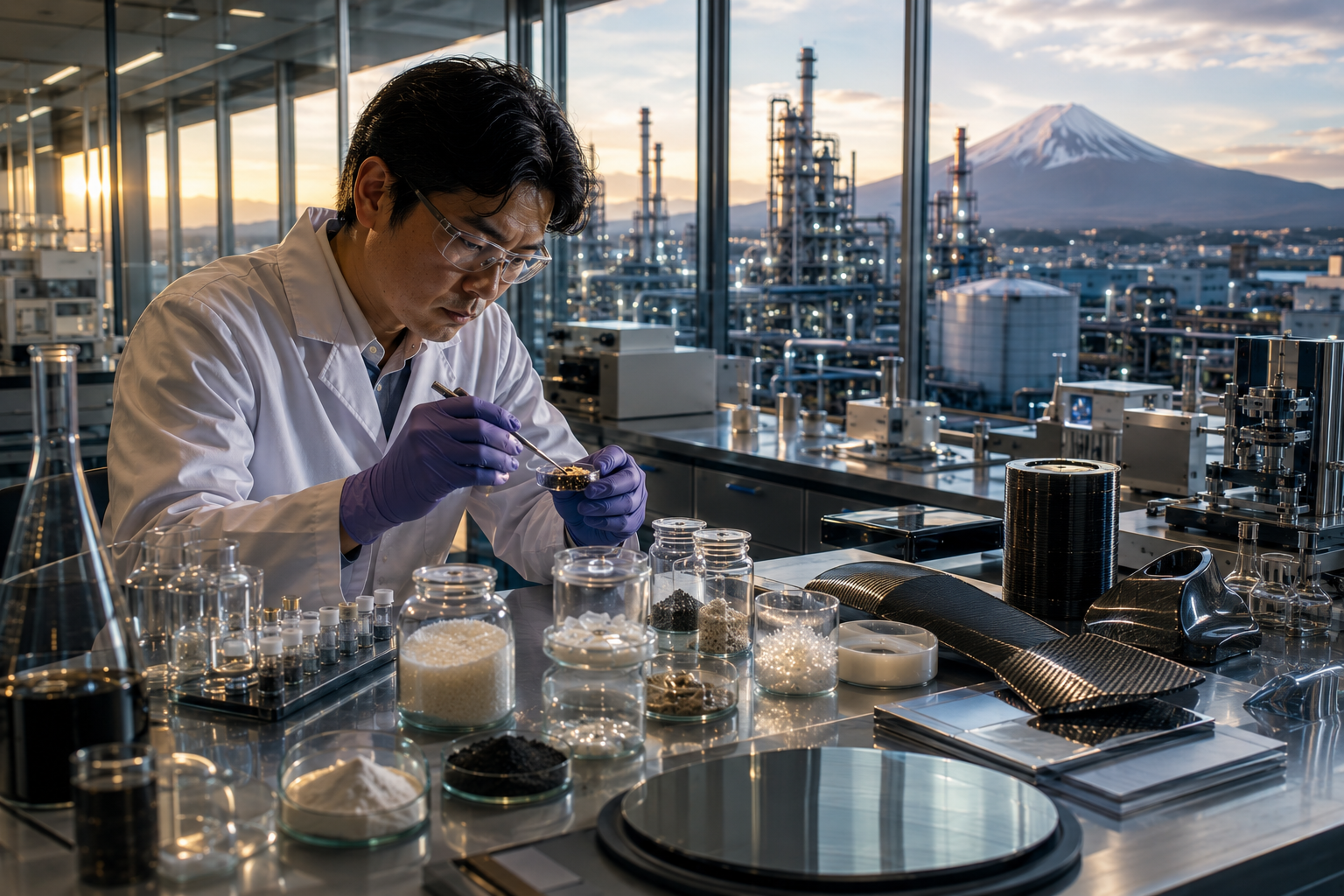
1. Monozukuri: The Philosophy That Built Japan’s Chemical Edge
Monozukuri (「ものづくり」) — literally “the making of things” — is one of those Japanese concepts that resist clean translation but define an entire industrial culture. It encompasses not merely the act of manufacturing but the spirit animating it: deep pride in craft, obsessive attention to process detail, continuous incremental improvement (kaizen), and the understanding that making things well is itself a form of knowledge. In Japan’s chemical industry, monozukuri is not a slogan — it is the operating system.
The products that Japanese chemical companies have built under this philosophy are among the most technically sophisticated in the global chemical industry. Shin-Etsu Chemical’s polydimethylsiloxane (PDMS) product lines represent decades of incremental molecular architecture refinement: controlled distribution of functional groups along the siloxane backbone, precise cross-link density engineering, surface tension profiles tunable to within a millinewton per metre for specific coating applications. Toray’s carbon fibre composites — used in Boeing 787 fuselages and Formula 1 chassis — achieve tensile strength and modulus specifications that competitors have spent twenty years attempting to replicate. JSR’s photoresist materials, formulated for extreme ultraviolet (EUV) lithography at 13.5 nm wavelength, require component purification to parts-per-trillion metal contamination levels. These are not products that emerge from a few years of focused R&D investment. They are the accumulated output of formulation knowledge systems refined over generations of chemists.
“In Japan’s chemical industry, the distinction between a master formulator and a competent one is not measured in publications or patents — it is measured in the depth of their ‘feel’ for how materials behave: a form of embodied chemical knowledge that is extraordinarily difficult to encode.”
The monozukuri approach to formulation is characterised by several features that distinguish it from Western industrial chemistry practice. First, it is intensely empirical: Japanese formulation chemists trust carefully controlled experiments and systematic observation over theoretical modelling. Second, it is deeply iterative: the concept of kaizen applied to formulation means that no product is ever considered finished, and incremental performance improvements are pursued continuously even on mature commercial products. Third, it is highly personalised: master formulators (“formulation meijin” in internal company parlance) accumulate decades of embodied knowledge that is passed to apprentices through direct mentorship rather than documented procedures. This last feature is both the source of Japan’s formulation excellence and its most significant structural vulnerability.
2. The Products That Define Japanese Formulation Mastery
To appreciate the data problem, one must first appreciate the depth of the chemistry it encodes. Japan’s specialty chemical strengths cluster in five areas of extraordinary formulation complexity:
Electronic chemicals and semiconductor materials represent perhaps the most demanding formulation discipline in the chemical industry. JSR, Tokyo Ohka Kogyo (TOG), and Shin-Etsu Chemical collectively supply the majority of the world’s photoresist materials for semiconductor lithography. An EUV photoresist formulation involves a polymer matrix (typically a methacrylate copolymer with acid-labile protecting groups), a photoacid generator (PAG) at sub-1% concentration, quencher amines for acid diffusion control, surfactants for coating uniformity, and solvent systems whose water content must be controlled to parts-per-million levels. The performance envelope — resolution, line-edge roughness, sensitivity, etch resistance — is defined by interactions between these components at molecular scales that are partially understood theoretically but primarily navigated through systematic experimental exploration.
Advanced carbon materials from Toray, Teijin, and Mitsubishi Chemical represent a different formulation paradigm: composite system design. A carbon fibre-reinforced polymer (CFRP) prepreg formulation involves not just the fibre architecture but the epoxy resin matrix chemistry (cure kinetics, Tg engineering, toughening agent type and loading), the sizing agent applied to fibre surfaces to control fibre-matrix adhesion, and the out-of-autoclave processability profile. Toray’s T800 and T1000 series fibres are accompanied by proprietary resin systems whose formulation represents as much competitive value as the fibre itself.
Functional coatings and surface treatment chemicals from Dainippon Paint Holdings, Kansai Paint, and Nippon Paint illustrate the consumer-facing dimension of Japanese formulation precision. Japanese automotive OEM coating specifications are the most demanding in the global automotive industry: distinctness of image (DOI) requirements above 90 on the ASTM scale, UV stability guarantees of 10–12 years, and chip resistance profiles that must be maintained at −30°C for vehicles used in Hokkaido winters. Achieving these specifications in waterborne basecoat-clearcoat systems — increasingly mandated by environmental regulation — requires formulation work of exceptional sophistication.
FORMULATION COMPLEXITY BENCHMARK: JSR EUV Photoresist vs. Standard Coating
A commodity architectural coating might involve 8–12 formulation variables across 3–4 component classes. A JSR EUV photoresist formulation involves 25–40 variables across 7–8 component classes, with interactions that are partially non-linear and change as a function of substrate temperature during spin-coating. The experimental design space is orders of magnitude larger — and the tolerance for performance deviation is orders of magnitude smaller.
3. The Paper Notebook Problem: Where Japan’s Data Sits
The monozukuri tradition of deep empiricism and mentorship-based knowledge transfer has created a structural data problem that is unique in its character, if not in its consequences. Japanese chemical R&D culture places enormous value on the laboratory notebook as a personal scientific document — a daily record of observations, hypotheses, failed experiments, and incremental insights that reflects the individual scientist’s intellectual journey. Many senior Japanese formulation chemists at companies like Shin-Etsu and Sumitomo maintain paper notebooks spanning decades of work. These notebooks are meticulous, scientifically rigorous, and essentially irretrievable at enterprise scale.
A 2022 survey by the Japan Chemical Industry Association (JCIA) found that 67% of Japanese specialty chemical R&D organisations still relied on paper notebooks as their primary experimental record system, compared with 31% in Germany and 28% in the United States. Even companies that have implemented electronic laboratory notebook (ELN) systems — and many large Japanese chemical companies have — face the challenge that their ELN adoption has frequently been additive rather than transformative: electronic notebooks that replicate the structure of paper notebooks without enabling the structured data extraction and cross-experiment analysis that creates genuine institutional knowledge assets.
“The Japanese formulation chemist who has been running the same adhesive product line for thirty years carries more formulation knowledge in their head than exists in their company’s entire documented R&D archive. When they retire, that knowledge retires with them.”
Legacy LIMS systems present a second layer of the problem. Many Japanese chemical companies made significant investments in laboratory information management systems during the 1990s and early 2000s. These systems captured analytical data — FTIR spectra, GPC traces, viscosity measurements — in formats that were state-of-the-art for their era but are now essentially isolated islands: not searchable by modern AI tools, not integrated with formulation records, and not connected to downstream performance data from application testing or customer qualification. The data exists; it is simply architecturally stranded.
The demographic dimension makes this urgent. Japan’s chemical industry workforce is ageing faster than any other major chemical-producing nation. The average age of a senior formulation chemist at a major Japanese specialty chemical company is currently estimated at 54–58 years. Within a decade, the generation that built Japan’s current specialty chemical product portfolio will have retired. The knowledge transfer mechanism — mentorship, apprenticeship, tacit transmission — that served Japan’s chemical industry for generations cannot scale fast enough to preserve what is being lost.
4. The Kaizen Paradox: Why Continuous Improvement Needs Structured Data
There is a profound irony in Japan’s formulation data situation. The kaizen philosophy — which has made Toyota’s production system the global benchmark for manufacturing efficiency — is fundamentally a data-driven discipline. Toyota’s production system works because every defect, every process deviation, every improvement suggestion is captured, analysed, and fed back into the production process. The knowledge loop is closed and institutionalised.
In Japanese formulation R&D, the knowledge loop is rarely closed at the institutional level. Individual researchers run elegant experiments and observe subtle performance differences that represent genuine advances in formulation understanding. But without structured data capture that links raw material lot parameters, process variables, formulation composition, and performance outcomes in a queryable format, those observations exist only in personal notebooks. The next researcher who approaches the same problem starts from scratch rather than from the frontier. Kaizen, applied to manufacturing, is extraordinarily powerful. Kaizen, applied to formulation R&D without structured data infrastructure, is a treadmill.
THE KNOWLEDGE LOOP GAP IN JAPANESE FORMULATION R&D
Individual experiment run ▸ Performance observation recorded in notebook ▸ [BREAK: data not structured or institutionalised] ▸ Next researcher starts from literature rather than from institutional history ▸ Duplicate experimental effort ▸ Lost cumulative learning velocityWith ChemCopilot: Experiment run ▸ Structured data captured automatically ▸ Predictive model updated ▸ Next hypothesis informed by full experimental history ▸ True institutional kaizen
5. Global Competition and the Speed Differential: Why Data Infrastructure Is Now Strategic
For decades, Japan’s formulation knowledge advantage was so large that data infrastructure inefficiency was irrelevant to competitive outcomes. If your EUV photoresist is three generations ahead of the nearest competitor, the fact that it took you 18 months to develop versus 12 months with better data tools matters little. That buffer is compressing.
South Korean competitors — particularly Samsung SDI’s chemical materials division and SK Materials — have made aggressive investments in AI-assisted formulation development. They have adopted modern ELN systems, structured DoE frameworks, and predictive modelling platforms as standard R&D practice. The formulation knowledge gap between Japanese incumbents and Korean challengers in electronic chemicals is narrowing, and the speed differential is part of the mechanism. A Korean materials company that can compress a photoresist formulation development cycle from 24 months to 14 months through better data infrastructure will, over a decade, run substantially more development cycles — and accumulate substantially more formulation knowledge — than a Japanese competitor operating on paper notebooks.
Chinese competitors in commodity specialty chemicals present a volume pressure rather than a technical pressure — for now. But the trajectory described in our companion article on China’s chemical industry upgrade is clear: Chinese companies are investing heavily in formulation capability, and the companies that build AI-native R&D infrastructure today will be technically competitive in mid-complexity specialty segments within five years.
6. ChemCopilot and the Monozukuri Tradition: Augmentation, Not Disruption
The framing that matters most when presenting AI R&D tools to Japanese chemical scientists is not efficiency or cost — it is fidelity to the monozukuri tradition. Japanese formulation chemists are not looking for a tool that automates their craft. They are looking for a tool that preserves, amplifies, and institutionalises it.
ChemCopilot is designed for exactly this use case. For a Shin-Etsu silicone formulation team, the platform’s most immediately valuable function is not prediction — it is memory. The ability to ingest decades of experimental records — whether from paper notebooks via structured input, legacy LIMS exports, or ELN data — and return a structured, searchable, cross-experiment knowledge base transforms individual formulation mastery into institutional formulation capital. The meijin who retires in three years does not take their knowledge with them; it lives in the platform.
Experimental data structuring: ChemCopilot converts unstructured notebook entries and legacy LIMS outputs into structured, queryable records — making decades of Japanese formulation history accessible to the next generation of researchers without losing the nuance of the original observations.
Kaizen-compatible iteration tracking: The platform’s version control and performance delta tracking maps directly onto Japanese R&D culture’s emphasis on incremental improvement, providing a systematic record of every formulation change and its measured outcome.
Predictive formulation suggestion: Trained on the company’s structured historical data, ChemCopilot’s AI engine proposes formulation hypotheses informed by the full experimental history rather than only the current researcher’s personal knowledge — accelerating exploration without sacrificing experimental rigour.
Raw material traceability: For electronic chemical applications where lot-to-lot raw material variation can be the difference between product acceptance and wafer-level yield loss, the platform’s raw material characterisation integration provides the traceability that Japanese customers already expect.
Regulatory intelligence for global markets: As Japanese specialty chemical companies face intensifying REACH, TSCA, and K-REACH compliance requirements, AI-assisted regulatory document generation dramatically reduces the administrative burden on formulation scientists.
The monozukuri tradition is not threatened by structured data infrastructure — it is fulfilled by it. The philosophy demands that the knowledge accumulated through decades of careful experimentation be preserved, transmitted, and built upon. Paper notebooks, however meticulously kept, do not achieve this at institutional scale. ChemCopilot does. For Japan’s specialty chemical industry, the question is not whether to adopt AI-native R&D tools, but how quickly the adoption can happen before the demographic cliff removes the option of knowledge recovery entirely.
“The greatest act of monozukuri in Japan’s chemical industry today is not the next incremental improvement to a photoresist or a carbon fibre sizing agent. It is building the data infrastructure that ensures the formulation knowledge of the current generation of master chemists is never lost.”
7. What Japanese Researchers Can Expect from ChemCopilot
Japanese researchers engaging with ChemCopilot will find a platform that respects the precision culture they inhabit. The AI models are not black boxes proposing arbitrary formulation changes; they are transparent systems that show the experimental precedents informing each suggestion and quantify their confidence intervals. Every prediction is traceable to the data that generated it — an epistemological standard that Japanese R&D culture demands.
The platform’s structured data capture preserves experimental nuance that purely automated systems discard: the observation that a particular lot of photoinitiator from supplier A produced slightly elevated line-edge roughness in summer months (temperature during shipping?), or that a specific silicone polymer batch showed anomalous viscosity build-up at storage temperatures above 25°C. These are exactly the observations that live in paper notebooks, that meijin pass to apprentices verbally, and that currently disappear from institutional memory at retirement. In ChemCopilot, they become searchable, cross-referenceable data points that inform the next generation’s formulation decisions.
Japan built its specialty chemical industry on the principle that the making of things is a form of knowledge, and that this knowledge, carefully accumulated and faithfully transmitted, is itself the most durable competitive advantage. ChemCopilot is built on precisely the same principle — extendedto the scale that the modern chemical industry demands.