The Danger of "Digital Alchemy": Why Generalist LLMs Like ChatGPT Are a Risk to Industrial Chemistry (And What to Use Instead)
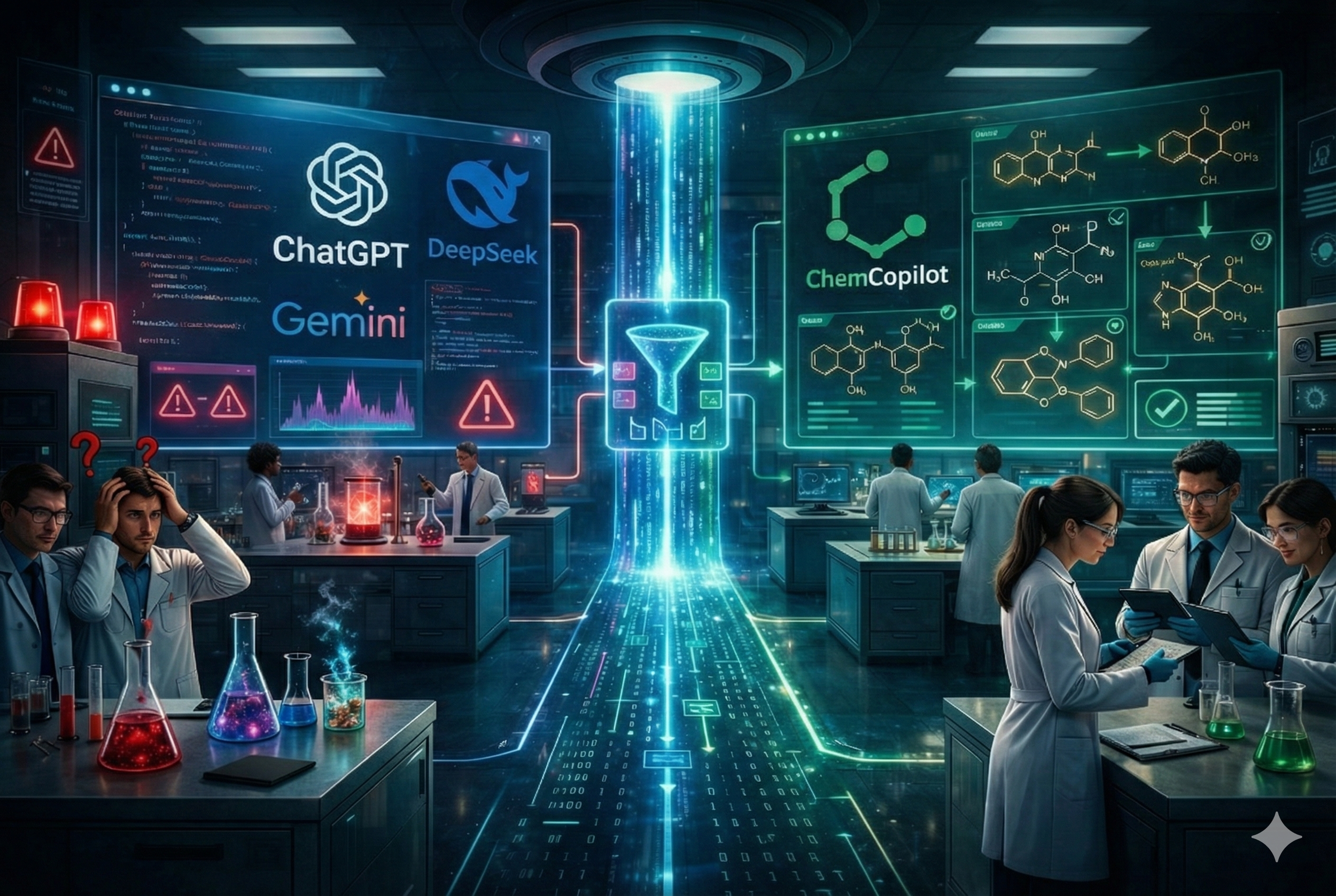
The promise of "discovering the next billion-dollar molecule" or "optimizing a complex polymer" just by typing a prompt into a chatbot is incredibly tempting.
However, in industrial chemistry, the cost of an error isn't just a software "bug"; it is measured in human safety, legal compliance, environmental impact, and millions of dollars in assets.
While large language models (LLMs) like ChatGPT, DeepSeek, or Gemini are incredible tools for summarizing text or generating emails, there is a vast chasm between generating plausible-sounding text and guaranteeing the stability, safety, and legality of an industrial chemical formulation.
Here is why relying on generalist AI for chemical R&D is a critical mistake, and how specialized AI is reshaping the industry.
1. The Critical Safety and Science Risk
Generalist LLMs operate based on linguistic statistical probabilities, not on the laws of thermodynamics or chemical kinetics.
Dangerous Hallucinations: An AI might suggest mixing two components that appear logically compatible in text descriptions, but in reality, result in a violently exothermic reaction or the release of toxic gases (like chlorine or phosgene).
The "Scale-up" Problem: What works in a theoretical simulation or an academic paper (the AI's training data) rarely translates directly to 50,000-liter tanks. Generalist AI ignores crucial engineering factors like fluid mechanics, heat transfer rates, and material corrosion specific to your plant’s infrastructure over time.
2. The Intellectual Property (IP) Maze
Using a commercial, public AI to discover or optimize a new formulation leads you into dangerous legal territory:
Data Leakage and Trade Secrets: By inputting your current "secret formula" into a public chatbot for optimization, you are effectively sending your industrial secret to external servers. This can legally invalidate its status as a "trade secret."
Patent Inability: Currently, major patent offices (like the USPTO in the US or EPO in Europe) do not recognize AI as an inventor. If a patent examiner can prove a solution was generated by a publicly accessible AI, it could be argued that the solution is "obvious" to a person skilled in the art, potentially blocking the patent registration.
3. The Regulatory and Compliance Bottleneck
The chemical industry is one of the most heavily regulated sectors in the world (REACH, TSCA, GHS).
Lack of Traceability: Regulatory bodies require knowing how and why a process was defined. "The chatbot suggested it" is not a valid technical justification in a registration dossier.
Restricted Substances: LLMs may suggest highly effective catalysts or solvents that have recently been banned or restricted due to being carcinogenic or persistent environmental pollutants (like certain PFAS), without issuing the necessary safety warnings.
4. The Scale-Up Challenge (Industrial Scaling)
What works in a laboratory simulation or in an academic paper (part of the AI’s training data) rarely translates directly to 50,000-liter industrial tanks.
Generic AI systems (GPT, Gemini, etc.) do not understand fluid mechanics or the long-term corrosion that certain additives may cause in your plant’s specific piping over five years of operation.
| Challenge / Functionality | ChatGPT / DeepSeek / Gemini | ChemCopilot (Specialist AI) |
|---|---|---|
| Stoichiometric Calculation | ✕ Frequently fails at complex calculations and units. | ✓ Exact and validated chemical calculation engines. |
| Regulations (REACH/Local Agencies) | ✕ Outdated or ignores specific local restrictions. | ✓ Automatic alerts for geographical restrictions. |
| SDS / MSDS Generation | ✕ May hallucinate or invent GHS hazard codes. | ✓ Generates documents based on verified technical data. |
| Retrosynthesis | ✕ Suggests generic or chemically impossible pathways. | ✓ Suggests routes based on patent data and viability. |
| Security & Confidentiality | ✕ Low. Your data is used to train public models. | ✓ High. Encrypted and isolated environment (PLM). |
| Governance & Teams | ✕ Individual use. No approval workflows. | ✓ Access management (R&D, Legal, Procurement, ESG). |
| Historical Data | ✕ No access to your company's legacy data. | ✓ Secure ingestion to train proprietary AI models. |
The Game Changer: Generalist AI vs. Specialist AI (ChemCopilot)
The major confusion in the market is the belief that "all AI is the same."
If generalist LLMs are like "creative writers" who sometimes invent facts, specialized platforms like ChemCopilot are built to act as a combined Process Engineer and Regulatory Lawyer working within a structured Product Lifecycle Management (PLM) environment.
Specialized AI serves to solve the catastrophic potential failures of generic LLMs in an industrial setting.
Comparative Overview: The Industrial Reality
Below is a comparison of how these different types of AI handle critical industrial challenges.
(The following table uses the "Green Tech" visual style to emphasize sustainability and specialized compliance)
| Challenge / Functionality | ChatGPT / Gemini / DeepSeek | ChemCopilot / Specialist Platform |
|---|---|---|
| Cross-Team Collaboration | ✕ Non-existent (individual, isolated use). | ✓ Integrated workflow (R&D, Legal, Procurement, ESG). |
| Access Levels & Governance | ✕ All or nothing. No data hierarchy. | ✓ Granular permissions by role and project. |
| Historical Data & Legacy | ✕ Does not access your private R&D data. | ✓ Trains models with your secure lab history. |
| Data Security & IP | ✕ Risk of exposure in public cloud training. | ✓ Enterprise-grade infrastructure (Trade Secret protection). |
| Real-Time Regulatory Filter | ✕ Ignores actual geographical restrictions. | ✓ Automatic blocking based on local/global laws. |