
What Are Molecular Fingerprints? ECFP & Tanimoto Guide
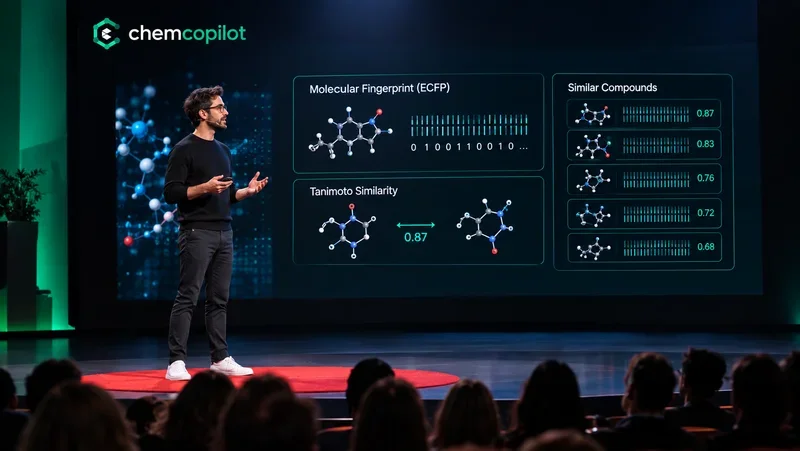
A specialty chemicals team had one additive that worked: excellent thermal stability, poor supply security, single source. The obvious next step was to find structural analogs already available from qualified suppliers. The chemist ran a substructure search across a 40,000-compound internal catalog, got 11 hits, and none of them were usable. Two weeks later, a colleague ran the same question using molecular fingerprints and Tanimoto similarity, surfaced 240 ranked candidates in under a minute, and the top 30 included four materials the lab had already purchased for an unrelated program.
Molecular fingerprints are the reason for that gap. Substructure search asks a binary question — does this exact fragment exist, yes or no. Fingerprints ask a much more useful one: how much of this molecule's local structure is shared with that one, expressed as a number you can sort, cluster, and feed into a model. For chemical R&D teams doing analog searching, virtual screening, or machine learning on chemical data, fingerprints remain the workhorse representation, even in an era of graph neural networks and foundation models.
What Are Molecular Fingerprints? (Definition)
A molecular fingerprint is a fixed-length numerical encoding of a chemical structure, usually a binary vector of 1,024 or 2,048 bits, where each position indicates the presence or absence of a particular structural feature. Some fingerprints store counts instead of bits. The point is the same: convert an arbitrary molecular graph — variable in size, atom types, and connectivity — into a fixed-size vector that a computer can compare, index, and learn from.
Two broad families exist. Keyed fingerprints use a predefined dictionary of substructures. MACCS keys, for example, define 166 specific patterns (an aromatic nitrogen, a carbonyl adjacent to oxygen, a halogen on a ring) and set the corresponding bit if the pattern is found. Every bit has a chemical meaning you can look up.
Hashed fingerprints generate features algorithmically from the structure itself, then hash them into a bit position. Extended-connectivity fingerprints (ECFP, implemented in RDKit as Morgan fingerprints) are the dominant example. Nothing is predefined: the algorithm enumerates every atom environment out to a given bond radius and hashes each one. This makes hashed fingerprints far more expressive for novel chemistry, at the cost of individual bits no longer mapping cleanly to an interpretable substructure.
How Molecular Fingerprints Work
Take ECFP4, the most widely used variant in industrial cheminformatics. The algorithm starts by assigning every atom an initial identifier derived from its element, degree, charge, attached hydrogens, and ring membership. Then it iterates: in each round, an atom's identifier is updated by hashing together its own identifier with those of its immediate neighbors. After one round, each atom encodes its environment out to one bond. After two rounds — the "4" in ECFP4 refers to a diameter of 4 bonds, or radius 2 — each atom encodes everything within two bonds.
All identifiers generated across all rounds are collected, then folded into a fixed-length vector by taking the hash modulo the vector length. A 2,048-bit ECFP4 for a mid-sized organic molecule typically sets 40 to 80 bits. Folding introduces collisions: two chemically distinct environments occasionally land in the same bit. At 2,048 bits, collision rates are low enough to be tolerable for most tasks; at 512 bits, they start to degrade similarity rankings noticeably.
The critical practical detail is that fingerprints are only as good as the structures you feed them. Inconsistent tautomers, unnormalized salts, and missing stereo flags produce fingerprints that disagree for molecules that are chemically identical. Canonicalization before fingerprinting is not optional — it is the difference between a search that works and one that quietly misses half its hits.
Here is how the common options compare in practice:
| Fingerprint | Type | Typical size | Strengths | Best for |
|---|---|---|---|---|
| MACCS keys | Keyed | 166 bits | Interpretable bits, very fast | Coarse filtering, quick clustering |
| ECFP4 / Morgan r=2 | Hashed, circular | 1,024–2,048 | Captures novel local environments | Analog search, ML features, screening |
| ECFP6 / Morgan r=3 | Hashed, circular | 2,048 | More specific, fewer false positives | Large libraries, tighter similarity |
| RDKit path (Daylight-like) | Hashed, path-based | 2,048 | Encodes linear fragments and topology | Substructure prefiltering |
| Atom pairs | Hashed, topological | Variable | Long-range distance relationships | Scaffold hopping |
| Avalon | Hashed, mixed | 512–1,024 | Strong general-purpose performance | Similarity ranking benchmarks |
Tanimoto Similarity: Reading the Number Correctly
Fingerprints are only useful with a comparison metric, and in chemistry that metric is almost always Tanimoto (Jaccard) similarity: the number of bits set in both molecules divided by the number set in either. The result runs from 0 to 1.
The most common mistake in industrial teams is treating 0.85 as a universal "similar enough" threshold. That number originated from studies using specific older fingerprint types and does not transfer. With ECFP4 at 2,048 bits, pairs scoring 0.40 are frequently close analogs, and a score of 0.55 often means a direct homolog. Applying a 0.85 cutoff to ECFP4 results will throw away nearly everything useful.
Two rules make Tanimoto scores actionable. First, calibrate the threshold against pairs your chemists already agree are analogs — take 20 known pairs from your own portfolio, compute their scores, and use the distribution as your cutoff. Second, never compare Tanimoto values computed with different fingerprint types or lengths; they are not on the same scale.
Size asymmetry also matters. Tanimoto penalizes comparisons between a small fragment and a large molecule because the bit counts differ so much. When searching for a 120-Da fragment inside 600-Da candidates, Tversky similarity with asymmetric weighting gives far more sensible rankings.
Where Molecular Fingerprints Are Used in Chemical R&D
The analog search described at the top of this article is the most visible application, but it is not the highest-value one for most industrial teams.
Deduplication and inventory reconciliation come first. A coatings group with three legacy databases and 26,000 registered raw materials typically discovers that 8 to 12 percent of entries are duplicates recorded under different supplier names, CAS numbers, or trade designations. Fingerprint-based matching combined with InChIKey comparison collapses those in hours rather than months of manual review.
Diversity selection is the second. When a screening budget allows 96 physical experiments out of 3,000 candidate structures, clustering by fingerprint similarity and sampling one representative per cluster produces a set that covers chemical space rather than 96 near-identical members of one family. Teams that switch from intuition-driven selection to fingerprint-based diversity picking consistently find that their hit rate per plate improves, because they stop re-testing the same scaffold.
Third, and increasingly important, is regulatory read-across. When a substance lacks toxicological data, REACH and TSCA submissions often rest on analog justification. Fingerprint similarity provides a defensible, reproducible, documentable basis for selecting those analogs, which is considerably stronger than "the toxicologist thought these looked alike." Pair it with mechanistic reasoning; similarity alone is not a read-across argument, but it is the evidence trail regulators expect to see.
Finally, fingerprints are the default feature set for property prediction models — solubility, logP, thermal decomposition onset, dye uptake, cure rate. A 2,048-bit vector plugged into gradient boosting gives you a working QSPR baseline in an afternoon.
Molecular Fingerprints and AI: How Machine Learning Is Changing This
The narrative since 2020 has been that learned representations replace fingerprints. Graph neural networks and transformer-based chemical foundation models learn their own embeddings directly from structure, and on large public benchmarks with tens of thousands of labeled examples they usually win.
Industrial chemical R&D rarely has tens of thousands of labeled examples. A formulation program with 400 historical batch records and 11 measured properties is far more typical. In that regime, ECFP4 features paired with XGBoost or Random Forest routinely match or beat deep models, train in seconds instead of hours, and — critically — support SHAP-based explanation that a formulator can interrogate. When a boosted tree tells you that a particular aromatic sulfonate environment drives the predicted dispersion stability, that is a hypothesis a chemist can test at the bench.
The practical 2026 answer is hybrid. Use fingerprints as the baseline and the interpretability layer. Use learned embeddings when you have enough data or when you can transfer from a pretrained model. And for formulation work specifically, remember that neither representation describes a mixture on its own: a fingerprint encodes one molecule, while a formulation is a set of molecules at specific weight fractions under specific process conditions. Real formulation models concatenate per-ingredient fingerprints weighted by concentration with tabular process variables — temperature, shear rate, cure time — because the property you care about depends on all of it.
Two limitations deserve explicit mention. Activity cliffs — pairs with Tanimoto above 0.9 and order-of-magnitude different performance — are invisible to similarity-based reasoning and will burn any team that trusts the number blindly. And fingerprints say nothing about conformation, so for anything driven by 3D shape or binding geometry, you need pharmacophore or shape-based descriptors instead.
How ChemCopilot Uses Molecular Fingerprints
Inside ChemCopilot, fingerprints run underneath several workflows rather than sitting in a separate cheminformatics module. Structures ingested from ELN exports, supplier documents, and legacy spreadsheets are canonicalized and fingerprinted automatically, which makes duplicate detection and analog retrieval available without anyone writing RDKit code. In the no-code ML modeling workflow, fingerprint features are generated alongside tabular formulation and process variables, so an XGBoost or Neural Network model trained on 300 batch records sees both molecular structure and the conditions under which it was processed. SHAP output then attributes predictions back to specific structural environments and process parameters together, which is what makes the result usable in a formulation review rather than just statistically interesting.
Key Takeaways
Molecular fingerprints turn structures into fixed-length vectors that support similarity search, clustering, and machine learning. ECFP4 at 2,048 bits is the sensible default for most industrial work. Calibrate your Tanimoto threshold against your own known analog pairs instead of inheriting 0.85 from a paper. Canonicalize before fingerprinting or your results will be quietly wrong. And treat fingerprints as complementary to learned embeddings, not obsolete — on sparse industrial datasets they remain both competitive and far easier to explain.
What is the difference between molecular fingerprints and chemical embeddings?
Fingerprints are computed deterministically from structure using a fixed algorithm; the same molecule always yields the same vector regardless of context. Embeddings are learned by a neural network trained on data, so they reflect whatever the training task emphasized. Fingerprints are transparent and reproducible; embeddings can capture subtler patterns when enough training data exists.
Can I use molecular fingerprints without coding?
Yes. RDKit remains the standard for scripted work, but platforms built for chemical R&D generate fingerprints automatically during data ingestion and expose similarity search, clustering, and model training through the interface. Teams without a dedicated cheminformatician can run analog searches and build fingerprint-based property models without writing Python.
How accurate are fingerprint-based models for formulation property prediction?
Accuracy depends on data quality and coverage, not on the fingerprint itself. On well-curated datasets of a few hundred formulations within a consistent chemistry family, fingerprint plus gradient boosting models typically achieve useful rank-ordering accuracy — enough to cut a screening set from 48 physical runs to 6. Extrapolating to chemistry outside the training distribution degrades sharply, which is why applicability domain checks matter more than squeezing out marginal R² gains.
Should I use ECFP4 or ECFP6?
ECFP4 is the general default. ECFP6 encodes larger atom environments, making it more specific and better at avoiding false positives in very large libraries, but it is less tolerant of small structural differences. If your searches return too many loosely related hits, move to ECFP6; if they return too few, move to ECFP4 or lower.
Do fingerprints work for polymers and mixtures?
Not directly. A fingerprint describes a single discrete structure. Polymers require repeat-unit representations plus separate descriptors for molecular weight distribution and architecture, and mixtures require concentration-weighted combinations of per-component fingerprints alongside process variables. Ignoring this is one of the most common reasons chemical ML projects underperform.
Ready to put your structural data to work? Talk to the ChemCopilot team about connecting your existing formulation records to fingerprint-based search and predictive modeling.
