
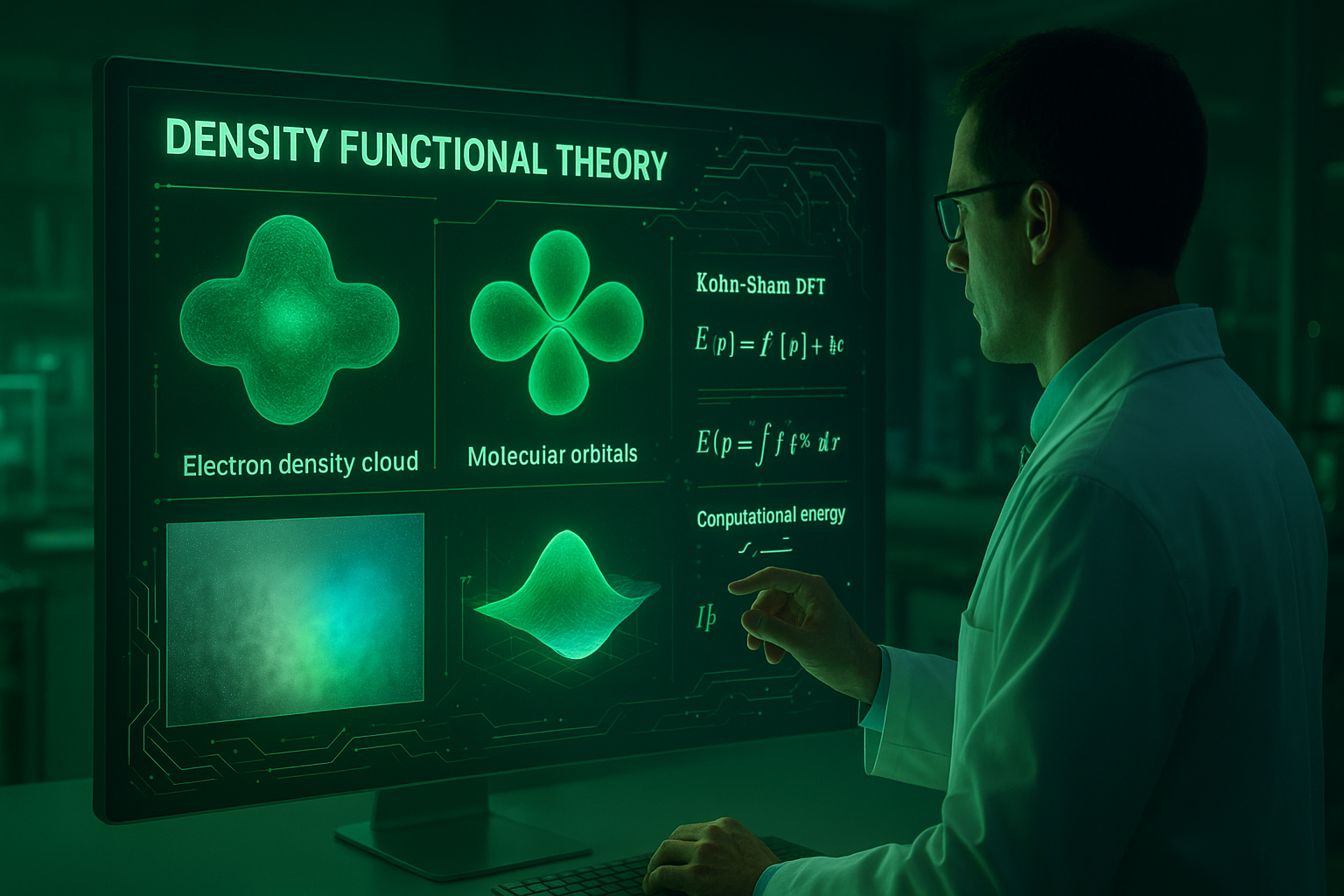
The world of chemical discovery is increasingly driven by theoretical insights. When trying to understand, design, or optimize a chemical process, researchers must first explore the quantum level—the realm of electrons and atoms. This is where Density Functional Theory (DFT) steps in.
While the acronym DTF often refers to "Direct-to-Film" printing in other industries, within the quantum world of chemistry, the fundamental theory that has revolutionized computational research is DFT. It stands as the single most important and widely used method for modeling and predicting the properties of molecules and materials.
The Quantum Problem and the DFT Solution
At the heart of quantum mechanics lies the famously complex Schrödinger Equation. Solving this equation precisely gives us the full wavefunction ($\Psi$), which describes the behavior of all electrons in a system. For anything larger than the simplest molecule, solving for this wavefunction is practically impossible—the computational effort scales astronomically with the number of electrons.
Density Functional Theory (DFT) elegantly sidesteps this intractable problem.
The Core Idea: Electron Density
Instead of solving for the highly complicated wavefunction, DFT operates on a much simpler concept: the electron density ($\rho$).
The revolutionary insight, formalized by the Hohenberg-Kohn theorems (a Nobel Prize-winning achievement), is that all the properties of a chemical system—its total energy, structure, stability, and reactivity—are uniquely determined by its ground-state electron density.
This shift reduces the complexity from tracking the individual coordinates of every electron to modeling a single three-dimensional function ($\rho$). This makes high-accuracy quantum calculations accessible for large, real-world systems like proteins, catalysts, and semiconductors.
Why DFT is the Workhorse of Computational Chemistry
The power of DFT lies in its perfect balance of accuracy and computational efficiency. It allows researchers to achieve reliable predictions for molecular structure and energy at a cost significantly lower than many traditional quantum methods.
Key Applications of DFT
DFT’s versatile nature makes it indispensable across nearly every branch of modern chemistry and materials science:
Molecular Properties: It accurately calculates bond lengths, vibrational frequencies, and energy barriers, essential for understanding how molecules are shaped and how they move.
Catalysis and Reaction Mechanisms: Researchers use DFT to map out the entire landscape of a chemical reaction, identifying crucial transition states and activation energies. This guides the design of more efficient catalysts, such as those used for green chemistry and industrial synthesis.
Drug Design: By predicting how drug candidates interact with biological targets (like proteins), DFT supports the rational design of safer and more effective pharmaceuticals.
Materials Science: DFT is vital for creating the next generation of materials. It predicts how new battery electrodes will store energy, how solar cells will absorb light, and what properties novel semiconductors will possess.
The Critical Role of Functionals
The accuracy of a DFT calculation hinges on the use of an accurate exchange-correlation functional. This is the mathematical term that accounts for all the complex, non-classical interactions between the electrons. Since the exact form of this functional is unknown, researchers use approximations (like GGA, meta-GGA, and hybrid functionals).
The continuous quest for improved functionals is what keeps DFT at the cutting edge, driving the industry closer to truly predictive power. For a comprehensive exploration of the foundational science, including the Kohn-Sham equations and how this powerful theory is transforming fields like material science and computational chemistry, check out the detailed analysis below:
Density Functional Theory (DFT): Unlocking the Quantum World of Chemistry
Conclusion: Driving the Future of Discovery
Density Functional Theory has transitioned from an esoteric quantum concept into a core component of digital R&D. By providing precise, quantum-level data at scale, DFT accelerates the timeline for discovery in materials, energy, and medicine.
As DFT continues to integrate with next-generation tools like AI and machine learning—which are increasingly trained on DFT-calculated datasets—its role will only expand, cementing its status as the engine driving the future of chemical innovation.
