How Chemcopilot AI Agents Turn Scientific Literature into Active Lab Intelligence
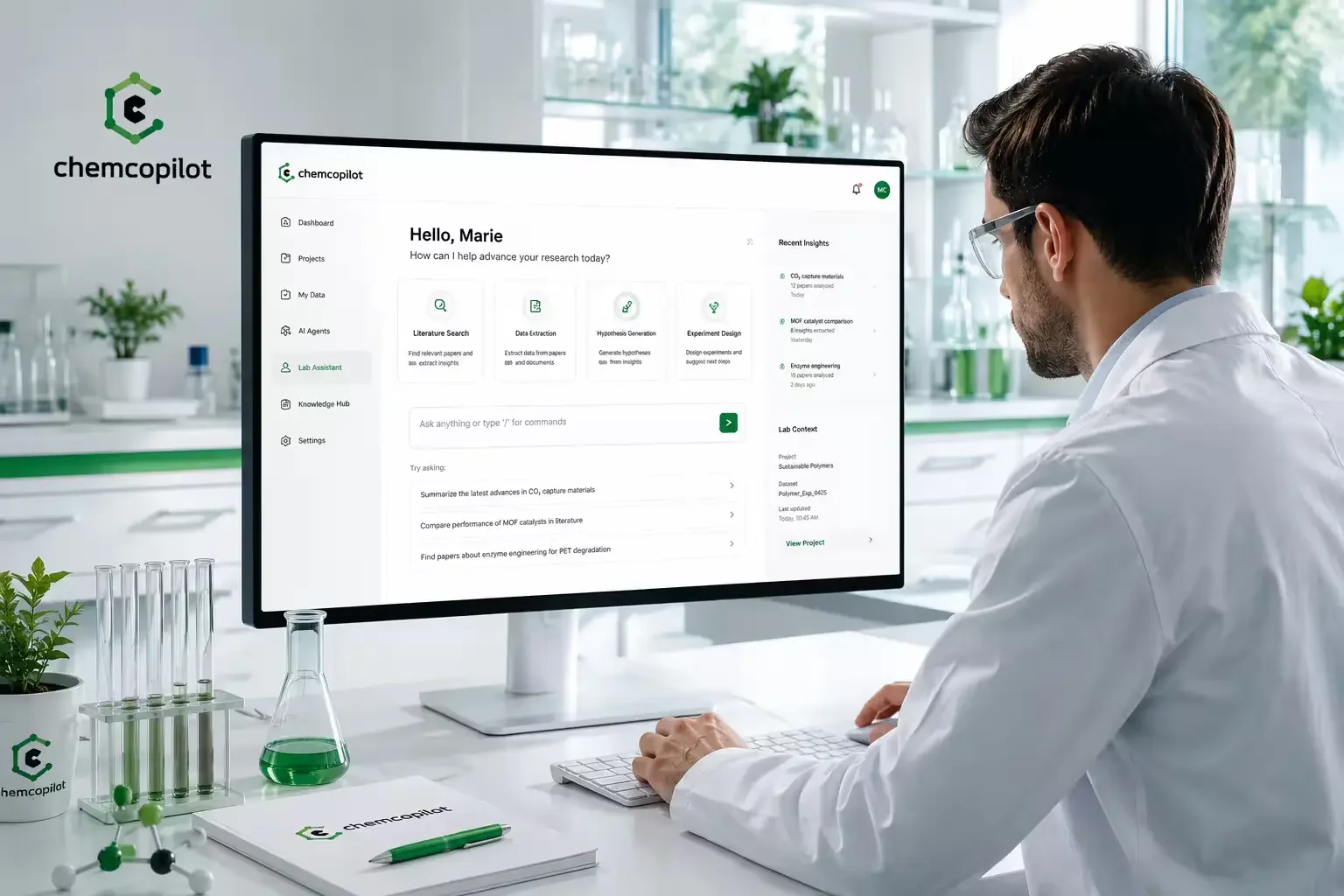
How Autonomous Chem Agents Turn Scientific Literature into Active Lab Intelligence
Industrial research and development departments spend thousands of hours synthesizing academic literature, cross-referencing patent databases, and evaluating historical project notebooks. A typical senior scientist spends up to 30% of their working week extracting specific parameters—such as solvent compatibility, kinetic rates, or formulation additive limits—from dense PDF documents.
While the emergence of Large Language Models (LLMs) promised to streamline text retrieval, consumer-facing interfaces (such as standard web implementations of ChatGPT or Claude) present critical barriers for commercial R&D. They lack domain-specific focus, operate under rigid document attachment limits, and operate under terms of service that risk exposing proprietary trade secrets to public model training pipelines.
Overcoming these operational limits requires moving from generic conversational text interfaces to task-oriented, autonomous AI Chem Agents. By deploying localized Retrieval-Augmented Generation (RAG) through high-density vector databases and programmatic API security layers, chemical and materials enterprises can convert unstructured document backlogs into an active, querying intelligence layer.
1. The Architecture of RAG Vector Databases in Scientific Discovery
When evaluating unstructured scientific literature, standard LLMs encounter severe mathematical context limits. A single research paper containing high-density text, data tables, and reaction schemes can easily consume tens of thousands of tokens. Attempting to feed 50, let alone 1,000, PDF documents into a standard LLM prompt results in immediate context truncation, severe hallucination rates, or complete system rejection.
Advanced scientific workspaces resolve this context bottleneck by building a dedicated Vector Database layer. Instead of attempting to force entire document collections into the model's active working memory simultaneously, the vector engine ingests, tokenizes, and mathematically indexes unstructured scientific literature:
- Document Chunking & Parsing: Ingests complex PDFs, academic journals, and internal lab reports, breaking the unstructured text down into semantic chunks while maintaining structural relationships across tables and figures.
- High-Dimensional Vector Embeddings: Maps semantic text chunks into a continuous mathematical vector space. When a scientist submits a query, the engine performs a high-speed vector similarity calculation (e.g., Cosine Similarity) to retrieve only the exact text segments relevant to the specific chemical target.
- Unlimited Scaling: By isolating search retrieval within a vector database, systems can scale to ingest over 1,000 comprehensive research papers or patent documents without hitting token context boundaries.
- Primary Knowledge Grounding: The ingested document repository acts as the system's explicit, primary training source. The underlying model is forced to evaluate scientific queries using the exact text provided, serving as an authoritative domain expert in that specified technical corpus.
2. Flexible Search Scopes: External Literature vs. Uploaded Knowledge Bases
A critical limitation of generic RAG systems is their rigid retrieval boundary. Modern enterprise scientific architectures provide configurable search scopes, allowing researchers to direct Chem Agents across three distinct knowledge environments based on project sensitivity and research phase:
3 Configurable Knowledge Retrieval Modes
- External Scientific Literature Mode: The Chem Agent searches open-access journals, published patents, and global academic databases in real time to gather broad state-of-the-art context on new molecular targets or formulation mechanisms.
- Internal Customer Database Mode: Search retrieval is locked strictly to the private PDF, CSV, and report repository uploaded by the customer. External web queries are disabled, guaranteeing that proprietary experimental findings remain 100% isolated.
- Hybrid Dual-Search Mode: The agent simultaneously cross-references internal experimental trial logs with external published literature. This enables the platform to detect gaps, identify novel patentable spaces, and continually evolve the internal knowledge base with fresh global findings.
3. Enterprise Security Architecture & Data Privacy Controls
For commercial chemical, pharmaceutical, and materials science organizations, intellectual property protection is paramount. Research managers cannot risk uploading novel molecular structures, trade secret formulation ratios, or un-patented reaction pathways into consumer AI tools.
To ensure enterprise-grade security, dedicated scientific platforms operate through programmatic API integration rather than consumer web portals. This structural distinction unlocks critical enterprise-level privacy guarantees:
Core Enterprise Security Controls
- Zero-Data Retention Guarantees: Programmatic API contracts enforce strict legal and technical controls. Data passed through the API is never retained by model providers, is never used for foundation model re-training, and cannot be accessed by external third parties.
- Compartmentalized Architecture: Sensitive organizational data is isolated within secure customer environments. System prompts and retrieval mechanisms operate behind enterprise firewalls, preventing cross-tenant data leakage.
- Internal-Only Privacy Toggle: Systems include local data restriction toggles. When enabled, sensitive dataset files are locked entirely within internal systems, shutting off external LLM routing completely for organizations operating under ultra-strict data isolation policies.
4. Designing Task-Oriented AI Chem Agents
Generic language models act like open-ended broad-spectrum search tools—when prompted, their attention disperses across their entire pre-trained web corpus, often returning generic or irrelevant results. In contrast, modern scientific platforms deploy Task-Oriented Chem Agents.
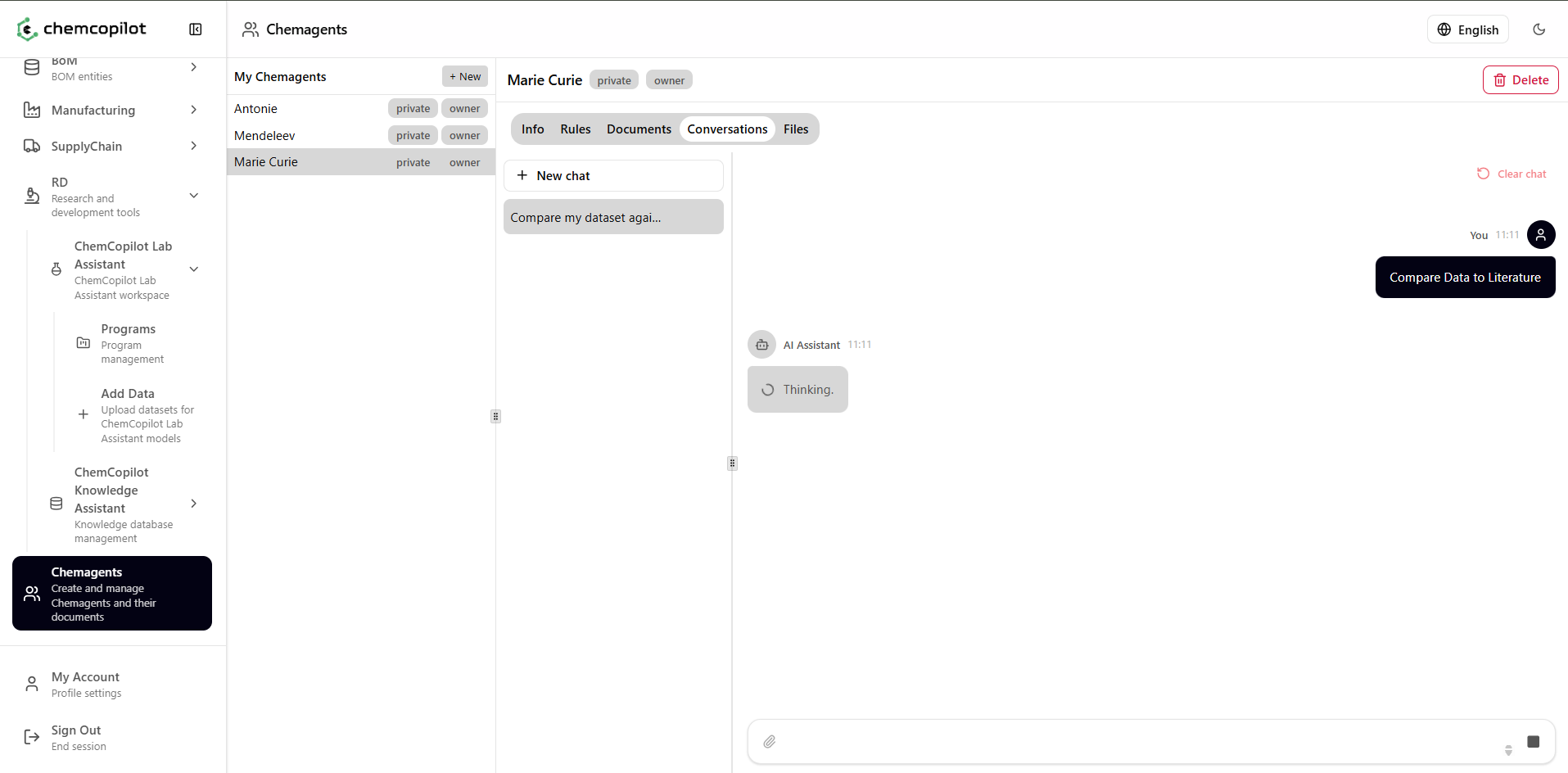
Think of a Chem Agent as a dedicated digital research assistant. Rather than operating as a blank slate, an agent (e.g., "George", "NMR Analyst", or "Literature Specialist") is initialized with specific persona parameters, strict operational instructions, search boundaries, and defined output formatting rules.
| Agent Configuration Parameter | Implementation Blueprint | Operational Objective |
|---|---|---|
| Persona & Core Role | "You are an expert formulation chemist specializing in agricultural soil additives and nutrient release kinetics." | Establishes contextual focus and restricts response vocabulary to technical domain language. |
| Task Directives | "Search uploaded document databases for published patents and articles relating to silica gel encapsulation." | Directs search engines precisely toward relevant technical literature and patent sets. |
| Operational Rules | "For every journal article identified, extract and log its commercial, academic, or open-access license status." | Prevents legal infringement by flagging proprietary or paid subscription barriers automatically. |
| Output Protocols | "Compile extracted kinetic parameters into a structured technical PDF report stored in the designated file repository." | Automates documentation workflows, placing clean files directly into accessible lab storage. |
Scientists can spin up multiple specialized Chem Agents simultaneously across distinct project workflows. One agent may focus exclusively on automated literature searching and patent extraction, while an adjacent agent analyzes analytical characterization data (such as NMR, FTIR, or rheology outputs).
5. Practical Workflow Examples: Transforming Knowledge into Action
How do scientists interact with Chem Agents during daily R&D operations? Rather than wrestling with prompt engineering, researchers leverage structured workflow actions designed to support physical chemical projects:
Rapidly synthesizes state-of-the-art academic findings, reaction pathways, and physical property benchmarks for target chemical systems.
Cross-references internal wet-lab experimental assay values against published literature data to detect anomalies and validate bench yields.
Identifies critical independent physical variables (e.g., shear rate, solvent dielectric constant) from published studies to guide machine learning feature selection.
Generates rigorous, peer-review-quality technical interpretations explaining unexpected experimental results or non-linear formulation behaviors.
Detects unexplored experimental coordinates between internal bench data and external prior art, suggesting targeted DOE trials.
Screens target structures and formulation ranges against patent databases to evaluate patentability and freedom-to-operate boundaries.
Establishes physics-informed feature engineering plans for predictive machine learning models grounded in validated thermodynamic principles.
Compiles audit-ready technical packages linking internal lab results, literature references, and regulatory compliance flags for executive review.
6. Multi-Disciplinary Flexibility: Beyond Organic Chemistry
A common misconception is that scientific AI systems are limited strictly to small-molecule organic synthesis. In practice, modern agentic architectures process diverse non-traditional data streams across multi-disciplinary research domains:
- Agronomy & Crop Protection: Processing soil formulation logs, moisture retention profiles, biological efficacy studies, and nutrient transport kinetics.
- Materials Science & Polymers: Analyzing composite stress-strain relationships, curing thermal profiles, plasticizer leaching rates, and structural degradation data.
- Regulatory Compliance: Ingesting safety data sheets (SDS), regional chemical registry rules (REACH, TSCA), and environmental toxicity guidelines.
7. Bridging Literature RAG with Experimental Lab Data
The true operational breakthrough occurs when an AI Chem Agent bridges the gap between unstructured literature research and structured experimental lab datasets.
Traditionally, literature research and physical bench testing operate in isolated silos. A scientist reads papers in one browser window and analyzes experimental formulation spreadsheets in another. Advanced Chem Agents break down this silo by accessing internal laboratory databases alongside document vector stores:
- Automated Data Analysis: Agents directly query historical lab formulation databases containing hundreds of physical trials.
- Statistical Variable Dependency: The agent executes statistical evaluations—calculating Pearson and Spearman correlation matrices across experimental variables (e.g., correlating plasticizer weight percentages against tensile strength or water release rates).
- Automated Graph & Report Generation: The agent visualizes complex variable dependencies, plotting correlation maps, heat maps, and property distribution histograms automatically.
- AI-Driven DOE Recommendation: Combining theoretical insights extracted from 1,000 literature PDFs with empirical results stored in the lab database, the agent acts as an intelligent Design of Experiments (DOE) generator. It highlights data gaps and recommends specific multi-variable candidate formulations for scientists to validate next at the bench.
8. System Comparison: Consumer LLMs vs. Enterprise Chem Agents
| Capability Dimension | Consumer LLM Interfaces | Generic Enterprise RAG | Task-Oriented Chem Agents |
|---|---|---|---|
| Document Ingestion Capacity | Strict file & token limits (< 10 PDFs) | Moderate document limits | 1,000+ files via scalable Vector Databases |
| Data Privacy & IP Protection | Public training risks; data retained | Standard cloud security | Zero-retention API contracts + Local Isolation Toggles |
| Domain Focus & Precision | Broad, unconstrained text output | Keyword text retrieval | Laser-focused role instructions & rule enforcement |
| Search Scope Flexibility | Web-only search | Internal files only | Configurable: External Literature, Uploaded Base, or Dual Mode |
| Lab Data Integration | None (Text only) | Limited file parsing | Direct correlation analysis & AI DOE generation |
9. Implementation Protocol for Research Leaders
For R&D directors seeking to deploy autonomous Chem Agents across their organization, implementation should follow a structured four-phase protocol:
- Phase 1: Knowledge Base Centralization: Aggregate fragmented research papers, competitor patents, safety sheets, and historical technical packages into centralized digital document repositories.
- Phase 2: Agent Configuration & Search Scope Setup: Initialize specialized Chem Agents with precise role definitions, strict search rules, and designated retrieval boundaries (External Literature, Customer DB, or Dual Mode).
- Phase 3: Secure API & Privacy Integration: Establish programmatic API connectivity enforcing zero-data retention guarantees, toggling internal-only local data security modes for highly sensitive IP.
- Phase 4: Closed-Loop Lab Integration: Connect Chem Agents to structured lab databases, allowing AI engines to run Pearson/Spearman statistical correlation analyses and generate AI-guided DOE recommendations directly from combined literature and bench data.
By moving beyond generic consumer chatbots and deploying task-oriented AI Chem Agents, enterprise R&D organizations eliminate document analysis backlogs, protect core intellectual property, and transform static scientific literature into an active engine for physical bench discovery.