China’s Chemical Industry Is Upgrading — And the R&D Gap Is Showing
China has held the title of world’s largest chemical producer for over a decade — but that dominance has been built on volume, not on value. Under Made in China 2025 and successive Five-Year Plans, the government is engineering a structural pivot from commodity bulk chemicals to specialty and high-performance formulations. This transition is revealing a formidable capability gap: the data architecture, formulation knowledge management, and AI-native R&D tooling that specialty chemistry demands simply does not exist at scale in most Chinese chemical enterprises. This article unpacks that gap — its chemistry, its policy roots, and how platforms like ChemCopilot are positioned to close it.
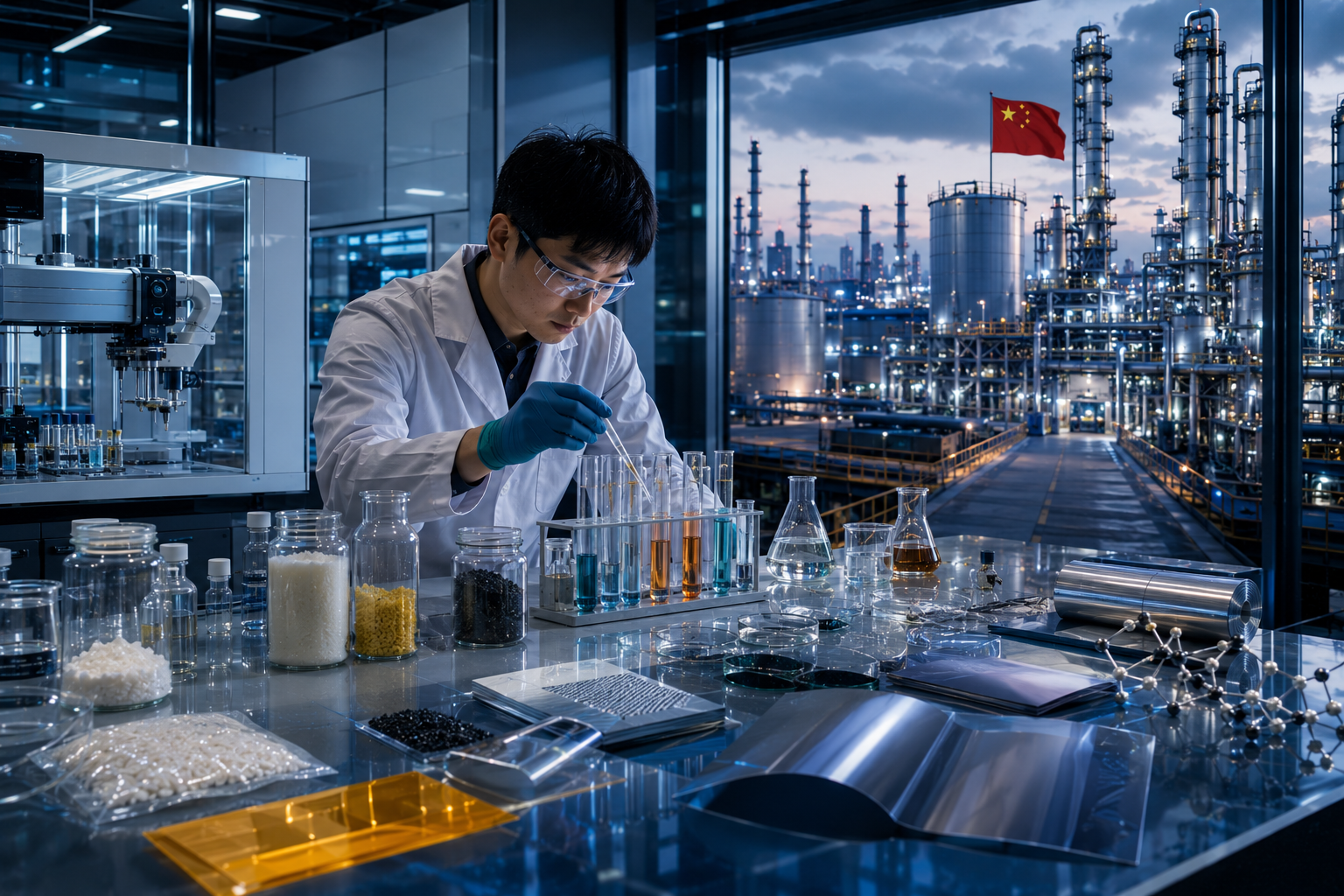
1. The Scale Paradox: World’s Largest Producer, Smallest R&D Return
China’s chemical industry is extraordinary by any macroeconomic measure. It accounts for roughly 40% of global chemical production by volume, operates the world’s largest ethylene crackers, and has built integrated petrochemical complexes in Zhejiang and Guangdong that rival anything in the Middle East or North America on cost efficiency. Yet when the unit of analysis shifts from tonne to renminbi of value-added per kilogram, the picture changes sharply. China’s specialty chemical sector — high-performance coatings, advanced adhesives, functional polymers, electronic chemicals, pharmaceutical actives — represents only 8–12% of its total chemical output by value, compared with 35–40% in Germany, Japan, and the United States.
This is not accidental. The business model that built China’s chemical industry was not designed for specialties. It was designed for capacity: large capital investment, compressed margins, extreme volume discipline, and procurement relationships built on reliability and price rather than performance and technical differentiation. Formulation R&D — with its multi-year development cycles, high failure rates, and intellectual property intensity — is antithetical to this model. The result is an industry that can manufacture a commodity polyethylene film to specification with extraordinary precision but struggles to develop the low-dielectric-constant encapsulant needed for 5G antenna modules from first principles.
“China’s chemical companies built global dominance on process discipline and capital efficiency — virtues that now work against them in specialty formulation, where the competitive advantage belongs to the lab, not the reactor hall.”
Made in China 2025, launched in 2015, identified specialty chemicals — particularly electronic chemicals, specialty coatings, and high-performance polymer formulations — as strategic sectors requiring domestic capability development. The 14th Five-Year Plan (2021–2025) reinforced this with explicit R&D spending mandates: large chemical SOEs are now required to maintain R&D expenditure above 3% of revenue, a threshold that many were not meeting as recently as 2019. The policy pressure is real, the funding is flowing, and the talent pipelines from Chinese universities are producing excellent synthetic chemists. What the policy cannot mandate into existence is the institutional knowledge, the formulation data architecture, and the structured experimental learning systems that specialty chemistry requires.
2. The Formulation Capability Gap: What Specialty Chemistry Actually Demands
The distinction between commodity and specialty chemistry is often framed as a product complexity question — and it is that, but it is equally a process knowledge question. Manufacturing commodity polyvinyl chloride (PVC) at scale requires deep process engineering knowledge: heat transfer, residence time distribution, initiator kinetics. But the formulation design space is relatively narrow — molecular weight distribution, particle size, plasticiser loading. A team of competent process engineers can master it in years.
Specialty formulation is a categorically different challenge. Consider a UV-curable adhesive for flexible display lamination — a product that Chinese OEM display manufacturers currently import from Japanese and Korean suppliers. The formulation space includes photoinitiator type and concentration, oligomer backbone architecture (urethane acrylate vs. epoxy acrylate vs. polyester acrylate), reactive diluent selection for viscosity management, adhesion promoter chemistry, UV-stabiliser packages to prevent yellowing under prolonged illumination, and rheology modifiers to achieve the thixotropic profile needed for slot-die coating without film defects. Each of these is a 3–5 variable sub-problem. The interaction effects between them are non-linear and cannot be predicted from first principles alone. Solving the full formulation requires a DoE architecture spanning potentially 50–100 designed experiments, rigorous data collection, and an institutional ability to learn from each iteration.
THE FORMULATION KNOWLEDGE STACK: What Commodity Producers Don’t Have
Structured experimental databases linking raw material lots to performance outcomes ▸ DoE expertise capable of navigating 8–12 variable interaction spaces ▸ Failure mode libraries: understanding why formulations degrade, delaminate, or yellow ▸ Regulatory and application testing protocols for end-use qualification ▸ Customer application engineering capability to co-develop with downstream OEMs
Chinese chemical companies attempting this transition are discovering that the knowledge gap is not primarily in chemistry — their scientists are internationally competitive — but in formulation data management. Experimental results live in individual researcher notebooks. Raw material specifications from different suppliers are stored in disconnected procurement systems. Pilot plant trial data is rarely integrated with laboratory formulation data. When a senior formulation chemist leaves, their tacit knowledge leaves with them. The institutional learning rate is low because the institutional memory is thin.
3. Data as the Missing Infrastructure: Why Chinese Labs Are Knowledge-Rich and Information-Poor
A 2023 survey of mid-tier Chinese specialty chemical companies by the China Petroleum and Chemical Industry Federation (CPCIF) found that fewer than 22% had implemented any form of electronic laboratory notebook (ELN) system, and fewer than 8% had structured their experimental data in a format amenable to machine learning or statistical modelling. This is not a technology availability problem — ELN systems have been commercially available for two decades. It is an organisational culture problem, compounded by the fact that the productivity metrics historically used to evaluate Chinese R&D teams (paper publications, patent filings) do not reward data curation.
The consequences for formulation development velocity are severe. A German specialty chemical company with 20 years of structured adhesive formulation data can train a predictive model that proposes the starting formulation for a new substrate combination within hours. A Chinese competitor starting from scratch must run the full DoE campaign from first principles, typically requiring 12–18 months for a complex formulation problem. The talent is equivalent. The institutional knowledge infrastructure is not.
This gap is further compounded by supply chain complexity. Chinese specialty chemical companies source raw materials from a fragmented domestic supplier base with significant lot-to-lot variability in key parameters — viscosity, acid value, hydroxyl number, trace metal content. Without systematic incoming material characterisation linked to formulation outcome data, it is impossible to build predictive models for raw material substitution or to diagnose batch-to-batch performance variation. The result is a formulation development process that is reactive rather than predictive, expensive rather than efficient.
“The Chinese chemical industry has invested trillions of yuan in physical plant. The investment now needed is far cheaper but far harder: building the data infrastructure that transforms individual researcher knowledge into institutional formulation capability.”
4. Policy Meets Platform: Where AI-Native R&D Tools Enter the Picture
The policy environment is creating demand; the AI tooling environment is creating supply. The convergence matters enormously for Chinese specialty chemical companies that need to compress a decade’s worth of formulation knowledge accumulation into three to five years.
The most immediate value AI platforms deliver is not prediction — it is structure. A platform like ChemCopilot that ingests unstructured experimental records, spectroscopic outputs, and raw material certificates of analysis and returns structured, queryable data retroactively builds the knowledge base that decades of paper notebooks failed to create. For a Chinese company with ten years of adhesive formulation experiments stored in disconnected spreadsheets and PDF reports, this alone is transformative. The historical data that previously existed only in the memory of senior scientists becomes an institutional asset that survives personnel turnover and can be modelled.
Formulation hypothesis generation: ChemCopilot’s AI engine, trained on global specialty chemical literature and the company’s own structured experimental history, can propose starting formulations for new application targets — reducing the blank-page problem that adds months to every new product development cycle.
Raw material variability modelling: By linking incoming material characterisation data to formulation performance outcomes, the platform builds predictive models for raw material substitution — critical for Chinese companies navigating a fragmented, variable domestic supply chain.
Competitive intelligence synthesis: Chinese specialty chemical companies often lack the deep application engineering knowledge their Western competitors have accumulated over decades. AI-assisted literature mining — across patents, journals, and regulatory filings — compresses the learning curve on new application spaces.
Regulatory navigation: As Chinese specialty chemical companies target export markets — European REACH, US TSCA, Japanese CSCL — the regulatory documentation burden is significant. AI-assisted compliance checking and dossier drafting is directly relevant to the export ambitions embedded in Made in China 2025.
5. Who Is Making the Transition: Case Observations from the Front Lines
Wanhua Chemical is arguably the most advanced example of a Chinese commodity producer successfully pivoting toward specialty formulation. Its MDI-based polyurethane business began as pure commodity production; it has since developed differentiated waterborne polyurethane dispersions for automotive coatings, TPU films for consumer electronics, and reactive hotmelt adhesives for footwear — products with formulation complexity and margin profiles that approach European competitors. The transition required not just chemistry investment but a fundamental restructuring of how R&D data is managed: Wanhua was an early adopter of SAP R&D modules and has invested significantly in structured experimental data systems.
Zhejiang Longsheng in reactive dyes presents a different pattern: a company with deep synthetic chemistry capability in a highly regulated product category (textile dyes under REACH restrictions) that has found formulation complexity to be a moat against lower-cost competitors. Its challenge is less about chemical knowledge than about managing the formulation data generated across hundreds of dye structures, substrate combinations, and application conditions — a challenge that AI-assisted data management is specifically designed to address.
The contrast case is instructive: dozens of mid-tier coating and adhesive companies in the Pearl River Delta that have access to equivalent raw materials, equivalent synthetic chemistry talent, and equivalent capital, but remain trapped in commodity competition because their formulation knowledge exists only in the heads of individual chemists rather than in institutional systems. For these companies, the path to specialty markets runs directly through data infrastructure investment.
6. What ChemCopilot Means for the Chinese Specialty Chemical Transition
The Chinese chemical industry’s upgrade moment is real, policy-supported, and funded. What it lacks is the R&D operating system — the platform layer that converts individual chemist expertise into institutional formulation capability, that makes historical experimental data queryable and predictive, and that compresses the development cycle for complex multi-variable formulations from years to months.
ChemCopilot is built precisely for this transition. For a Chinese specialty chemical company at the inflection point between commodity production and formulation innovation, it offers three things that talent and capital alone cannot provide: institutional memory that survives personnel change, predictive modelling that learns from every experiment run, and regulatory intelligence that opens export markets without a dedicated compliance team.
The R&D gap that China’s chemical industry is confronting is not a gap in scientific talent — it is a gap in the systems that turn scientific talent into competitive product portfolios. That gap is closeable. The tools are here. The question is which companies move first.