South Korea’s Semiconductor Chemical Supply Chain: The Hidden Formulation Science
South Korea’s dominance in global semiconductor manufacturing — Samsung Electronics and SK Hynix together command over 70% of the DRAM market and approximately 50% of NAND flash production — rests on a substrate of extraordinary chemical precision that rarely appears in industry analyses. Ultra-pure photoresists, chemically aggressive etchants, nanometre-selective CMP slurries, and particle-free cleaning formulations collectively determine whether a 3 nm node logic device or a 176-layer NAND stack yields at commercially viable rates or not. Formulating these materials is among the most technically demanding challenges in applied chemistry: multi-variable experimental spaces, contamination sensitivities measured in parts per trillion, and performance requirements that shift with every new process node. This article examines the chemistry in precise depth, the data-management realities that define R&D in this sector, and how AI-native platforms are being adopted by Korean chemical R&D laboratories navigating this complexity.
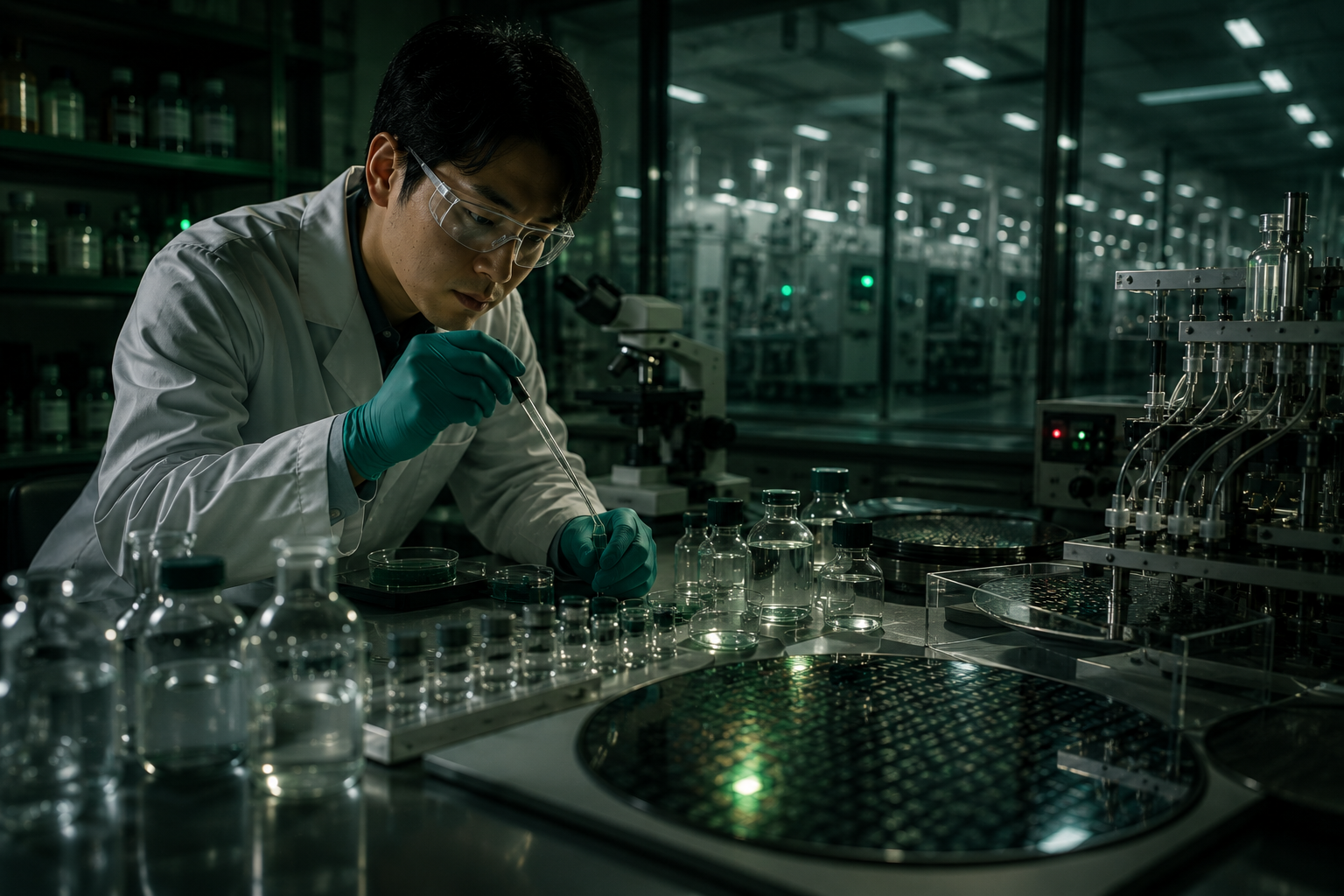
1. The Invisible Layer: Why Process Chemicals Define Semiconductor Yield
Every semiconductor wafer manufactured at Samsung’s Hwaseong fab or SK Hynix’s Icheon complex passes through approximately 800 to 1,200 individual process steps before becoming a functional memory device. A meaningful fraction of those steps — lithography, etching, chemical mechanical planarisation, cleaning, and deposition — are chemically mediated. The transistor geometries being patterned at 3 nm node and the 176-layer vertical stacks defining cutting-edge 3D NAND architecture impose chemical specifications that would have been considered physically impossible two decades ago. Yet the formulation science enabling them receives almost no public attention. It operates invisibly, upstream of the fabs that dominate the industry’s public narrative.
The economic stakes of this invisible layer are staggering. A single 300 mm wafer at advanced node carries a manufacturing cost exceeding $5,000 before packaging. A yield loss of 3 percentage points — attributable, in many documented cases, to process chemical formulation issues such as photoresist line-edge roughness, CMP slurry non-uniformity, or cleaning agent metal contamination — represents a loss exceeding $150 per wafer across a production run. Samsung’s Hwaseong P3 fab processes approximately 100,000 wafers per month. The financial exposure from sub-optimal process chemical performance is not a marginal concern; it is a first-order business variable.
“At 3 nm node, the difference between a photoresist formulation that prints at specification and one that prints 0.3 nm wide of specification is not detectable by the human eye, is barely resolvable by the most advanced electron microscopes, and can collapse the electrical yield of an entire wafer lot.”
South Korea’s chemical industry has historically been a supplier of commodity petrochemicals and polymers rather than a developer of high-performance specialty materials. The country imports the majority of its leading-edge semiconductor process chemicals from Japan (JSR, Tokyo Ohka Kogyo, Shin-Etsu Chemical, Stella Chemifa) and from the United States (DuPont, Entegris, Cabot Microelectronics). This import dependency was dramatically exposed in July 2019, when Japan restricted exports of three critical semiconductor chemicals to South Korea — fluorinated polyimide, photoresist, and high-purity hydrogen fluoride — in a trade dispute. The episode catalysed a national policy response: the Korean government’s Materials, Parts and Equipment (MPE) Independence Initiative, backed by 5 trillion won in public and private investment, made domestic development of semiconductor process chemicals a strategic imperative.
The chemistry challenge embedded in that imperative is formidable. Replacing a photoresist supplier is not a matter of finding an alternative polymer — it requires replicating a formulation system tuned over decades of iterative development to a specific scanner platform, process window, and defect specification. It requires building the formulation data infrastructure, the analytical capability, and the institutional knowledge that Japanese suppliers accumulated over thirty years. For Korean chemical companies, AI-assisted R&D tools are not a convenience — they are a strategic accelerant in a race against a multi-decade head start.
2. The Chemistry of Semiconductor Process Materials: A Deep Formulation Science
Understanding the data challenge requires first understanding the chemistry. Semiconductor process materials are not a homogeneous product category — they encompass at least four distinct chemical families, each with its own formulation science, its own failure modes, and its own multi-variable experimental landscape.
2a. Photoresist Formulations
Photoresist is the most formulation-intensive of semiconductor process chemicals. A modern chemically amplified resist (CAR) for deep ultraviolet (DUV) lithography at 193 nm contains at minimum: a base polymer (typically a methacrylate copolymer bearing acid-labile protecting groups, lactone functionalities for adhesion, and hydroxyl groups for development contrast); a photoacid generator (PAG) that produces a strong acid upon photon absorption; a quencher amine that retards acid diffusion to control the blur of the latent image; a casting solvent system (propylene glycol methyl ether acetate, PGMEA, being standard) whose purity is specified to sub-ppb metal contamination; and sometimes dissolution inhibitors or surfactants that modify development kinetics. For extreme ultraviolet (EUV) lithography at 13.5 nm, the formulation challenge escalates further: the polymer’s EUV absorption cross-section must be engineered through incorporation of high-Z elements (iodine, tellurium, hafnium) or metal-organic hybrid architectures that improve photon capture efficiency, while maintaining the line-edge roughness specifications of 1.5 nm or below that 3 nm node patterning requires.
The formulation design space for a competitive EUV photoresist involves a minimum of 12–18 independent variables: polymer composition (monomer ratios, molecular weight, dispersity), PAG type, PAG loading, quencher identity, quencher-to-PAG ratio, solvent system composition, coating thickness, post-apply bake temperature, post-exposure bake temperature and time, developer composition and concentration, development time and temperature. The interaction effects between these variables are non-linear and partially coupled: changing the quencher-to-PAG ratio affects sensitivity, resolution, and line-edge roughness simultaneously, and the direction of each effect depends on the PAG type and the polymer architecture. No theoretical framework exists that predicts these interaction effects from first principles with sufficient precision for formulation design. The experimental dataset required to navigate this space rigorously runs to hundreds of designed experiments per formulation candidate.
PHOTORESIST FORMULATION VARIABLES: A Partial Inventory
Polymer backbone: monomer composition, Mw, dispersity (D) ▸ Protecting group type and deprotection activation energy ▸ PAG structure (onium salt vs. non-ionic) and molar loading ▸ Quencher basicity and diffusivity (fast vs. slow quencher) ▸ Q/PAG ratio (acid amplification balance) ▸ Surfactant type and loading (surface segregation control) ▸ Casting solvent and water content ▸ Post-apply bake (PAB) temperature ▸ Exposure dose (mJ/cm²) ▸ Post-exposure bake (PEB) temperature and duration ▸ Developer (TMAH concentration, temperature, puddle time) ▸ Rinse chemistry ▸ Substrate surface treatment (HMDS priming, adhesion promoter type)
2b. Etchants and Wet Process Chemicals
Wet etch chemistries for silicon, silicon dioxide, silicon nitride, and metal layers represent a different formulation challenge: controlling selectivity ratios between materials that must be removed and those that must be preserved, at etch rates precise enough to hit angstrom-level depth targets reproducibly. Buffered oxide etch (BOE) — ammonium fluoride in aqueous HF — is the archetype: the NH₄F/HF ratio determines the SiO₂ etch rate and the selectivity over Si₃N₄ and silicon. But at sub-10 nm node, the selectivity requirements have become severe enough that simple two-component systems are inadequate. Modern wet etch formulations for advanced node incorporate surfactants for contact-angle control (ensuring liquid penetration into high-aspect-ratio structures without pattern collapse), chelating agents that complex dissolved silicon species to prevent re-deposition, and pH stabilisers that maintain etch rate consistency across a bath lifetime of thousands of wafer exposures. Each additive introduces a new dimension of the formulation design space and a new potential source of contamination.
High-purity hydrogen fluoride (HF) for semiconductor-grade wet processes must be purified to metal ion concentrations below 1 ppt (part per trillion) for critical gate oxide etch steps. The formulation science of HF purification and stabilisation — preventing disproportionation, managing dissolved metal speciation, maintaining consistent water content in anhydrous HF grades — is itself a multi-variable optimisation problem that Korean chemical companies Soulbrain and ENF Technology have been investing in aggressively since the 2019 Japan export restrictions.
2c. CMP Slurries
Chemical mechanical planarisation (CMP) slurry formulation is perhaps the most multi-variable problem in the entire semiconductor process chemical portfolio. A tungsten CMP slurry for contact plug planarisation contains: abrasive particles (typically colloidal silica or alumina at 1–5 wt%, with particle size distribution controlled to a coefficient of variation below 10%); an oxidiser (hydrogen peroxide at 1–6 wt%, with decomposition rate a critical shelf-life variable); a complexing agent for the tungsten oxidation product (citric acid, glycine, or proprietary chelates); a corrosion inhibitor for the titanium nitride barrier layer (benzotriazole derivatives at sub-0.1 wt% concentrations); a pH buffer; and a surfactant system that controls particle dispersion stability and wafer surface wettability. The slurry must remove tungsten at 200–400 nm/min while removing the underlying SiO₂ dielectric at less than 5 nm/min — a selectivity ratio of 50:1 or greater — without generating abrasive scratches larger than 30 nm, without leaving residual metal contamination above 10¹¹ atoms/cm² on the wafer surface, and while maintaining colloidal stability at pH 2–3 over a bath lifetime at 25°C.
Particle agglomeration in CMP slurries is the dominant failure mode, and it is a formulation problem of considerable subtlety. Colloidal stability at low pH depends on electrostatic repulsion (characterised by zeta potential, which must exceed ±30 mV in absolute value for adequate stability), steric stabilisation from adsorbed surfactant layers, and the prevention of salt-induced screening of the double layer by ionic species generated during tungsten oxidation. The interaction between the oxidiser concentration, the chelating agent speciation, the pH, and the ionic strength creates a stability landscape that cannot be predicted analytically and must be navigated experimentally.
2d. Post-Etch and Post-CMP Cleaning Chemistries
Cleaning formulations for post-etch residue removal and post-CMP particle removal are the least visible but arguably the most critical process chemicals in the advanced node fabrication sequence. A single metallic contamination event — an iron atom at a concentration of 10¹ atoms/cm² on a gate dielectric surface — can generate a gate oxide trap that shifts the threshold voltage of a transistor by several millivolts and causes a static random access memory (SRAM) cell to fail its timing specification. At the transistor density of a 3 nm node chip — approximately 100 million transistors per mm² — the statistical probability of yield-limiting contamination events scales directly with cleaning chemistry performance. Modern SC-1 (NH₄OH/H₂O₂/H₂O) and SC-2 (HCl/H₂O₂/H₂O) formulations have evolved significantly from their RCA Clean origins: surfactant additions that reduce particle re-adhesion, chelating agents that complex dissolved metal ions in the bath before they re-deposit, megasonic transducer compatibility requirements that constrain surfactant foam behaviour, and low surface tension formulations for sub-10 nm fin and gate-all-around structures where conventional cleaning chemicals cause pattern collapse.
“In advanced node semiconductor manufacturing, a cleaning chemistry is not a cleaning chemistry. It is a precisely engineered multi-component system that must remove particles and metal ions at concentrations measured in single atoms per square centimetre, without disturbing a three-dimensional transistor structure whose critical dimensions are measured in nanometres.”
3. The Data Landscape: Why This Sector Is the Most Demanding in Applied Chemistry
The formulation data generated in semiconductor process chemical R&D is unique in its complexity, its precision requirements, and its volume. A photoresist development programme for a new process node generates experimental datasets that include: polymer synthesis and characterisation data (GPC, NMR, DSC, TGA for dozens of candidate polymers); formulation screening data from hundreds of Spin-Coat-Expose-Develop (SCED) experiments measuring critical dimension, line-edge roughness, sensitivity, and defect density; process window characterisation data from dose-focus matrices; and reliability data from long-term storage stability studies, wafer-level yield correlation studies, and multi-site cross-fab qualification. The total experimental record for a single photoresist product generation development programme can exceed 50,000 individual data points, generated over 18–24 months, by teams distributed across synthetic chemistry, formulation, analytical, and process engineering functions.
The challenge is not data volume per se — modern laboratory information management systems handle large datasets routinely. The challenge is data heterogeneity and cross-functional integration. A photoresist formulation scientist working on line-edge roughness optimisation needs to correlate their SCED experimental outcomes with: the polymer batch characterisation data from the synthetic chemistry team (which lives in a different database); the PAG lot analysis reports from the raw material supplier (which arrive as PDF certificates of analysis); the scanner qualification data from the lithography process engineering team (which lives in a fab metrology system with restricted access); and the historical formulation performance database from previous product generations (which may be partially in an ELN, partially in a legacy LIMS, and partially in a senior scientist’s personal spreadsheets). Without a unified data architecture that integrates these sources, the correlation analysis that drives formulation insight — the recognition, for example, that line-edge roughness spikes correlate with a specific lot of PAG whose synthesis batch contained elevated levels of a photochemically active impurity — is practically impossible.
THE SEMICONDUCTOR CHEMICAL DATA INTEGRATION PROBLEM
Polymer synthesis batch records (MW, dispersity, functional group ratios) ▸ PAG/quencher supplier CoA data (purity, water content, trace metals) ▸ Formulation preparation records (weights, mixing conditions, filtration) ▸ Coating process data (spin speed, PAB conditions, humidity) ▸ Exposure data (dose, focus, scanner platform, reticle ID) ▸ PEB and development conditions ▸ CD-SEM metrology outputs (CD, LER, LWR, pattern collapse events) ▸ Defect inspection data (KLA output files) ▸ Yield correlation data from fab (restricted access, often delayed) ▸ Stability study time-series dataAll generated by different teams, in different systems, on different timescales.
The purity specification management dimension adds a further layer of complexity unique to this sector. Process chemicals for semiconductor applications operate under incoming quality control (IQC) protocols that require trace metal analysis by ICP-MS to sub-ppb detection limits for 30–50 individual elements, particle sizing by dynamic light scattering or single-particle ICP-MS, dissolved gas content by membrane inlet mass spectrometry, and in some cases molecular organic impurity profiling by GC-MS. Each incoming raw material lot generates an analytical dossier of 50–100 data points. Linking these lot-level characterisation data to formulation performance outcomes — identifying which trace impurity species are responsible for sporadic defect events — requires a data infrastructure that virtually no Korean chemical supplier had built before the 2019 MPE Independence Initiative forced the issue.
4. Korea’s Domestic Chemical Industry Response: Companies at the Frontier
The 2019 export restriction crisis galvanised Korean chemical R&D in a way that years of policy exhortation had not. Three companies exemplify the nature and scale of the formulation challenge being addressed:
Soulbrain Holdings is the most advanced Korean developer of wet process chemicals for semiconductor applications, with established commercial supply of HF-based etchants, sulfuric acid blends, and phosphoric acid solutions for nitride etch. Its post-2019 R&D investment has focused on developing alternatives to Japanese high-purity HF grades from Stella Chemifa and Morita Chemical Industries. The formulation challenge is not synthesis — HF purification chemistry is well understood — but consistent process qualification: demonstrating to Samsung and SK Hynix’s process integration teams that Soulbrain’s HF performs identically to the incumbent in gate oxide etch selectivity, across thousands of wafer lots, with no anomalous defect events. This requires the kind of structured lot-to-lot performance correlation dataset that only a rigorous experimental data management system can generate.
ENF Technology has focused on developing photoresist developer and remover formulations, and more recently has entered the cleaning chemistry space with post-CMP cleaning solutions. Its R&D challenge illustrates the multi-variable complexity of this sector: a post-CMP cleaning solution must simultaneously remove abrasive particles (via megasonic-assisted physical removal aided by surfactant charge reversal), dissolve residual tungsten oxidation products (via chelation), passivate the metal surface to prevent re-contamination during rinsing, and maintain a pH profile that does not etch the underlying SiO₂ dielectric. Optimising all four performance dimensions simultaneously requires DoE methodologies capable of navigating four-dimensional interaction spaces — a practical impossibility without computational support.
Dongjin Semichem has the most ambitious photoresist development programme among Korean chemical companies, targeting the DUV photoresist market currently dominated by JSR and TOG. Its programme illustrates the knowledge accumulation challenge most starkly: developing a competitive ArF immersion photoresist from scratch requires not just synthetic chemistry capability and formulation expertise, but access to the decades of process window, defect mechanism, and raw material specification data that incumbent suppliers have accumulated across multiple process node generations. No amount of talent or capital can shortcut this — but AI-assisted data mining of the published patent and scientific literature, combined with rigorous structured experimental data capture from the outset of the development programme, can compress the learning curve materially.
5. AI-Native R&D Platforms: What They Mean for Semiconductor Chemical Development
The semiconductor process chemical sector is, in many ways, the ideal proving ground for AI-assisted formulation R&D. The experimental datasets are large, precisely measured, and quantitatively structured. The performance targets are numerically defined (CD at specification, LER below threshold, defect density below limit). The raw material characterisation data is already generated in machine-readable formats by ICP-MS, GPC, and DLS instruments. The infrastructure for AI is present; what has been missing is the platform architecture to unify it.
ChemCopilot’s value proposition in this context operates on three levels that are uniquely relevant to semiconductor chemical R&D:
Cross-functional data integration: The platform ingests heterogeneous data sources — ELN records, LIMS outputs, supplier CoA PDFs, fab metrology exports — and returns a unified, queryable formulation performance database. For a photoresist development team whose experimental data currently exists in five separate systems, this alone transforms the analytical capability of the team without requiring a multi-year IT integration project.
Predictive modelling for multi-variable formulation spaces: Gaussian Process models and Gradient Boosted Trees trained on structured historical formulation data can propose the next experiment in a DoE sequence that is most likely to improve LER while maintaining sensitivity — a classic multi-objective optimisation problem that conventional statistical tools handle poorly when the number of variables exceeds eight. ChemCopilot’s AI engine is designed for exactly this problem class.
Raw material lot correlation and impurity tracking: By linking incoming material ICP-MS and GPC data to formulation performance outcomes at the lot level, the platform identifies impurity species responsible for sporadic defect events — the most costly and elusive failure mode in semiconductor chemical manufacturing. This capability alone, applied to a single photoresist production batch with a yield-limiting defect event, can justify a full platform deployment.
Literature mining and competitive intelligence: For Korean chemical companies developing formulations against entrenched Japanese incumbents with 30 years of proprietary data, AI-assisted mining of the published patent literature — which contains substantial formulation information in JSR’s, TOG’s, and Shin-Etsu’s filings — provides a structured starting point for formulation hypothesis generation that significantly compresses the initial exploration phase.
Process node transition support: When Samsung or SK Hynix transitions to a new process node, the process chemical specifications change materially. AI models trained on historical process-chemical-to-yield correlation data can predict which formulation parameters are most likely to require adjustment for the new node requirements, reducing the qualification timeline for each successive generation.
“For a Korean chemical company developing a photoresist to qualify against a Japanese incumbent with three decades of formulation history, the question is not whether to use AI tools — it is whether to use them from the first experiment or after the first five years of unstructured data accumulation.”
6. The Geopolitical Dimension: Data Infrastructure as Strategic Sovereignty
The 2019 Japan export restriction episode introduced a dimension to semiconductor chemical formulation R&D that is rarely discussed in technical literature: geopolitical risk. South Korea’s dependence on Japanese process chemicals is not merely a commercial concentration risk — it is a supply chain sovereignty vulnerability that became a weapon in a bilateral trade dispute. The lesson drawn by Korean policymakers and industrial planners was unambiguous: domestic formulation capability, backed by domestic formulation data infrastructure, is a national security asset.
This framing elevates the importance of AI-assisted R&D platforms beyond commercial R&D efficiency. A Korean chemical company that builds a structured, AI-queryable formulation database for its photoresist development programme is not just improving its internal R&D velocity — it is building the institutional knowledge asset that makes its products difficult to substitute, its customer relationships technically sticky, and its position in the Korean semiconductor supply chain strategically secure. The data infrastructure is the moat.
The Korean government’s continued investment in the MPE Independence Initiative — with 2024 extensions targeting next-generation EUV photoresist and high-aspect-ratio CMP slurry development — ensures that the policy environment supporting domestic semiconductor chemical R&D will remain favourable for the foreseeable future. The companies that build AI-native formulation data infrastructure today will be positioned to absorb and leverage that policy support most effectively.
7. What ChemCopilot Delivers to Korean Semiconductor Chemical Labs
For a Korean chemical R&D scientist working on photoresist, CMP slurry, or cleaning chemistry development, ChemCopilot is not an abstraction — it is a specific set of capabilities that address specific bottlenecks in their daily work.
The most immediate impact is experimental data organisation. A photoresist chemist who has run 200 SCED experiments across six formulation candidates over twelve months, with results stored in a combination of Excel workbooks, CD-SEM output files, and engineering notebook entries, cannot efficiently identify the cross-experiment correlation that reveals why candidate three consistently outperforms candidate five on LER at tight process windows. ChemCopilot structures that data automatically, renders it queryable, and surfaces the correlation without requiring the chemist to manually normalise five data formats.
The second impact is formulation hypothesis acceleration. A CMP slurry scientist targeting a selectivity ratio improvement for a new barrier metal system does not need to design the full 96-run central composite DoE from scratch. ChemCopilot’s AI engine, drawing on the company’s historical slurry data and relevant published literature, proposes the minimum experiment set most likely to identify the selectivity-controlling variable — reducing a 96-run programme to 24 targeted experiments without sacrificing statistical validity.
The third impact is the one that matters most at the strategic level: institutional knowledge continuity. The Korean chemical engineers who designed the first generation of domestic HF etch formulations and cleaning chemistries under the MPE Independence Initiative are accumulating formulation knowledge at a rate that has no precedent in their companies’ histories. Whether that knowledge becomes a permanent institutional asset or a personal tacit asset that departs with them is determined entirely by the data infrastructure around which it accumulates. ChemCopilot closes that gap — and in doing so, transforms South Korea’s semiconductor chemical ambition from a well-funded initiative into a durable competitive position.