ELN vs PLM vs LIMS: Which Does Your Chemical Company Actually Need? (2026)
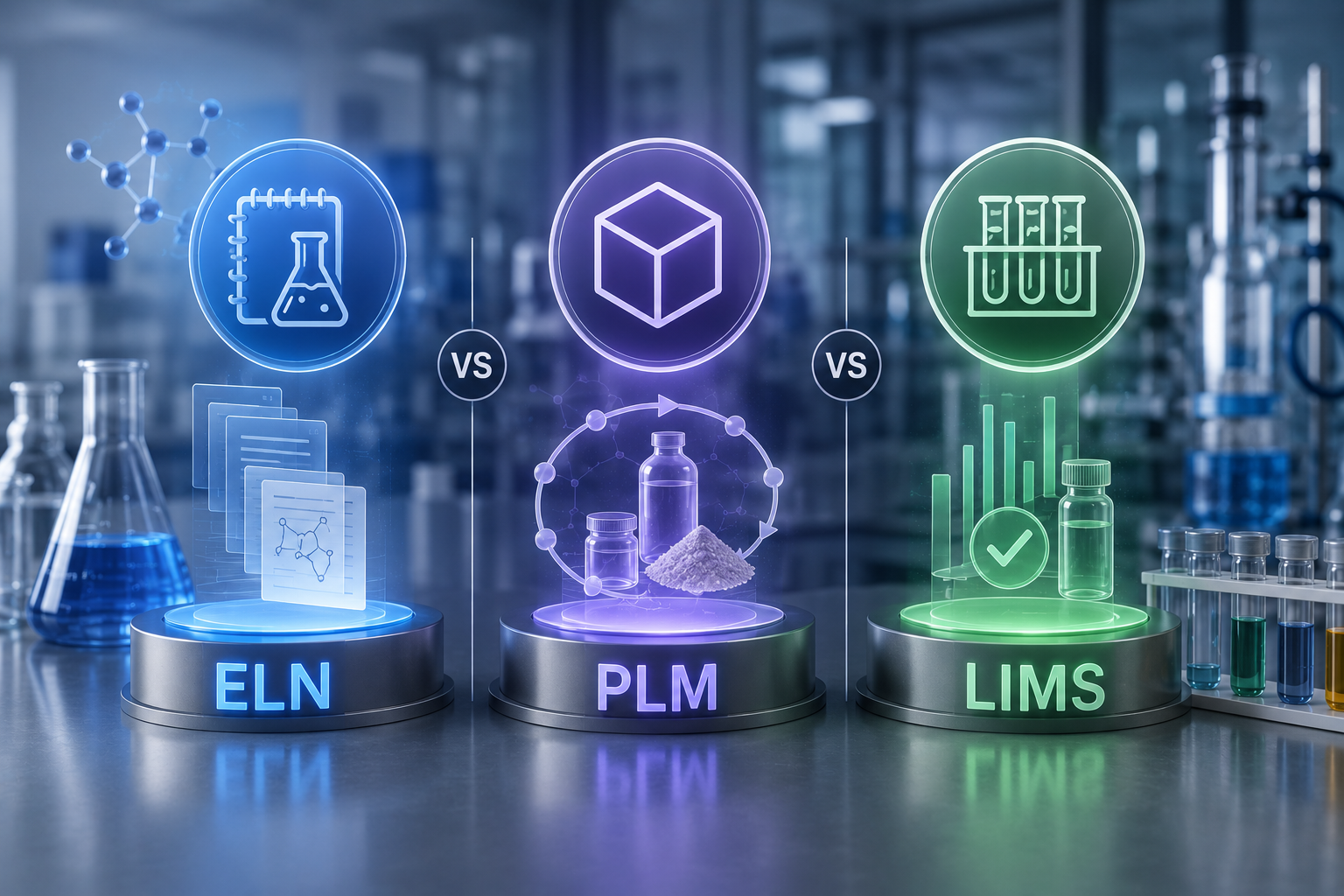
As chemical manufacturers and materials R&D laboratories scale operations, the digital software landscape often becomes a major source of friction. Engineering teams frequently find themselves trapped in an un-intuitive web of overlapping acronyms. A lab manager requests a **LIMS** upgrade, the product development group demands a unified **PLM** configuration, and the bench chemists bypass both by keeping daily experimental records in a localized **ELN**.
When these core systems are deployed incorrectly, it results in disconnected software architectures, redundant documentation, and expensive data fragmentation. Valuable chemical formulations get trapped inside isolated file silos, forcing technicians to repeat trials simply because past data is unreachable.
To build an agile lab environment in 2026, leadership must understand exactly where each software system excels, where their structural boundaries lie, and how next-generation AI orchestration layers connect them all.
ELN
The chemist's digital journal. It captures unstructured experimental narratives, observations, raw observation text, and daily bench recipe adjustments as they happen in real time.
LIMS
The operational controller. It tracks sample IDs, structures strict workflows, manages testing queues (HPLC, MS), monitors chemical inventory, and logs QA/QC properties.
PLM
The commercial coordinator. It manages the verified institutional Bill of Materials (BOM), scales pilot runs to production, handles global compliance packaging, and syncs with ERP data.
Deep-Dive: The Core Functional Differences
To choose the right core system architecture for your enterprise, look beyond standard marketing checklists and analyze how data actually flows through each ecosystem:
1. ELN: Electronic Lab Notebook (The Innovation Engine)
An ELN replaces the traditional paper laboratory notebook. Its primary objective is flexibility. Because early-stage molecular discovery or polymer formulation testing is unpredictable, an ELN allows scientists to record unstructured textual annotations, attach reaction images, and make sudden changes to trial mixtures on the fly.
- Primary Assets: Captures the specific context surrounding an experiment (e.g., "The solution turned yellow after adding 5g of catalyst variant B at 80°C"). Vital for protecting corporate Intellectual Property (IP) and filing accurate patents.
- The 2026 Failure Mode: Because the data input is largely semi-structured or conversational text, legacy ELNs act as passive data cemeteries. The information is logged for compliance, but it cannot be easily queried by traditional automation software to guide future trials.
2. LIMS: Laboratory Information Management System (The Operations Anchor)
Where an ELN focuses on unstructured experimentation, a LIMS demands absolute structure. It views the laboratory through the lens of operational metrics, tracking samples, barcoding storage blocks, queuing analytical hardware testing pipelines, and recording formal quality check outputs.
- Primary Assets: Standardizes analytical workflows and ensures complete execution consistency. It is the core platform required for high-volume QA/QC environments, regulatory safety verification, and operational compliance auditing.
- The 2026 Failure Mode: A LIMS does not design molecules. It tracks *what happened* to a sample during physical characterization, but it cannot offer predictive suggestions regarding how to change ingredient concentrations to fix a flawed batch.
3. PLM: Product Lifecycle Management (The Scale-Up Bridge)
A PLM software suite handles a formulation once it moves out of early-stage laboratory exploration and transitions into a commercial product line. It bridges the gap between R&D, corporate compliance legal teams, purchasing networks, and plant floor manufacturing ERPs.
- Primary Assets: Manages the master Bill of Materials (BOM). It ensures that changes to European REACH or US TSCA rules instantly trigger warning blocks across active manufacturing recipes, coordinating global labeling updates seamlessly.
- The 2026 Failure Mode: It is optimized for enterprise governance, not discovery. A formulation chemist cannot use a corporate PLM architecture to easily model multi-variable active learning loops or test fluid parameter variations virtually.
The Side-by-Side Comparison Matrix
| Feature Metric | ELN (Notebook) | LIMS (Operations) | PLM (Lifecycle) |
|---|---|---|---|
| Core Intent | Record daily flexible R&D observations | Standardize sample processing & testing | Manage commercial formulas & scale-up |
| Primary Users | Formulation Chemists, Molecular Researchers | Lab Technicians, QA/QC Operators | Product Managers, Regulatory Officers |
| Data Structure | Semi-structured text, image attachments | Highly structured tables, sample fields | Relational Bill of Materials (BOM) grids |
| Workflow Flexibility | High (Changes dynamically per trial) | Rigid (Strict step-by-step enforcement) | Regulated (Requires sign-off tracking) |
| 2026 Bottleneck | Data is trapped in flat text logs | Lacks predictive/optimization engine | Disconnected from early-stage design labs |
The Modern Solution: Seamless AI Orchestration
Historically, software providers attempted to build massive "all-in-one" systems, creating complex ELN/LIMS hybrids that were too un-intuitive for chemists and too flexible for QA operators.
In 2026, enterprise leaders have abandoned the all-in-one approach. Instead, they deploy optimized, distinct platforms for each functional department and connect them using a centralized cognitive layer like **ChemCopilot**.
Siloed Data Repositories
Isolated Information StorageELN records text, LIMS isolates sample parameters, and PLM tracks the regulatory BOM. Data remains trapped in functional silos, requiring manual transcription across departments.
Unifying Cognitive Layer
ChemCopilot Ingestion LoopLeverages semantic AI to ingest data from your existing ELN, LIMS, and PLM files automatically, parsing text and variables to drive predictive machine learning models.
ChemCopilot does not replace your existing systems. It acts as the centralized brain that links them together. Through its **Knowledge Base ("Smart Librarian")**, ChemCopilot utilizes semantic AI to parse unstructured text notes out of your ELN logs, match them to structured physical analytical parameters recorded inside your LIMS, and cross-reference them with the master commercial formulas in your PLM.
Once unified, the **ChemOptimize** engine runs active learning loops (like Bayesian optimization or XGBoost trees) over the complete data matrix. This allows your scientists to test hypothetical formulation recipe variations virtually inside a "Silicon Lab," finding optimal targets from their historical institutional data before executing expensive physical trials at the lab bench.
Which System Mix Does Your Firm Actually Need?
- R&D Startups & Agile Formulators: Skip large-scale LIMS and PLM platforms initially. Begin with a flexible ELN to secure your core chemistry intellectual property, and layer **ChemCopilot** over it immediately to run predictive active learning loops on your data from day one.
- High-Volume Testing & Pilot Facilities: You need an established LIMS first to manage high-throughput sample workflows, barcode generation, inventory control, and tracking across physical instruments.
- Mature Multi-National Enterprises: You require all three systems working in harmony. Deploy the ELN for bench discovery, the LIMS for characterization testing, and the PLM for compliance and global supply chains—then tie them together with **ChemCopilot** to unlock unified predictive modeling across your global organization.