How Retrieval-Augmented Generation (RAG) Transforms LLMs for Enterprise Chemistry
Author: Jonathan Woo | Chief Product Officer, ChemCopilot
About the Author: Jonathan Woo is the Chief Product Officer at ChemCopilot. Former VP of Product at Noble.AI, Co-founder/CTO at Nanostellar (Quantum Simulation & Catalysts), and NASA/Harvard ACIS Software Team Leader. Over 25 years pioneering enterprise SaaS, deep-tech AI architectures, and automated materials modeling.
Category: Artificial Intelligence Architecture | Chemical Knowledge Engines
Last Updated: September 2026
While Large Language Models (LLMs) have demonstrated remarkable conversational fluency, deploying standalone foundational models in physical chemistry repeatedly exposes severe operational limits. Generic LLMs suffer from parametric static memory, context window constraints, and a tendency to hallucinate plausible-sounding yet thermodynamically impossible chemical reactions or non-existent CAS registry numbers.
In physical R&D, a hallucinated recipe is not merely a minor bug—it represents thousands of dollars in wasted physical reagents, potential safety hazards, and compromised intellectual property.
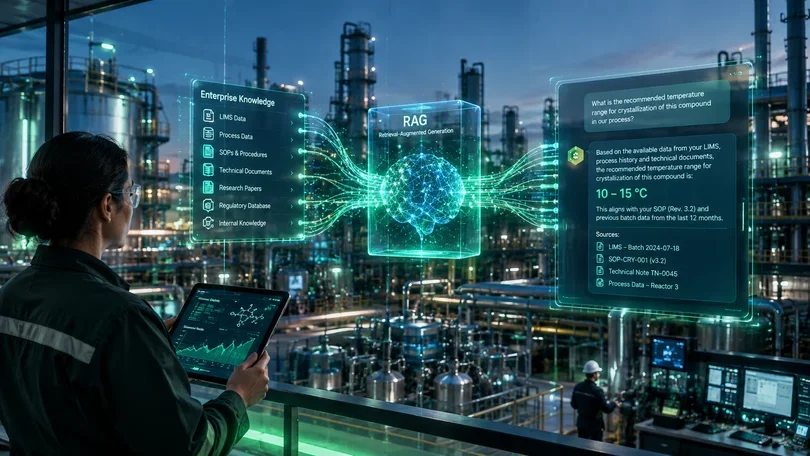
To overcome these constraints, enterprise chemical architectures utilize Retrieval-Augmented Generation (RAG). By decoupling a model's reasoning capabilities from its static knowledge weights, RAG acts as a dynamic bridge between generative neural networks and deterministic chemical databases, patent archives, and private lab notebooks.
1. The Fundamental Problem: Why Standalone LLMs Fail at Chemistry
Standard foundation models store knowledge implicitly within millions or billions of parametric weights ($\theta$). When asked a technical question regarding a niche reaction pathway or a specific formulation ratio, the model attempts to generate tokens based on probabilistic distribution learned during training:
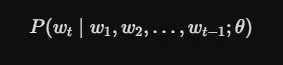
$$P(w_t \mid w_1, w_2, \dots, w_{t-1}; \theta)$$
For natural language, this probabilistic approximation is highly effective. For chemical informatics, it creates three catastrophic failure modes:
Parametric Memory Freeze: The model cannot know about internal experimental assays run yesterday in your laboratory or patent claims published last week.
Lack of Grounding in Domain Truth: A text-centric LLM does not natively verify valence rules, stoichiometry, or 3D stereochemistry.
Proprietary Data Inaccessibility: Enterprise R&D teams cannot upload internal trade secrets to public foundation models to update their base weights without violating corporate IP isolation mandates.
2. The RAG Architecture for Chemical Science
Retrieval-Augmented Generation resolves these bottlenecks by transforming the generative process from a closed-book exam into an open-book synthesis.
UNSTRUCTURED & STRUCTURED DATA
- LIMS Assay Output
- Internal ELNs & PDFs
- Supplier Safety Data Sheets
CHEMICAL VECTOR ENCODING
- High-Dimensional Embeddings
(Morgan Fingerprints / SMILES) - Local Vector Database Indexing
SEMANTIC RETRIEVAL STEP
- Top-K Contextual Snippets
- Exact Match Vector Lookups
- Zero-Data Retention Security
GENERATIVE RESPONSE
- Grounded Technical Reports
- Citation-Backed Synthesis
- Zero-Hallucination Answers
Vectorization & Indexing: Unstructured documents (PDFs, research articles, SDSs) and structured assay logs (LIMS outputs, 4-column DOEs) are broken into semantic chunks and converted into high-dimensional vector embeddings using domain-adapted featurizers.
Dynamic Context Retrieval: When a computational chemist queries the system, the RAG engine calculates mathematical similarity (e.g., cosine distance) across the private vector database to retrieve the Top-K most relevant, verifiable snippets.
Grounded Synthesis: The retrieved facts are injected directly into the LLM's prompt context, instructing the model to synthesize an answer strictly grounded in the provided factual evidence.
As detailed in our analysis on AI Chem Agents & Scientific Literature, coupling RAG architectures with specialized chemical embeddings transforms static software into an active scientific co-pilot capable of automating literature reviews, cross-referencing bench data with published patents, and generating audit-ready evidence packages.
3. High-Impact Applications of RAG in Modern R&D
Deploying RAG engines inside physical chemical laboratories unlocks three critical capabilities:
A. Literature-Informed Feature Prioritization
Before building a machine learning surrogate model over a sparse experimental dataset ($N \le 50$), scientists must identify which physical descriptors matter most. A RAG-equipped agent scans thousands of internal technical documents and external publications to highlight key variables—such as Hansen solubility parameters, cross-link densities, or dipole moments—drastically improving downstream model accuracy.
B. Automated Freedom-to-Operate (FTO) & Patent Screening
Instead of manually searching patent databases, RAG systems continuously retrieve relevant patent claims based on candidate SMILES structures and formulation weight fractions, flagging potential infringement risks early in the discovery phase.
C. Unlocking Dark Data for No-Code Machine Learning
Over 80% of enterprise chemical knowledge resides in unstructured "dark data"—scanned PDFs, instrument output logs, and legacy lab notebooks. RAG pipelines automatically parse and sanitize these unstructured files, feeding clean 4-column relational schemas (Inputs, Process Parameters, Categories, Outputs) into automated training engines.
This bridge between unstructured historical text and quantitative predictive modeling is explored further in our guide on No-Code Machine Learning for Chemists: What Changed in 2026.
4. Enterprise Security: Sovereign RAG Behind the Firewall
For Chief Information Security Officers (CISOs) and IT leaders, the primary advantage of RAG is data sovereignty.
Because knowledge resides in an external, air-gapped vector database rather than within model weights, enterprise chemical data remains completely isolated. RAG deployments operate seamlessly inside a customer's dedicated Virtual Private Cloud (VPC) or on-premise hardware using Zero-Data Retention (ZDR) protocols.
When a bench scientist queries proprietary formulation logic, the context is retrieved locally, processed in volatile memory, and immediately flushed—guaranteeing that multi-billion dollar trade secrets and molecular IP are never exposed to public networks.
Summary: The RAG Advantage in Chemistry
Retrieval-Augmented Generation bridges the gap between statistical natural language processing and the deterministic demands of physical chemistry. By combining generative reasoning with verified, local vector search, RAG turns generative AI into a precise, sovereign, and indispensable tool for enterprise R&D acceleration.