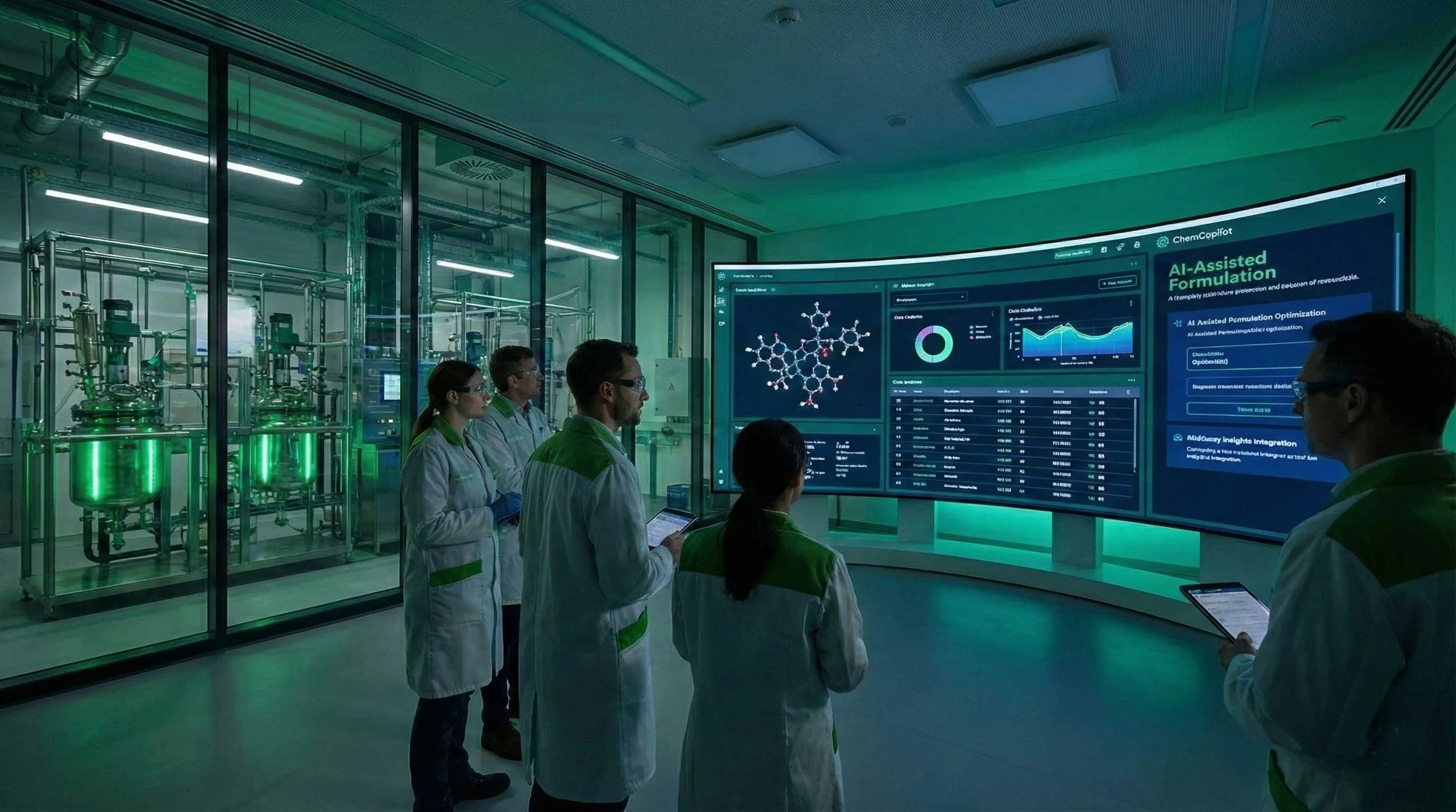
For decades, the chemical industry has been defined by long R&D cycles and asset-heavy operations. However, a landmark analysis by McKinsey reveals that the industry is at a tipping point. While chemicals have historically been cautious adopters of AI—with only a 14% exposure rate compared to the 23% cross-industry average—the potential value at stake is staggering: between $80 billion and $140 billion.
As we move toward 2026, the question is no longer if AI will transform chemicals, but how companies can bridge the gap between "messy data" and these massive economic possibilities.
1. Accelerating R&D: From Months to Days
McKinsey identifies R&D and Formulation as prime areas for impact, noting that AI can accelerate the journey to a desired formulation by more than 30%.
In 2026, this acceleration is being realized through Multi-Objective Optimization (MOO). While McKinsey highlights the need to minimize "overspecification" and optimize raw material costs, MOO provides the mathematical framework to do this at scale. By finding the Pareto Frontier, AI allows chemists to balance performance, cost, and sustainability simultaneously, fulfilling McKinsey’s vision of a more "precise formulation".
2. Commercial Growth: Precision Targeting
A major bottleneck in the chemical sector is identifying new applications for existing molecules—a process that traditionally took months. McKinsey estimates that Gen AI can reduce this timeline to just days.
This is where Multi-Agent Systems (MAS) become critical. Instead of a single algorithm, a "swarm" of AI agents can scan patents, scientific literature, and market reports in parallel to:
Identify unexplored market niches.
Predict customer churn with 10% to 20% higher accuracy.
Optimize real-time pricing to secure a 2% to 5% return on sales.
3. Operational Excellence: The Control Room "Copilot"
McKinsey notes that chemical manufacturing produces vast amounts of data that have been "too unwieldy" for traditional analytics. They predict that "Control Room Copilots" will soon tap into technical documentation to provide live troubleshooting, potentially increasing yield and throughput by more than 10%.
In 2026, platforms like ChemCopilot are fulfilling this role by acting as a Single Source of Truth. By converting unstructured lab notes and sensor data into Structured Insights, these tools empower technicians to diagnose equipment failures before they happen, driving a 30% to 40% increase in maintenance labor productivity.
4. Overcoming the "Cautious Adopter" Hurdle
McKinsey warns that the transition won't be easy. Success requires moving AI from a "peripheral initiative" to a C-suite priority. The roadmap for 2026 involves:
Managing the Talent Gap: Upskilling chemists to work alongside AI.
Building a Scalable Tech Stack: Moving away from data silos.
No-Code Empowerment: Making AI accessible to the scientists on the bench, not just the data scientists in IT.
Conclusion: The Competitive Edge of 2026
The McKinsey report makes one thing clear: future competitive advantage in the chemical industry will rely heavily on the strategic use of AI. By combining McKinsey’s high-level value mapping with specialized tools like ChemCopilot and advanced architectures like MAS and MOO, chemical companies can finally unlock the "untapped potential" to leapfrog their competitors.
Tell us about the R&D you want to create — and we’ll help you design it end-to-end with AI.
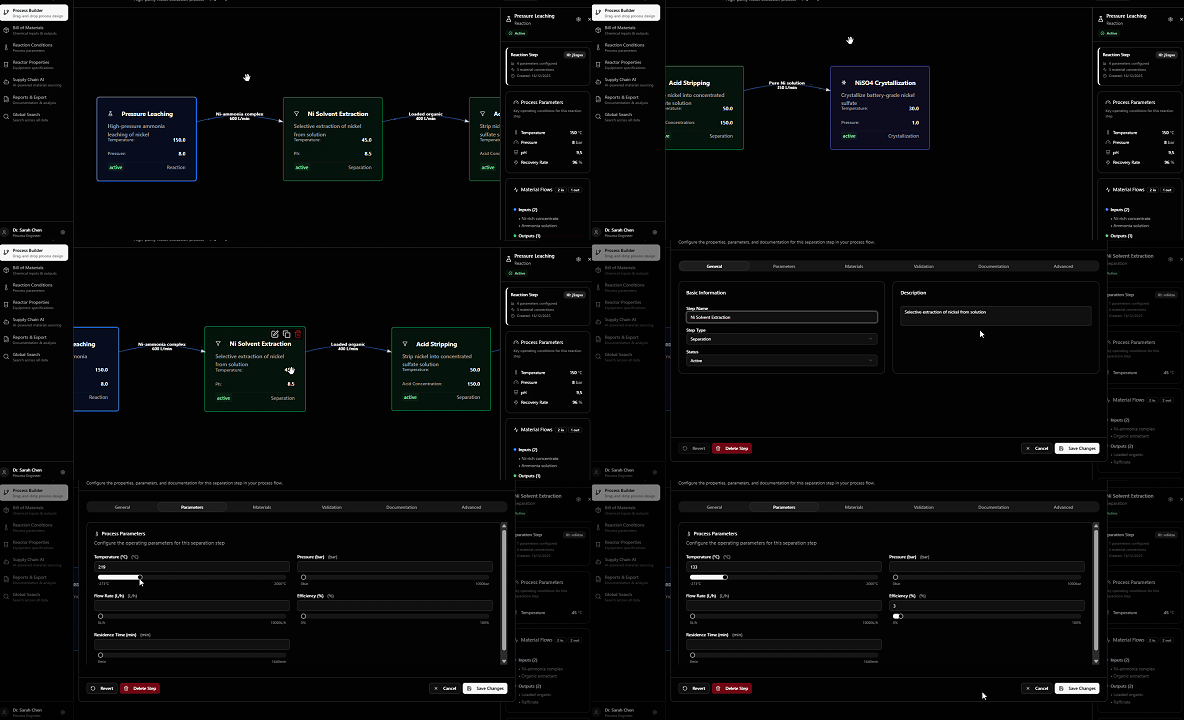
Chemcopilot UX interface.