Molecular Toolkit: A Guide to NMR, IR, and MS in the Age of AI
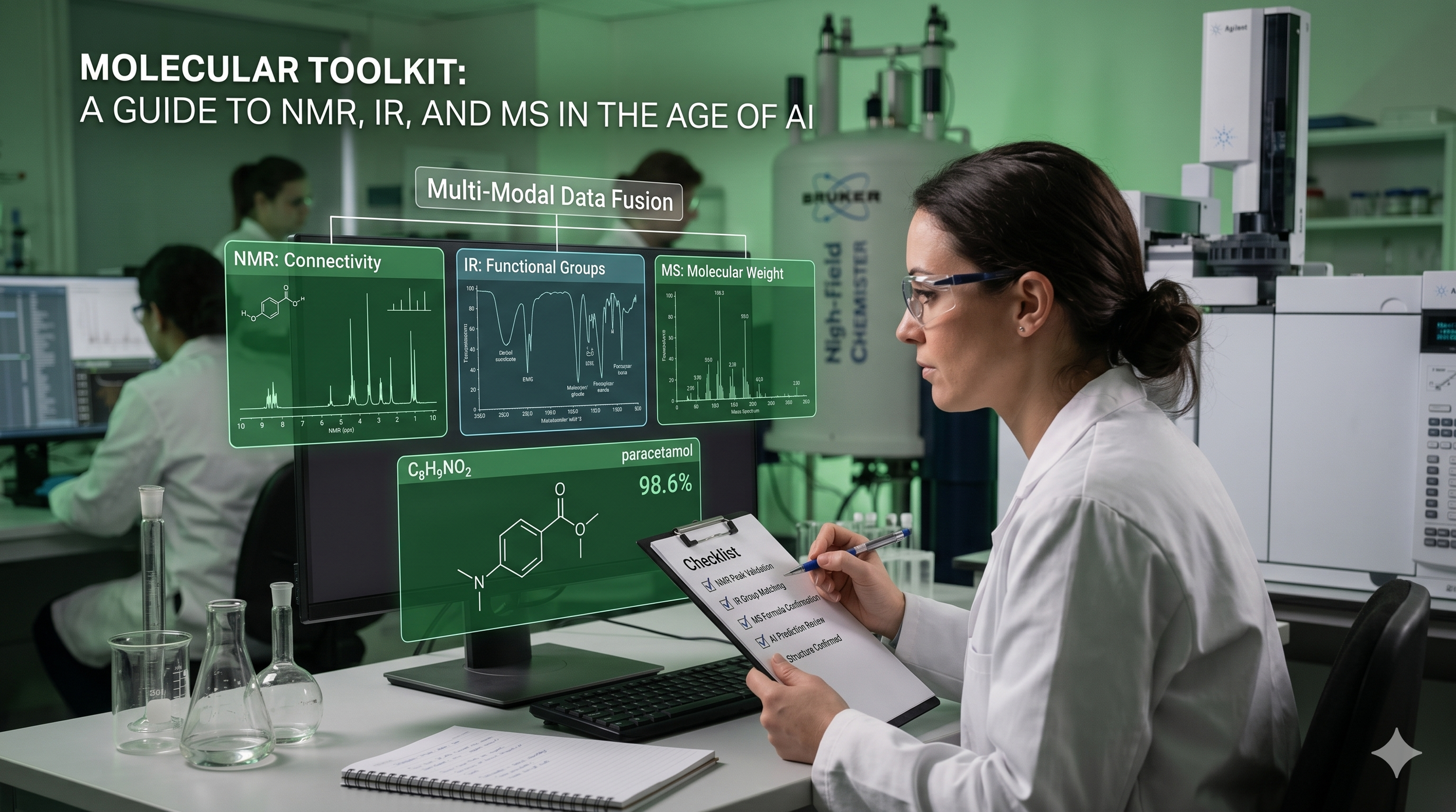
In the modern laboratory, the "Big Three"—Nuclear Magnetic Resonance (NMR), Infrared Spectroscopy (IR), and Mass Spectrometry (MS)—remain the pillars of chemical characterization. However, the integration of Artificial Intelligence is transforming these traditional techniques from manual interpretations into high-throughput, predictive powerhouses.
At ChemCopilot, we believe the future of chemistry lies in the synergy between rigorous lab protocols and machine learning. Here is your comprehensive guide to mastering these techniques.
1. Nuclear Magnetic Resonance (NMR)
The Objective: Determining the carbon-hydrogen framework and molecular connectivity.
Lab Protocol Essentials
Sample Prep: Dissolve 5–10 mg of your compound in 0.6 mL of a deuterated solvent (e.g.,CDCl3 or D2O). Ensure the solution is clear; suspended particles cause field inhomogeneity (line broadening).
Shimming: Vital for a sharp signal. Use automated gradient shimming to ensure the magnetic field is uniform across the sample.
Pulse Sequence: For standard characterization, use a $1H$ 1D pulse sequence. For complex molecules, 2D experiments like COSY (correlation) or HSQC (C-H coupling) are essential.
AI Integration
Automated Peak Picking: AI models like DeepNMR can distinguish between noise and weak signals more accurately than threshold-based software.
Structure Elucidation: Neural networks can now predict chemical shifts ($\delta$) with $0.1 \text{ ppm}$ accuracy, comparing experimental data against libraries of millions of simulated spectra to suggest the most likely molecular candidate.
2. Infrared Spectroscopy (IR)
The Objective: Identifying functional groups via molecular vibrations.
Lab Protocol Essentials
ATR Advantage: Most modern labs use Attenuated Total Reflectance (ATR). Simply place a small amount of solid or liquid directly on the diamond crystal.
Background Subtraction: Always run a "blank" scan of the ambient air or the clean crystal to subtract $CO_2$ and water vapor interference.
Pressure: When using ATR, ensure the "pressure tower" is engaged consistently. Variable pressure can lead to inconsistent absorbance intensities.
AI Integration
Fingerprint Recognition: The "fingerprint region" ($< 1500 \text{ cm}^{-1}$) is notoriously difficult for humans to parse. Convolutional Neural Networks (CNNs) excel at pattern matching in this region to identify specific isomers.
Real-time Reaction Monitoring: AI can analyze "In-situ" IR data during a flow chemistry setup, alerting the chemist the exact moment a starting material is consumed.
3. Mass Spectrometry (MS)
The Objective: Determining molecular weight and fragmentation patterns.
Lab Protocol Essentials
Ionization Choice: Use ESI (Electrospray Ionization) for polar, high-molecular-weight biomolecules, and EI (Electron Ionization) for small, volatile organic compounds.
Calibration: Perform a daily mass calibration using a standard (like sodium iodide) to ensure the $m/z$ (mass-to-charge ratio) accuracy is within $< 5 \text{ ppm}$.
Solvent Purity: Use LC-MS grade solvents. Impurities can cause "ion suppression," where your target molecule fails to ionize because of contaminants.
AI Integration
De novo Fragmentation Prediction: Tools like CSI:FingerID use machine learning to predict how a molecule will break apart, helping identify "unknown unknowns" that aren't in any database.
Metabolomics: AI algorithms handle the massive datasets generated by LC-MS, filtering out isotopes and adducts to find meaningful biological markers.
The Unified Workflow: How AI Ties It All Together
The real magic happens when AI integrates data from all three sources simultaneously—a process known as Multi-Modal Data Fusion.
| Technique | Primary Data | AI Enhancement |
|---|---|---|
| NMR | Connectivity | Structural Skeleton Prediction & Automated Chemical Shift Assignment |
| IR | Functional Groups | Pattern Recognition for Complex Fingerprint Regions (1500-500 cm-1) |
| MS | Formula / Weight | De Novo Fragmentation Prediction & Formula Validation |
The ChemCopilot Vision
Instead of spending hours manually "walking" the spectrum, the modern chemist uses AI to generate the top three most likely structures. This allows you to focus on the high-level science: What does this molecule do, and how can we use it?
Pro Tip: Always validate AI predictions. Machine learning is a powerful co-pilot, but the chemist remains the captain. Use AI to narrow the search, but use your expertise to confirm the chemistry.