Platforms Accelerating Polymer and Chemical R&D Cycle Times
Platforms Accelerating Polymer and Chemical R&D Cycle Times

Chief Marketing Officer at ChemCopilot. Over 7 years of experience in B2B SaaS growth, deep-tech market research, and AI-as-a-Service (AIaaS) strategies for enterprise chemical, materials, and industrial sectors.
In the chemical and polymer sectors, speed to market has shifted from a competitive advantage to a baseline survival requirement. Global R&D departments face a perfect storm of challenges: rapidly tightening regulatory restrictions on established chemical classes (such as regional PFAS bans), supply chain disruptions of key raw ingredients, and customer demands for high-performance sustainable alternatives.
Yet, traditional laboratory workflows remain painfully slow. Developing a new structural adhesive, functional elastomer, or high-barrier packaging polymer historically relied on trial-and-error campaigns, taking years to synthesize and screen thousands of physical combinations.
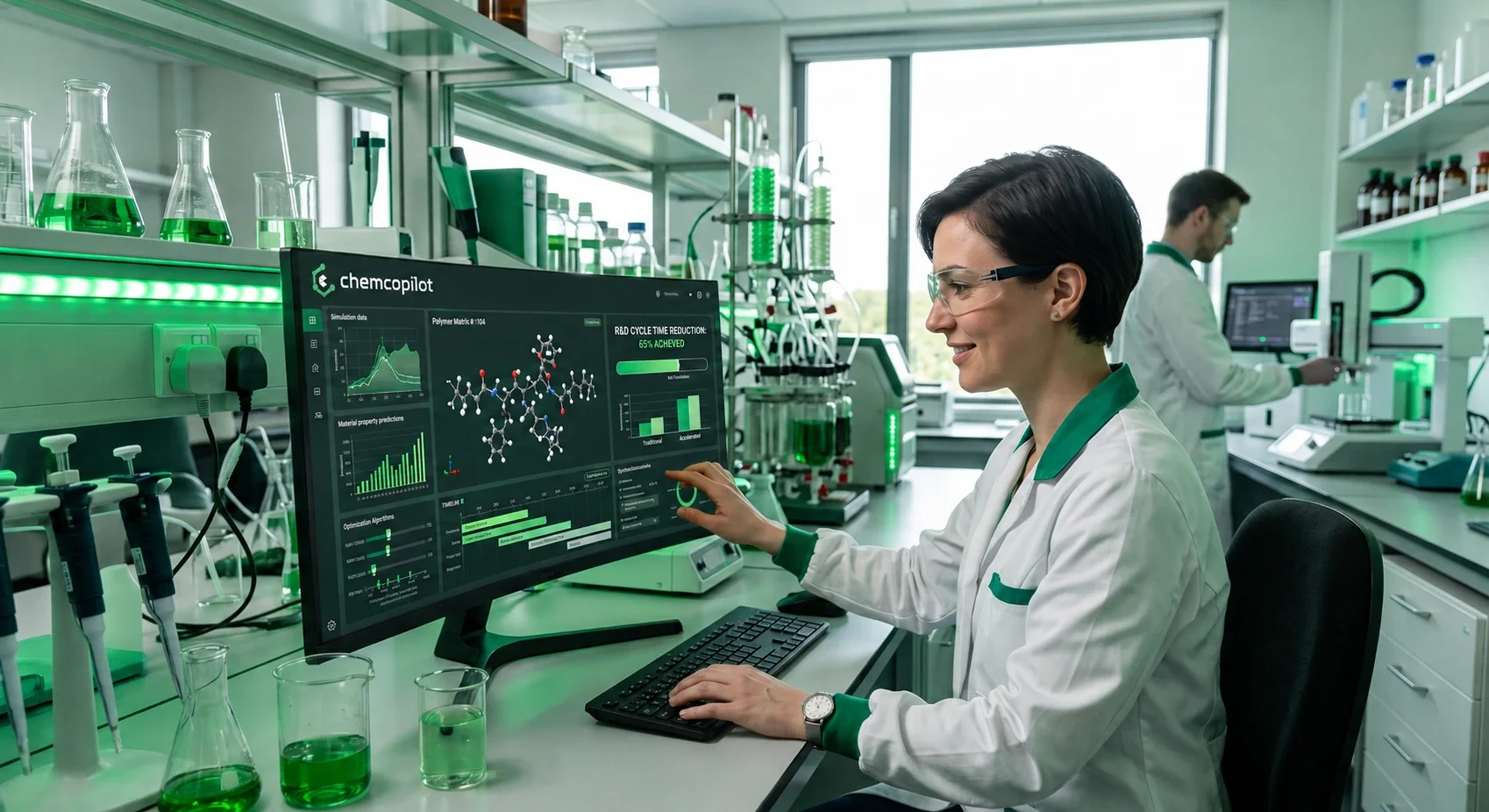
To break this bottleneck, leading materials companies are deploying advanced software platforms that leverage materials informatics, active learning loops, and quantum modeling to shift development from physical benches into digital workspaces.
The Paradigm Shift in R&D Execution
- Legacy Physical Guess-and-Check: Formulations are designed in static spreadsheets. Technicians manually prepare dozens of batches sequentially, resulting in high material waste and long optimization timelines.
- Informatics & Active Learning Acceleration: Predictive models screen thousands of virtual ingredients. Intelligent active learning loops identify the single best experiment to run next, cutting cycle times by over 70%.
The Top 5 R&D Platforms for Polymer & Chemical Development
01. Schrödinger: Physics-Based Molecular Design
For projects requiring innovation at the molecular level, Schrödinger is an industry cornerstone. It combines quantum mechanics and molecular dynamics simulation tools to predict molecular behaviors before physical synthesis ever begins.
- Strengths: Exceptional at calculating thermodynamic properties, glass transition temperatures (Tg), and structural mechanical behaviors of polymer matrices from pure quantum-mechanical principles.
- Limitations: Highly complex to configure; requires deep domain expertise in computational chemistry and significant computing resources.
02. Citrine Informatics: Enterprise Materials AI
Citrine focuses on materials informatics, using machine learning to map out complex structure-property-processing relationships at scale. It acts as an enterprise platform for structuring materials data and identifying optimization paths.
- Strengths: Highly effective for multi-variable materials development where processing conditions (such as curing profiles) are just as critical as the chemical ingredients themselves.
- Limitations: Tailored primarily for large, centralized enterprise data science teams with substantial upfront integration budgets.
03. Uncountable: Structured Informatics & Laboratory LIMS
Uncountable unifies laboratory data management by structuring experimental inputs and analytical measurements within a centralized repository, replacing scattered local spreadsheets.
- Strengths: Strong visualization tools, structured testing logs, and a clean interface that allows laboratory managers to analyze data trends across different project groups.
- Limitations: Functions mainly as a data structural platform; lacks built-in zero-code active learning optimization systems for bench chemists.
04. Enthought: Scientific Software Solutions
Enthought provides specialized scientific software development services and digital transformation training, helping chemical companies build customized Python-based analytics environments.
- Strengths: Highly customizable configurations for specialized scientific data streams and proprietary research pipelines.
- Limitations: Requires a continuous, hands-on programming commitment from internal research data teams.
05. ChemCopilot: The Zero-Code AI Lab Assistant
ChemCopilot bridges the gap between high-end materials informatics and the daily workflows of bench formulators. By combining pre-trained molecular transformers with an intuitive zero-code workspace, it enables chemists to run complex predictive modeling immediately.
"When evaluating R&D software, market adoption comes down to accessibility. Enterprise software fails if bench chemists can't use it on day one without waiting for data science backlogs."
— Paulo, Chief Marketing Officer at ChemCopilot
- Strengths: Seamlessly processes sparse tabular data (under 50 rows), features an interactive molecular sketcher canvas, runs instant tabular ML models (XGBoost, TabPFN), and cross-references active trials with live regulatory safety databases (REACH/ECHA) automatically.
- Deployment: Rapid, SaaS-based deployment that requires no complex technical code configurations, allowing laboratories to see immediate operational results.
Platform Comparison Matrix
This comparative breakdown outlines how the leading platforms align with different chemical laboratory priorities:
| Platform | Primary Focus Area | Key Technology | Ease of Deployment |
|---|---|---|---|
| Schrödinger | Molecular-level physics modeling | Quantum & Molecular Dynamics | Complex (Requires coding & computing clusters) |
| Citrine Informatics | Enterprise-scale materials informatics | High-parameter Machine Learning | Complex (High upfront enterprise integration) |
| Uncountable | Structured laboratory data storage | Structured database LIMS | Moderate (Requires systemic workflow training) |
| Enthought | Custom computational chemical tools | Scientific Python services | Complex (Requires long-term custom development) |
| ChemCopilot | Formulator-led property prediction | Zero-Code Active Learning & MoLLMs | Fast (Zero-code cloud environment) |
Selecting the Right Accelerator for Your Workspace
Choosing the right platform depends on your developmental scale and internal technical resources:
- If your primary goal is modeling individual polymer chains or calculating quantum mechanical parameters from scratch, Schrödinger is a highly precise tool.
- If you have a large database of past materials experiments and a dedicated team of data scientists to manage them, Citrine provides robust enterprise architecture.
- If you want to quickly empower your physical formulation chemists to predict mixture behaviors, run safe active learning loops, and eliminate administrative overhead without writing code, ChemCopilot delivers the ideal operational sandbox.
🚀 Compress R&D Cycle Times & Empower Your Chemists
Ready to see how ChemCopilot accelerates polymer and specialty chemical development across your active commercial projects? Connect with Paulo and our solutions engineering team to evaluate ChemCopilot on your proprietary datasets under enterprise-grade IP protection.
- Compress Development Timelines: Screen 10,000 virtual formulations in seconds before heating a single beaker.
- Enterprise Security: Single-tenant data isolation, SOC 2 compliance, and strict API zero-retention guarantees.
- Seamless LIMS/ERP Integration: Connect directly to historical SCADA logs, vendor cost tiers, and REACH compliance feeds.
Schedule a Private Enterprise Demo & ROI Assessment → | Start Your 14-Day Free Commercial Lab Trial →